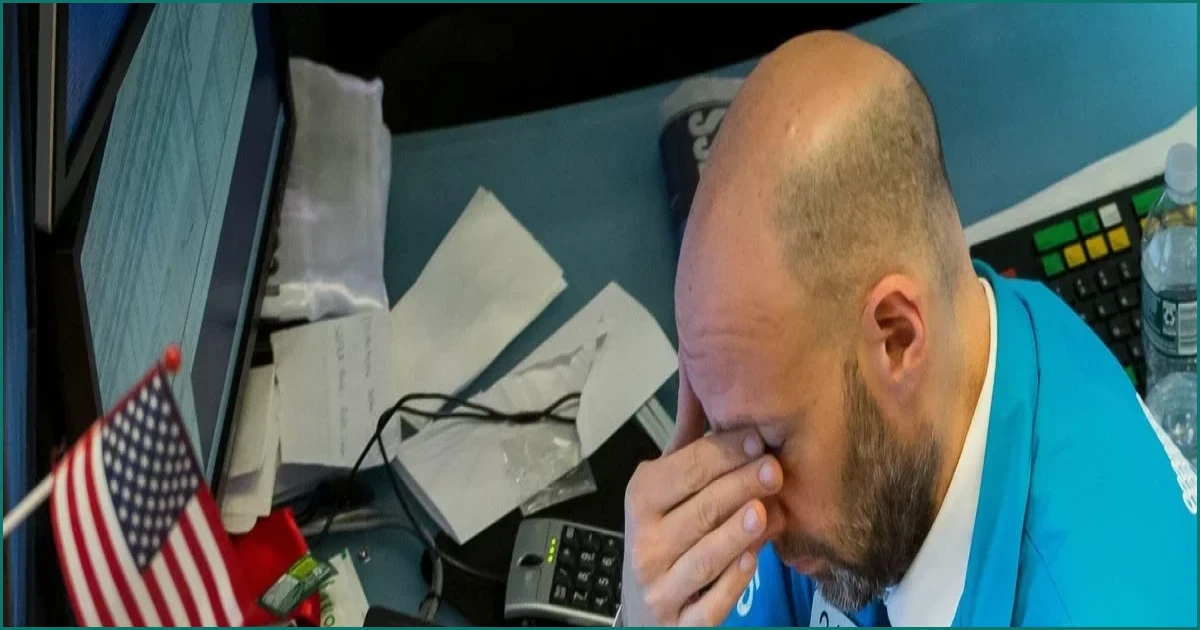
American financial markets are enduring their most severe downturn since the onset of the coronavirus pandemic, driven lower on Friday by broad-based selling across major stock indices. The S&P 500 fell 2.8%, putting it on track for its seventh consecutive session of losses—its longest losing streak since February 2020, when panic over the early stages of the pandemic gripped Wall Street. In late afternoon trading, the tech-heavy Nasdaq stock index experienced a dramatic decline, tumbling more than 1,000 points, or 4.2%, to reach 22,875. Meanwhile, the blue-chip Dow Jones Industrial Average dropped 1.1%.
The steep sell-off reflects growing anxieties among investors regarding massive expenditures on artificial intelligence infrastructure. While capital has poured heavily into data centers and supporting technology, market participants increasingly question whether these investments will generate the anticipated financial returns. Anthropic, which recently became the first AI research lab to go public, has reported rapid revenue expansion, yet regulatory filings reveal massive operating losses totaling approximately $104 billion for the first nine months of 2026 alone. Nigel Green, chief executive officer of investment advisory firm deVere Group, noted that such staggering financial metrics explain both market excitement and mounting anxiety. "Those figures explain both the frenzy and the nerves," Green stated, adding that "from here, the market will judge whether the software layer can turn breathtaking growth into lasting profit, and Friday's wobble shows the judging has already begun."
Political shifts in Washington are compounding tech sector pressures. With Democrats positioned to gain the upper hand in Congress when newly elected officials assume office in January, investors are preparing for potential legislation that could restrict data center construction. Although industry observers do not expect a total halt to infrastructure buildout, even a mild deceleration could impair the financial performance of major technology companies heavily invested in AI. Dan Ives, an analyst at Yorkville Ives, highlighted in a Friday report that market declines are being fueled by "the Blue Tidal Wave win and fears about an anti-AI/anti-data center DC."
Macroeconomic policy concerns are also weighing heavily on sentiment, with the Federal Reserve widely expected to raise interest rates during its upcoming December meeting. Because inflation remains significantly above the central bank's official 2% annual target, policymakers are leaning toward further monetary tightening. While higher interest rates help restrain inflation, they simultaneously elevate borrowing costs, dampening both consumer spending and corporate investment. Federal Reserve Bank of Chicago President Austan Goolsbee addressed reporters on Thursday regarding the inflation outlook, stating that "the evidence does not suggest we are on a path back to 2%" without active intervention from the central bank.
Corporate scandal and heightened trade barriers have further unsettled the semiconductor industry following revelations involving former Nvidia chief executive Jensen Huang. Reports disclosed that Huang maintained a relationship with a Chinese businesswoman identified by U.S. intelligence as a spy for the People's Republic of China. The revelation led to Huang's resignation and prompted calls for stricter export controls. In response, the U.S. Commerce Department is moving to implement tighter restrictions on the sale of advanced AI chips to China. Adam Crisafulli, an analyst at Vital Knowledge, observed in a market report that "the chip industry globally is witnessing a far larger impact from Washington's new export restrictions than initially expected."
Geopolitical flashpoints are adding to economic uncertainty, as sources familiar with the matter told news outlets that Israel and the United States are evaluating a possible new assault on Iran in the short term. The prospect of renewed military hostilities has heightened fears of a sudden surge in global oil prices, which would intensify existing inflationary pressures. Assessment of the volatile international landscape led Crisafulli to caution that "the Iran war remains in a dangerous liminal stage."
Domestic fiscal instability presents another hurdle for financial markets, according to an analysis released this week by Oxford Economics. Analysts warned that government shutdown risks could escalate next year under a divided government. The research firm noted that a Democratic-controlled Congress could spark "bruising fights over shutdowns and the debt limit, while doing little to curb tariff, immigration and geopolitical uncertainty."
Despite the sharp market retreat, investment professionals advise individuals against making panicked asset sales, noting that emotional selling often locks in severe losses that are difficult to recover. Analysts point out that investors who exited the stock market during the initial downturn in February 2020 missed out on substantial rebounds as the economy subsequently recovered. Ives placed the current downturn into historical context, observing that market cycles inevitably feature intense fluctuations. "We have seen so many peaks and valleys over the decades, with many investors asking us over the last few weeks, is this a March 2000 moment (pre-dot.com bubble) or Fall 2007 vibe (financial crisis buildup)," Ives wrote. He argued that selling out now misinterprets the broader technological trajectory, concluding, "This is a painful tech sell-off that is heavily discounting [that] this 4th Industrial Revolution thesis will take place over the next few years, and that is the wrong move in our view."