The United States military has confirmed that a service member was killed in northern Iraq on Saturday during a controlled detonation of unexploded ordnance. The incident involved remnants from a downed Iranian attack drone, and a second service member was wounded during the same operation. This fatality occurred just one day after a separate assault on a base in Jordan resulted in the deaths of two other US soldiers and left another missing.
US Central Command (Centcom) reported that they have discovered unidentified remains at the site of Friday's attack in Jordan and are currently undergoing an examination process to verify the identities. The cumulative US death toll in the ongoing conflict has now reached 17, following the death of an American Navy pilot who had been reported missing earlier this month.
Meanwhile, Iran's health ministry stated that at least 50 people have been killed and over 500 injured during US strikes throughout the past three weeks.
As the exchange of strikes between the two nations entered its eighth day, both sides have faced accusations of targeting critical infrastructure. In Iran, state media reported that an under-construction nuclear power plant in the south-western city of Darkhoveyn was struck overnight, alongside targets on Qeshm Island.
The United Nations' nuclear watchdog has called for restraint, noting that the facility was in the very early stages of development and contained no nuclear material during its most recent inspection.
Tensions remained high in Jordan, where state news reported that the military shot down three Iranian missiles, while a fourth landed in a remote area. This followed a warning from the United States that the port of Aqaba could be targeted. In response, Jordan summoned Iran's charges d'affaires in Amman to demand an immediate cessation of what the foreign ministry described as "unjustified and blatant Iranian attacks," emphasizing that the nation's security is a non-negotiable red line.
Israel's military also reported launching interceptors toward missile debris to prevent impacts near Eilat, noting no casualties or damage.
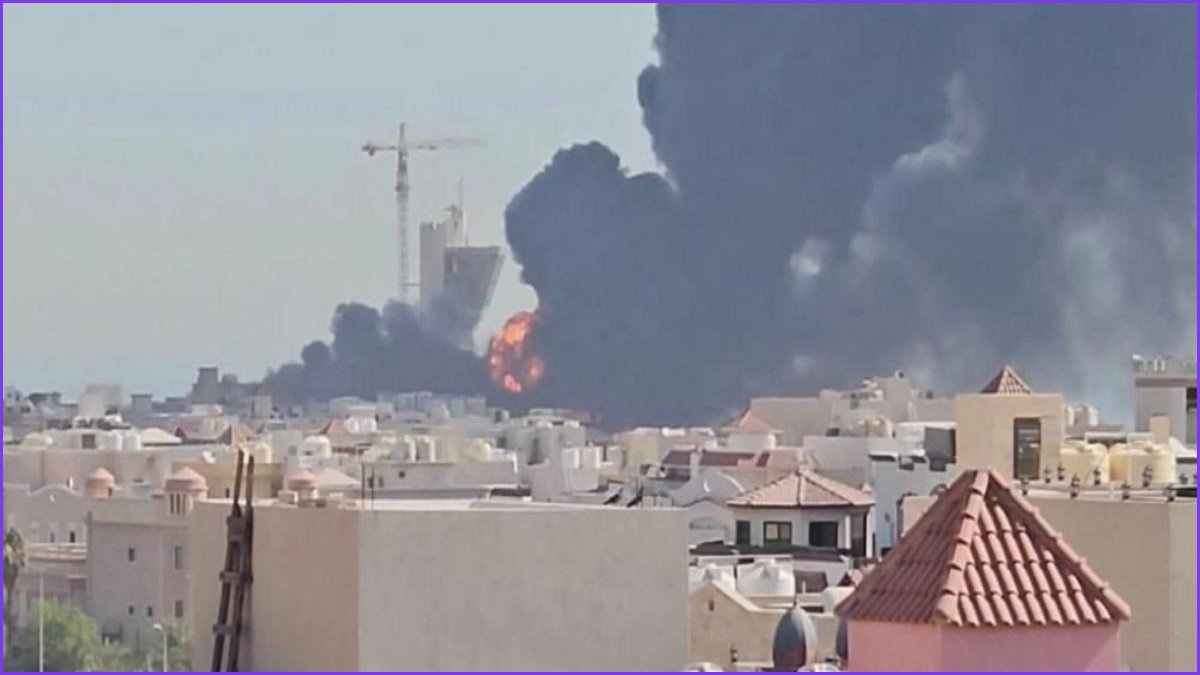
The conflict has further impacted regional maritime and industrial sites. The Islamic Revolutionary Guard Corps (IRGC) claimed that two vessels ignored warnings regarding the Strait of Hormuz and were involved in an accident, warning that any ships influenced by the US would face similar consequences. In Kuwait, local officials reported that an electricity and water plant was struck for a second time, causing a fire.
The Gulf Cooperation Council—an alliance including Bahrain, Kuwait, Oman, Qatar, Saudi Arabia, and the United Arab Emirates—has condemned the targeting of civilian infrastructure as a violation of international law.
While Iran has accused the US of striking bridges, an airport, and a train station, Washington maintains its operations are directed exclusively at military targets and logistics infrastructure. Late on Saturday, Iranian Supreme Leader Mojtaba Khamenei issued a statement criticizing the US for repeated agreement breaches, declaring the American president's signature to be without credibility.
Verified footage from inside the Jordanian facility showed at least two impacts and an explosion.