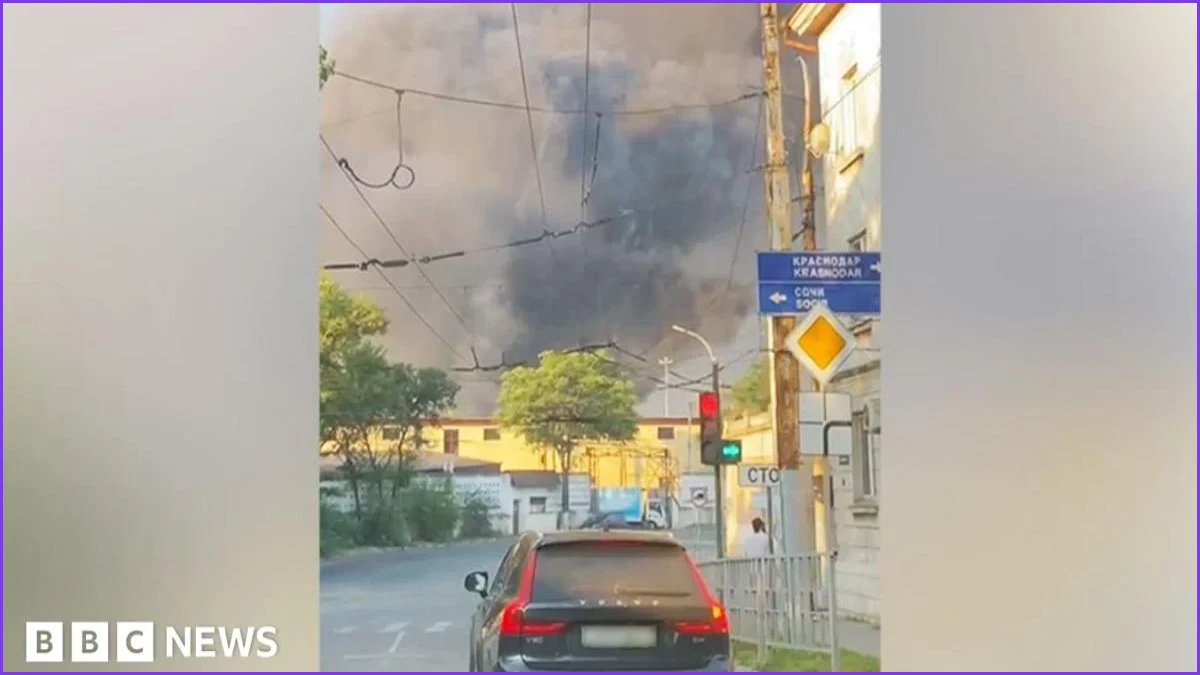
A massive overnight strike involving Ukrainian drones and missiles has caused significant damage to the Russian port of Novorossiysk, impacting two major grain export terminals and targeting the last primary Russian naval base on the Black Sea. Local officials confirmed that the attack resulted in three deaths, including an eight-year-old child, and left 24 other people injured. Regional Governor Veniamin Kondratyev reported that a man was also killed elsewhere in the Krasnodar region due to falling drone debris, as several locations were hit by what he described as several hundred drones, damaging dozens of buildings and homes.
Ukrainian President Volodymyr Zelensky described the operation as a unique mission involving rockets, jet drones, and naval drones. While he did not explicitly mention the damage to grain terminals, he emphasized that the Russian fleet and its supporting infrastructure would remain unsafe as long as the aggression continues. The Ukrainian military later claimed the strike hit four Russian warships, including two frigates, though Russia has not provided an official comment on the status of its vessels. Most of Russia's Black Sea fleet has been docked in Novorossiysk since being forced out of its original base in Sevastopol, Crimea, which was deemed too vulnerable to Ukrainian fire.
The impact on the grain terminals was confirmed by major trading companies, which reported damage to their facilities to outlets including TASS, Reuters, and RBK. In response to the logistical disruption, the Russian agriculture ministry announced on Wednesday that it is actively working to redirect cargo flows through land routes and ports in the Baltic and Caspian Seas. Although the ministry did not directly reference the Ukrainian attacks, it cited current logistical constraints as the reason for the shift.
The city of Novorossiysk declared an emergency situation on Wednesday following the barrage, which damaged pipelines and forced a suspension of the city's water supply. Air defenses were reportedly active throughout the night, attempting to intercept the incoming objects as repeated explosions rang out. Meanwhile, Russia conducted its own aerial strikes against Ukraine between Tuesday and Wednesday, killing at least 11 civilians, primarily in the southern city of Zaporizhzhia where ballistic missiles and glide bombs were used.
The broader conflict has significantly disrupted Black Sea trade. Maria Zakharova, a spokesperson for the Russian foreign ministry, accused Ukraine of targeting agricultural infrastructure, which she claimed has contributed to rising global food prices and potential shortages. She further stated that Russia would continue to strike facilities used by Ukrainian forces in the Black Sea to destabilize the navigation situation until the full elimination of threats to security projected to the Sea of Azov and the Black Sea. Data from a Moscow-based analytics firm suggests that Russia's wheat exports for August could drop by more than half compared to the same month over the last five years due to these ongoing maritime disruptions. Concerns over global food supplies have persisted since the 2022 invasion, and the 2022 Black Sea Grain Initiative failed after Moscow resumed attacks on vessels in the maritime corridors to Odesa.