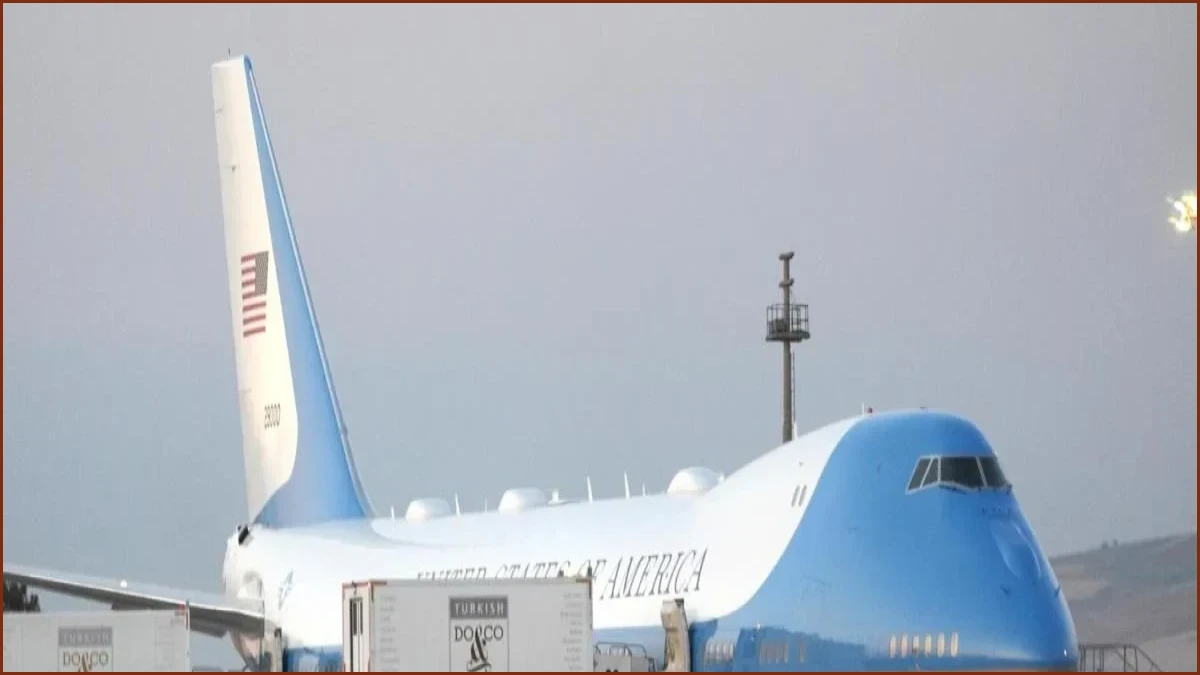
During a high-stakes trip to Turkey last month, US President Donald Trump employed a complex security ruse involving a decoy plane to manage potential threats. According to reports, President Trump, accompanied by members of the press and several cabinet officials, initially boarded an aircraft designated as Air Force One on 8 July. However, the president later exited the plane via a catering truck to be transported clandestinely to a separate military aircraft for his departure from Ankara.
Secretary of State Marco Rubio and Treasury Secretary Scott Bessent remained on the original aircraft, which continued to carry the Air Force One call sign, effectively acting as a decoy. The decision to keep these high-ranking officials on the first plane was intended to preserve the line of presidential succession in the event that something happened to the president.
In the established order of succession, the vice-president is first in line, followed by the Speaker of the House of Representatives, the President Pro Tempore of the Senate, the Secretary of State, and then the treasury secretary.
Other prominent officials who stayed on the initial aircraft included White House Deputy Chief of Staff Stephen Miller and the White House communications director, Steven Cheung.
The second aircraft that flew President Trump out of Ankara also reportedly carried Defence Secretary Pete Hegseth. Speaking to reporters on Monday night, President Trump confirmed that the decision to undertake the deception was made by the US military and the Secret Service, who requested that he utilize a different flight.
While the president did not provide specific details regarding the nature of the security threat, he noted that he receives a lot of threats, adding that any consequential president faces such dangers.
It remains unclear what the cabinet secretaries, other officials, and the Air Force members working on the plane knew of the operation. Members of the press who were on board have stated they were not aware they were on a decoy flight at the time.
Various ruses, often referred to as "shell games" by Secret Service personnel, are common in presidential security. Identical versions of the president's heavily armoured limousine often switch positions in motorcades, as do helicopters transporting the president. More elaborate operations are typical during high-risk trips abroad, where reporters on Air Force One are usually briefed and asked not to report movements in real-time.
Historical precedents for these maneuvers exist, such as in March 2000, when then-President Bill Clinton flew to the Pakistani capital of Islamabad on an unmarked executive jet that landed after a decoy jet with the livery of Air Force One.
Susan Page, then the head of the White House Correspondent's Association, revealed this week that she had been informed of the extraordinary security procedures and the use of a decoy plane ahead of that trip. She noted that the dangers threatened the journalists covering the trip as well as the president.
It is not currently clear what danger the occupants of the plane carrying Rubio, Bessent, and the press pool were in during the recent Ankara trip, and the White House Correspondent's Association has not publicly commented on the incident.