Confronting shifting realities nine months into the war with Iran, President Donald Trump faces narrowing options to bring the conflict to a close. With diplomatic negotiations stalled while mediator Qatar attempts to bridge the rift between Washington and Tehran, the White House is signaling a willingness to maintain current economic pressure rather than launching an immediate military escalation.
Following a meeting at the White House this week with Qatar's prime minister, President Trump stated that Gulf Arab allies favor the "status quo" of sustained economic sanctions against Iran. Trump noted online that while the U.S. military remains "locked and loaded," a new offensive at this juncture "seems to be quite unlikely." The stance represents a shift from earlier threats of rapid, high-intensity strikes, issued before the administration encountered major domestic and international political hurdles.
The political maneuvering space for the White House has narrowed significantly following recent electoral setbacks. At home, the Republican Party lost its majority in Congress during the midterm elections, an outcome Vice President JD Vance attributed directly to the unpopularity of the war with Iran and public sentiment surrounding U.S.-Israel relations. Abroad, Israeli Prime Minister Benjamin Netanyahu, a key wartime ally supported heavily by Trump, faces potential removal from power following elections in Israel.
Regional leadership has urged preparation for extended volatility. Speaking to an audience in Abu Dhabi this week, senior United Arab Emirates diplomat Anwar Gargash warned that the region must "prepare for a prolonged period of uncertainty, in which neither a decisive resolution nor a stable regional order can be taken for granted."
The ongoing status quo has dramatically reshaped commerce and security across the Gulf. Official Iranian social media channels routinely broadcast footage of attacks on maritime traffic in the Strait of Hormuz, enforcing new Iranian rules requiring ships to seek explicit permission to transit the waterway. To protect commercial interests, the U.S. Navy is escorting oil tankers through a passage hugging the coastline of Oman. While this route allows Arab nations to continue exporting crude oil, it has failed to restore pre-war production levels for vital commodities such as liquefied natural gas, fertilizer, and aluminum, while leaving ports in Kuwait, Qatar, and Bahrain struggling to receive standard commercial imports.
Economic figures highlight the severe regional toll. According to the International Monetary Fund, Gulf Arab economies have slipped into recession despite elevated global oil prices. The IMF reports that the economies of Kuwait, Qatar, and Iraq are contracting by approximately 16% this year, while Bahrain's economy has dropped by 11%.
Despite the current pause in major offensive actions, military force posture remains aggressive. The U.S. is deploying a third aircraft carrier accompanied by thousands of additional troops to the Middle East, preserving the option for future military operations. Meanwhile, Iran unveiled a new underground missile production facility this week, and low-level tit-for-tat strikes persist.
On Friday, Iranian state media reported that U.S. forces targeted an island in the Strait of Hormuz housing Iranian radar stations and drone launch facilities. In response, Iran's Islamic Revolutionary Guard Corps launched strikes against an early-warning U.S. radar installation located in Bahrain.
U.S. Secretary of State Marco Rubio defended the reliance on non-military leverage while speaking to reporters this week, arguing that economic sanctions are severely weakening Tehran. "The pain that they're feeling is, eventually you have to eat. Eventually you have to be able to pay your own fighters and your own security forces," Rubio said. U.S. military officials estimate that an ongoing naval blockade preventing Iranian tankers from shipping crude to overseas buyers, including China, has cut off Iran from at least $25 billion in revenue.
Financial isolation has been compounded by regional action. Over the summer, the United Arab Emirates severed all trade and economic relations with Iran. The UAE had historically served as one of Tehran's primary commercial partners, with local bank networks allegedly utilized by Iran's supreme leader and the Revolutionary Guard to move funds internationally. Concurrently, U.S. Central Command, in partnership with other federal agencies, initiated Operation "Iron Gate" to intercept Iranian land and Caspian Sea transit routes used for moving advanced weaponry across borders.
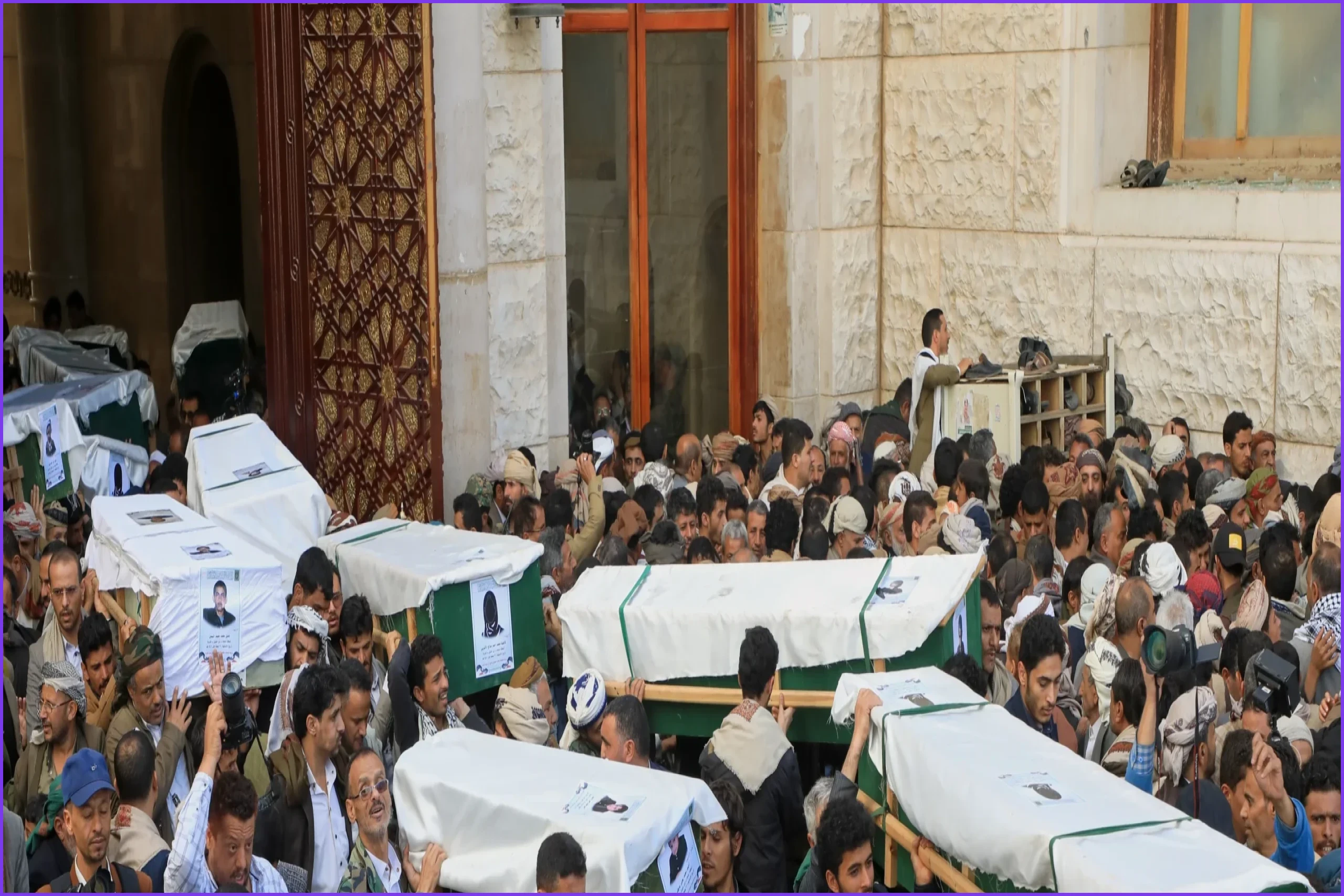
The broader regional confrontation has also reignited full-scale conflict in Yemen between Saudi Arabia and Iran-backed Houthi forces. Houthi officials report that Saudi airstrikes across Yemen have claimed scores of lives in recent months, including nearly 60 people—many of them women and children—killed this past weekend in al-Shariya village, northeast of Sana'a. In response, Houthis launch daily drone and missile strikes against Saudi infrastructure, recently striking the kingdom's East-West crude pipeline and the Riyadh skyscraper headquarters of state oil firm Aramco. Houthi strikes on Saudi airports have caused significant flight cancellations and the disruption of high-profile events.
As fighting in Yemen deepens, Pakistan, Turkey, and Egypt have stepped in to provide defensive military assistance to Saudi Arabia, while the U.S. continues supplying intelligence on Houthi targets. The United Nations estimates that the renewed fighting between Houthi forces and the Saudi-backed Yemeni government has displaced approximately 330,000 Yemenis, drastically worsening the country's severe humanitarian situation.
Diplomatic avenues to resolve the crisis remain firmly blocked. Iranian officials indicate they are willing to accept a temporary pause on maritime attacks in the Strait of Hormuz, but demand seven key prerequisites before commencing direct negotiations regarding their nuclear program. Hamidreza Gholamzade, a spokesperson for the Tehran municipality, stated: "The message has been only one thing. These seven items are on the table. Take it or leave it." The conditions demand an immediate end to economic sanctions, a complete lifting of the naval blockade, the unfreezing of Iranian assets in foreign bank accounts, and an enforced comprehensive ceasefire across all regional fronts, including the cessation of Israeli military operations in Lebanon and Gaza.
Secretary of State Rubio dismissed Tehran's demands as "absurd." Proposals to dilute and transfer Iran's enriched uranium stockpiles out of the country have also been rejected. Mohsen Rezaei, head of Iran's Supreme National Security Council, told state broadcasting on Wednesday: "We will not remove even a shred of enriched nuclear material from Iran," underscoring the ongoing gridlock governing the conflict.
Here's what keeping the status quo looks like.
It's another indication of the gridlock.