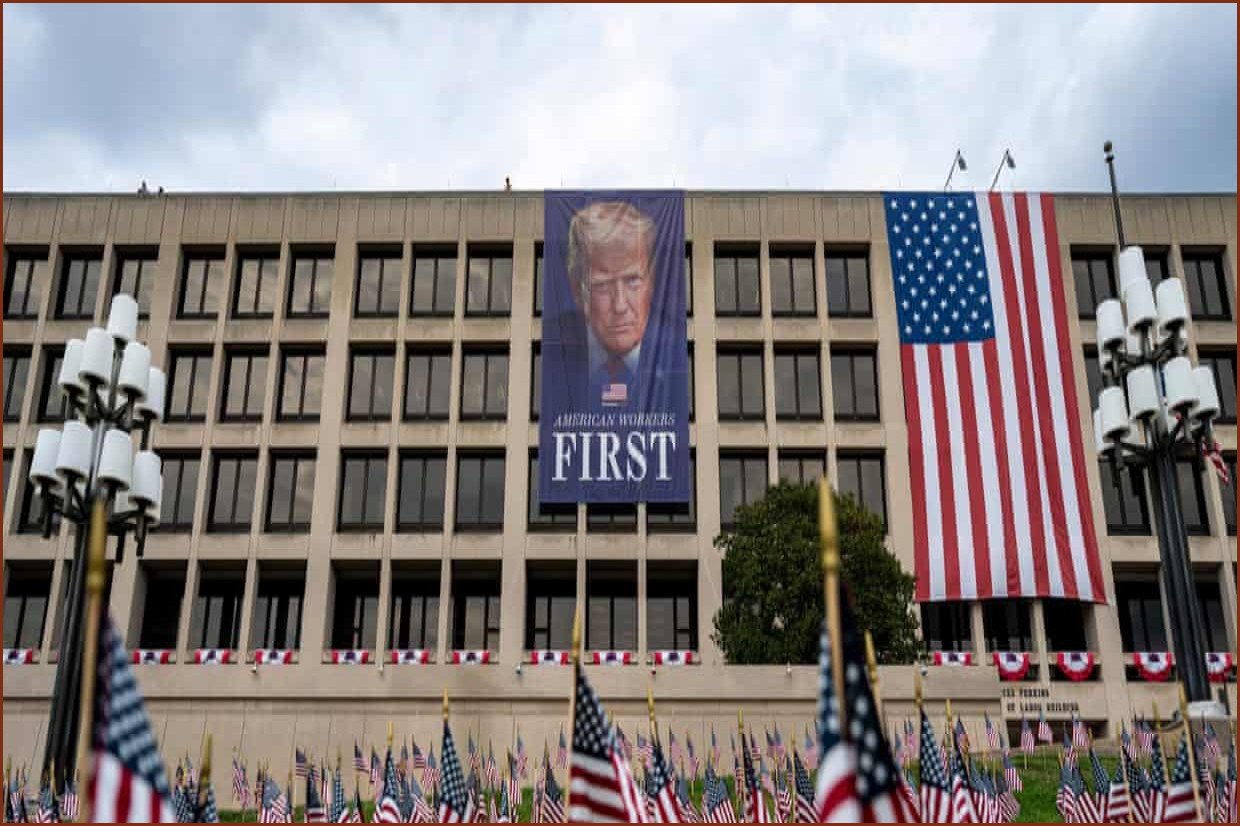
Despite his repeated promises to champion the American worker and promote high-paying blue-collar jobs, Donald Trump’s administration has enacted a series of policies over the past year that labor experts and union leaders describe as deeply hostile to the working class. From cutting safety inspections to rolling back wage protections and targeting union organizations, critics argue that the administration's actions have systematically undermined the labor movement.
In the months following Trump’s return to the presidency, the Occupational Safety and Health Administration (OSHA) reduced workplace inspections by 20% compared to the final year of Joe Biden's administration. Furthermore, despite campaigning as a supporter of coal miners, Trump’s administration has repeatedly delayed a safety rule designed to limit silica dust. This dust is a primary cause of black lung disease, which has afflicted and killed numerous miners. The United Mine Workers union has aggressively lobbied for the immediate enforcement of this stalled regulation.
Wages have also failed to keep pace with the cost of living. Although the White House has highlighted rising wages, the reality for many workers is that prices—driven upward by the administration’s tariffs and the ongoing war with Iran—have climbed at a faster rate, worsening the nation's affordability crisis. At the same time, the administration has proposed a measure that would strip federal minimum wage and overtime protections from 3 million homecare workers, who provide essential care to senior citizens and disabled individuals.
In what AFL-CIO President Liz Shuler described as "the largest single act of union-busting in our history," the Trump administration has pushed forward with a campaign to strip collective bargaining rights from 1 million federal employees. This effort has proceeded despite multiple court rulings attempting to halt or slow the process. The administration has targeted union contracts for hundreds of thousands of employees across several agencies, including the Transportation Security Agency, the Department of Veterans Affairs, the Department of Agriculture, and the Environmental Protection Agency.
In another unprecedented move, Trump took the historic step of firing Gwynne Wilcox, the pro-union chair of the National Labor Relations Board (NLRB), marking the first time a U.S. president has dismissed a member of the board. Since then, Trump has filled the labor board with numerous pro-business officials. Sara Nelson, president of the Association of Flight Attendants, strongly condemned these moves. "Trump’s actions make him by far the most anti-union president in our modern history," Nelson said, adding that his administration has been "massively anti-worker, anti-union and anti-working class."
Heidi Shierholz, president of the Economic Policy Institute, expressed shock at the administration's aggressive rollbacks. She pointed specifically to an executive order issued last year that slashed the minimum wage for federal contractors from $17.75 to $13.30 per hour, a change that cost some workers more than $9,000 annually. Additionally, the administration rescinded a Biden-era regulation that expanded overtime eligibility to salaried workers, disqualifying approximately 4.3 million people from receiving time-and-a-half pay. This rollback followed rulings against the Biden rule by two federal courts in Texas. Throughout his presidency, Trump has also declined to support raising the federal minimum wage, which has remained at $7.25 an hour since 2009.
"The Trump administration is systematically weakening policies and institutions that give workers a voice, that give workers protections and that hold employers accountable," Shierholz observed. She noted that these actions have accelerated, targeting everything from health and safety standards to wage protections.
While the administration has introduced some popular tax cuts—such as eliminating taxes on tips and reducing taxes on overtime pay—critics argue that these cuts primarily benefit the ultra-wealthy while offering only modest relief to average workers. Meanwhile, the administration, under heavy pressure from corporate interests, has sought to weaken a proposed Biden-era regulation designed to protect outdoor workers from extreme heat. The administration is pushing to dilute requirements for rest breaks, water, and shade, and wants to prevent extreme heat from being officially codified as a workplace hazard.
Corporate lobbying also successfully pushed the administration to dismantle a Biden-era rule regarding worker classification. In February, the administration made it significantly easier for companies to classify employees, such as construction workers and Uber drivers, as independent contractors. This change reduces labor costs for employers by exempting them from paying minimum wage and overtime, as well as eliminating their obligation to contribute to Social Security, Medicare, and unemployment insurance.
On the economic front, monthly job growth under Trump has slowed significantly compared to the Biden administration, leaving young workers struggling to find employment. While Trump has championed artificial intelligence and data centers, these technologies have raised widespread concerns about job displacement. His efforts to revitalize American manufacturing through tariffs have also faced setbacks; since Trump took office, the U.S. has lost 35,000 manufacturing jobs due to tariff-induced market uncertainty, despite modest factory job gains in recent months.
The administration's friction with organized labor has also extended into federal law enforcement. As part of an investigation into protests against Immigration and Customs Enforcement (ICE) operations in Minnesota, the Department of Homeland Security obtained the financial records of two major unions: the Service Employees International Union (SEIU) and the Communications Workers of America (CWA). Federal officials claimed the records were part of an investigation into "domestic terrorism financing." Furthermore, federal prosecutors told a grand jury that the AFL-CIO, which represents 15 million workers and retirees, along with several other unions, participated in a criminal conspiracy to obstruct ICE agents in Minnesota. Nelson called the move outrageous, stating, "It’s terrible that they’re going after labor activists and unions in Minnesota for merely standing up for their neighbors."