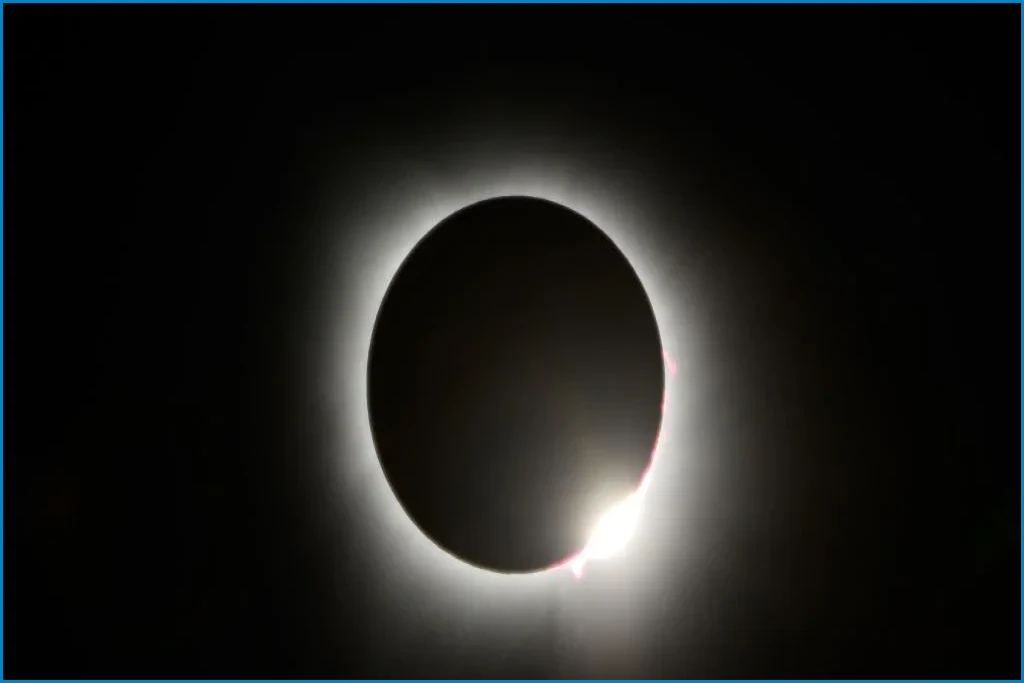
A celestial event will occur next Wednesday as a solar eclipse becomes visible to observers across parts of Europe and the United States. Astronomers report that individuals in Iceland, Greenland, northern Russia, Spain, and parts of Portugal will be positioned to witness a total solar eclipse. During this event, the moon will pass directly between the Earth and the Sun, effectively blocking the Sun's face entirely.
For those in Spain, the event marks a significant milestone, as it will be the first total solar eclipse visible from the country's mainland since 1905, according to the European Space Agency. In León, Spain, totality is scheduled to begin at 8:28 p.m. local time and is expected to last for two minutes. Meanwhile, in Reykjavík, Iceland, the total eclipse is slated to commence at 5:48 p.m. local time.
In the United States, observers in northern regions—stretching from Alaska to North Carolina—will have the opportunity to view a partial solar eclipse. This occurs when the moon, Earth, and Sun are not perfectly aligned. Because only parts of the sun are obscured, the sun appears as a crescent shape. In Washington, D.C., NASA expects the partial eclipse to begin around 1:17 p.m. ET, with approximately 4% of the sun obscured by the moon.
Safety remains a priority for all observers. The American Academy of Ophthalmology warns that looking at the sun without specialized equipment can cause permanent vision loss and burns. Regular sunglasses are insufficient for protection; instead, the public must use approved eclipse glasses or handheld viewers equipped with special filters.
Beyond the visual spectacle, the eclipse provides a rare research opportunity. NASA plans to deploy scientific balloons and a high-altitude jet to study the impact of a darkened sky on the Earth's atmosphere. Kelly Korreck, NASA's eclipse program manager, noted that the unique perspective provided by a total eclipse allows scientists to study the Sun's corona in ways not possible from other locations in the solar system.
Looking ahead, the next partial solar eclipse for parts of the U.S. is scheduled for August 2, 2027, with totality visible across Spain, the Middle East, and parts of North Africa. A total solar eclipse is anticipated to cross parts of the contiguous United States on August 23, 2044.
The Moon crosses in front of the Sun during a total solar eclipse at Lake Monroe on April 08, 2024 in Indiana, United States. Edward M. Pio Roda/Getty Images hide caption