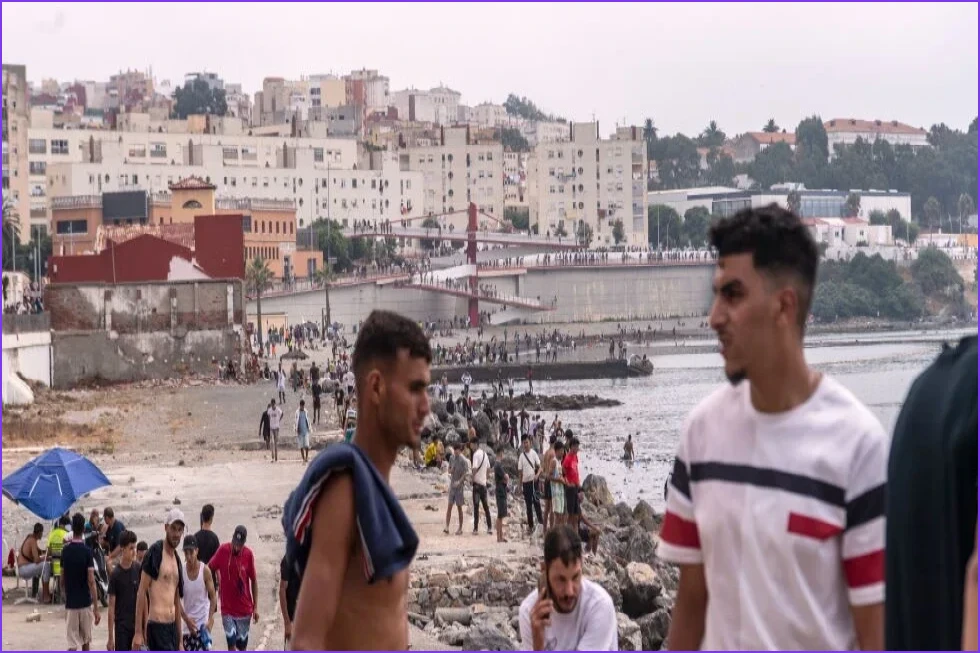
When word spread that the border had been breached, 21-year-old Abdulah Buji did not hesitate. He jumped on his motorbike and raced from his home in northern Morocco toward the Spanish enclave of Ceuta, joining tens of thousands of others who were attempting to swim into the tiny Spanish territory in North Africa.
Buji, who is currently studying to become a teacher, expressed a deep sense of frustration with his home country. He stated that he is a talented individual who simply wants a chance to build a future, noting that Spain offers opportunities that he cannot find in Morocco.
However, his initial elation upon setting foot on Spanish soil was quickly tempered by the harsh reality that he remained far from his ultimate goal of reaching mainland Europe. He and the other new arrivals were met with resistance, as Spanish authorities ordered them to turn around and return to Morocco or face the prospect of expulsion.
The journey was fraught with danger. Buji revealed that he nearly joined the more than 50 people who died while attempting to swim around the border fence. Although he successfully made it across, he lost his money and personal belongings during the crossing. Upon realizing that he would likely face detention and legal limbo rather than a path to a new life, he decided to head back.
He explained that he has spent approximately 14 years studying, yet he sees no future at home, where he would be forced to work 12-hour shifts for a meager wage. He noted that because he found no opportunities in Ceuta either, he had no choice but to return.
The scale of the movement was unprecedented. Between Thursday and Friday morning, approximately 60,000 people crossed into the territory. By Friday, about 45,000 of those individuals had returned to Moroccan territory after spending a night on the streets of Ceuta, where they were surrounded by startled locals and armed Spanish police and soldiers. The influx, which totaled 70% of Ceuta’s resident population, led local Spanish authorities to call for the police and the army to establish order.
Residents were visibly concerned by the thousands of mostly young men wandering the streets aimlessly. Many locals recalled a similar but smaller migration crisis in 2021, when the Moroccan government dropped border controls, but they noted that the current situation represented a much larger humanitarian crisis.
As videos and reports of the migrants reaching Ceuta circulated on social media, the momentum grew, with more people heading north in hopes of reaching European Union territory. Train stations in Rabat and Casablanca became crowded with people attempting to travel to the border. Local media reported that police officers were actively preventing some of these individuals from boarding trains and buses.
Myriam Cherti, a senior researcher at the University of Oxford’s Centre on Migration, Policy and Society, stated that it is unclear exactly what triggered the influx, though social media was filled with posts encouraging Moroccans to attempt the crossing in the days leading up to the event.
These posts provided practical information on how to cross the border and what to say to authorities to increase the chances of being allowed to stay.
Cherti noted that many of the migrants she has interviewed over the past year have lost count of how many times they have attempted to cross the border. She explained that their actions are driven by despair and a desire to support their families, which they feel is only possible if they successfully reach Spain. For some, however, the motivation was not to stay, but to search for loved ones. Ikrra Khai, a 33-year-old woman who regularly holds temporary job permits to work on Spanish farms during harvest, was in Ceuta searching for the brother of a close friend.
She expressed the agony of not knowing if he was dead or alive, noting that she held his residency card but had no idea where he was. Meanwhile, 33-year-old Ahmed Karim, who also managed to cross, emphasized that the core issue for many Moroccans is the lack of opportunity to travel or work outside the country, leaving them feeling trapped.