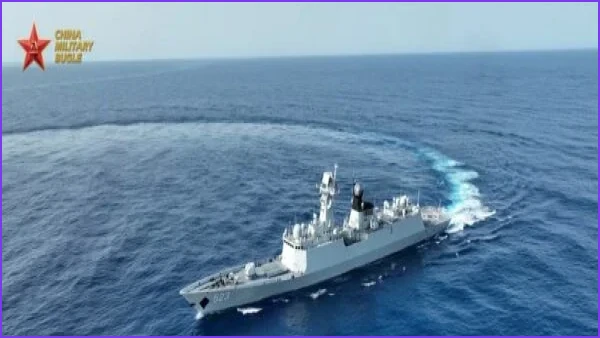
In a move reflecting heightened regional tensions, Taiwan has formally requested that the Indonesian government provide clarification regarding a joint naval exercise conducted with China. The drills occurred on the morning of August 12, 2026, between 6:30 a.m. and 9:30 a.m., in waters located east of Taiwan—a region that is also in close proximity to Japan and the Philippines. You have reached the limit of 2 free articles this month.
The exercise involved the Indonesian Navy frigate KRI I Gusti Ngurah Rai and the Chinese People’s Liberation Army Navy’s (PLAN) guided-missile frigate Honghe, which operates under the Eastern Theater Command. Before its joint exercise with the Honghe, the I Gusti Ngurah Rai had participated in a bilateral exercise, the Orruda 2025, with the Russian navy in late July. After docking at Yokosuka Naval Base in Japan from August 1 to August 8, it later set out for the joint exercise with the PLAN. Data from the geointelligence firm ingeniSPACE indicated that the Indonesian vessel had its Automatic Identification System (AIS) activated when it entered Taiwan’s exclusive economic zone (EEZ). In contrast, the Chinese frigate maintained a dark status with its AIS turned off, which is typical for Chinese naval operations in the area. The Indonesian ship reportedly passed near, but did not enter, Taiwan’s contiguous zone.
The Indonesian Navy defended the operation, stating that such "passex" activities are standard maritime traditions and goodwill engagements meant to express naval brotherhood rather than serve as war-fighting exercises. The Chinese government similarly characterized the drills as a contribution to safeguarding regional peace and stability. However, the exercise has drawn scrutiny from analysts who view it as a potential signal regarding shifting maritime alliances, particularly following the KRI I Gusti Ngurah Rai’s recent participation in the Orruda 2025 exercises with Russia and a subsequent port call at Yokosuka Naval Base in Japan.
The waters east of Taiwan have become a significant focal point for geopolitical friction. Tensions have been exacerbated by recent maritime cooperation between Japan and the Philippines, including an agreement to delimit their overlapping EEZs. China has vocally opposed these talks, asserting its own claims over Taiwan and the surrounding maritime territory. Furthermore, the China Coast Guard has increased patrols in the area, a development that has prompted concern from the United States, Britain, France, and Germany.
The exercise also raises questions regarding the foreign policy trajectory of Indonesian President Prabowo Subianto. Prabowo, previously a former general in Suharto’s New Order regime known for a long-standing record of human rights issues dating back to 1998, has expressed a desire to maintain balanced relations with China, Japan, and the United States. Some observers speculate on whether a shift toward Beijing is possible, drawing comparisons to the previous administration of Philippine President Rodrigo Duterte. Unlike the Philippines, which has roughly 150,000 citizens in Taiwan, Indonesia has approximately 350,000 nationals residing there, mostly as blue-collar migrant workers. Despite this large population, there has been limited public dialogue concerning the safety or status of these workers should a contingency arise in the Taiwan Strait. Marcos has also signaled greater interest in ties with Taiwan, congratulating President Lai Ching-te on his election victory in 2024, while regional analysts note that over 1000 vessels transit these waters daily, highlighting the 1 critical nature of maritime security.