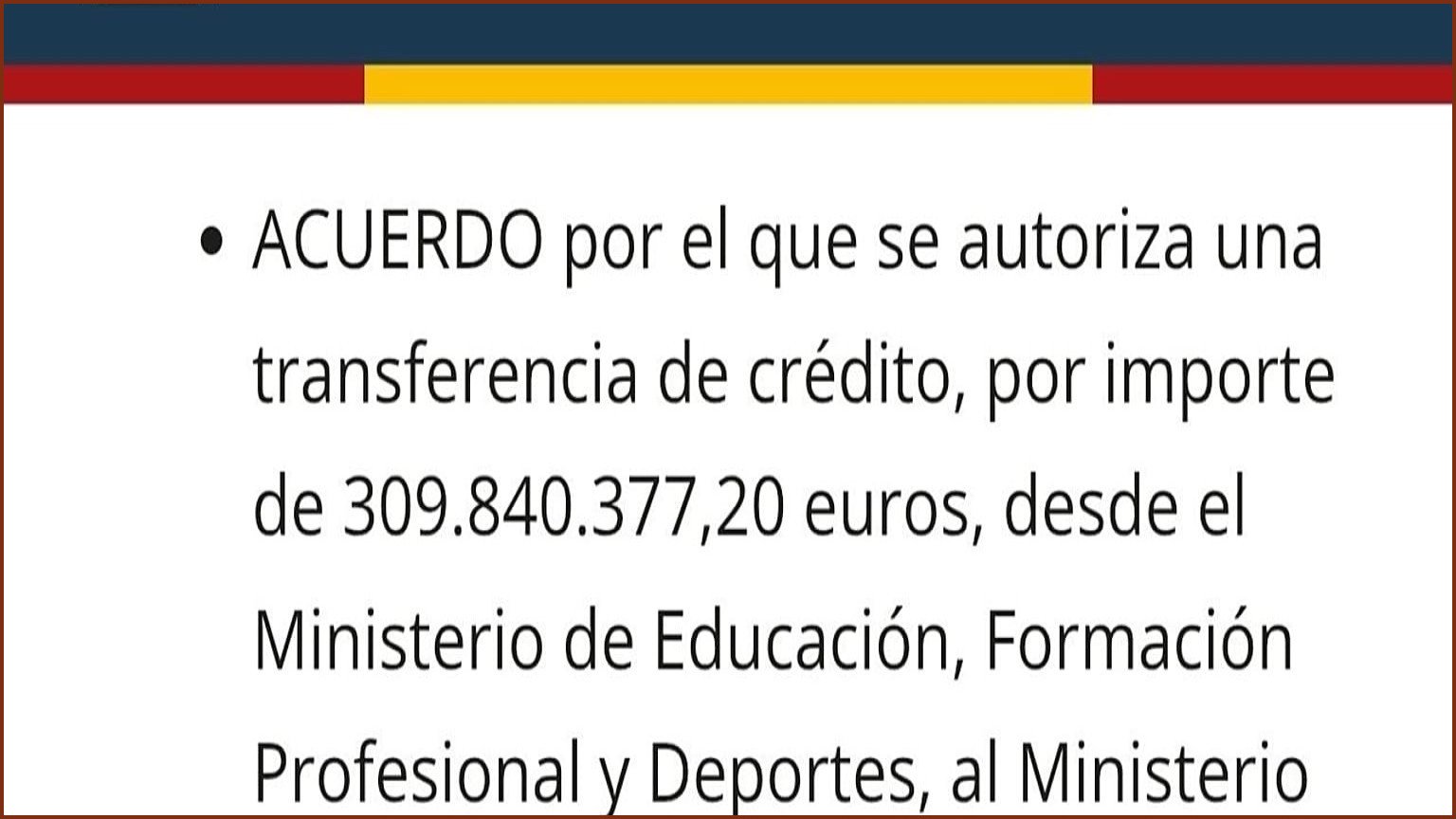
On Tuesday, 14 July, the Spanish government approved a significant budget transfer through the Council of Ministers, moving more than €309,840,000 from the Ministry of Education, Vocational Training and Sport to the Ministry of the Presidency, Justice and Relations with Parliament. The official agreement explicitly states that these funds are intended to cover shortfalls in Chapter 1, which encompasses the staff costs for the department currently headed by Félix Bolaños. This specific budgetary chapter covers payroll, social security contributions, length-of-service increments, and various pay supplements for civil servants assigned to the ministry. Consequently, the diverted money is being used to sustain the internal administrative structure of the department rather than to fund specific investment programs or educational initiatives.
This financial maneuver is not an isolated event. In April, the executive branch had already diverted nearly €30 million from the department, which was then headed by Pilar Alegría, to the Ministry of Justice. That earlier transfer was aimed at financing digitalisation projects associated with the national Recovery Plan. The current situation differs significantly in scale, as the amount being moved is ten times larger and is directed toward meeting routine payroll obligations rather than technological modernization.
The government has justified these shifts by pointing to the ongoing extension of the 2023 budget. Because the administration has now gone three financial years without successfully passing a new budget, any spending that does not fit within the inherited items must be covered by reallocating funds between various government departments. However, the agreement approved by the Council of Ministers fails to explain why the education sector was selected to fill this budgetary gap. The document does not specify which areas—such as grants, classroom digitalisation, catch-up support, or vocational training—will be left with reduced budgetary room following the loss of €310 million.
This development stands in sharp contrast to the government's official narrative regarding its priorities. While the Ministry of Education, now led by Milagros Tolón, has recently boasted about distributing over €31 million among autonomous communities to boost vocational training and has highlighted the receipt of European funds via the Recovery Plan, the ministry is now simultaneously seeing a sum ten times larger leave its coffers. This transfer was executed through administrative means, bypassing both public debate and a specific parliamentary vote.
The reliance on budget extensions creates more than just a technical challenge. Each transfer forces the government to make decisions that, under a scenario with updated accounts, would have been subject to a higher level of parliamentary scrutiny. The Independent Authority for Fiscal Responsibility has issued repeated warnings that the lack of new budgets complicates both economic planning and the oversight of public accounts. By choosing to cut the education budget to reinforce the internal functioning of another ministry, the government has provided the opposition with a concrete argument to challenge the gap between its rhetoric on public education as a social priority and its actual budgetary decisions. As negotiations for the 2026 budget remain blocked, the government faces ongoing structural tension, leaving the question of how many similar transfers will be required to maintain staff spending while the financial framework remains outdated.