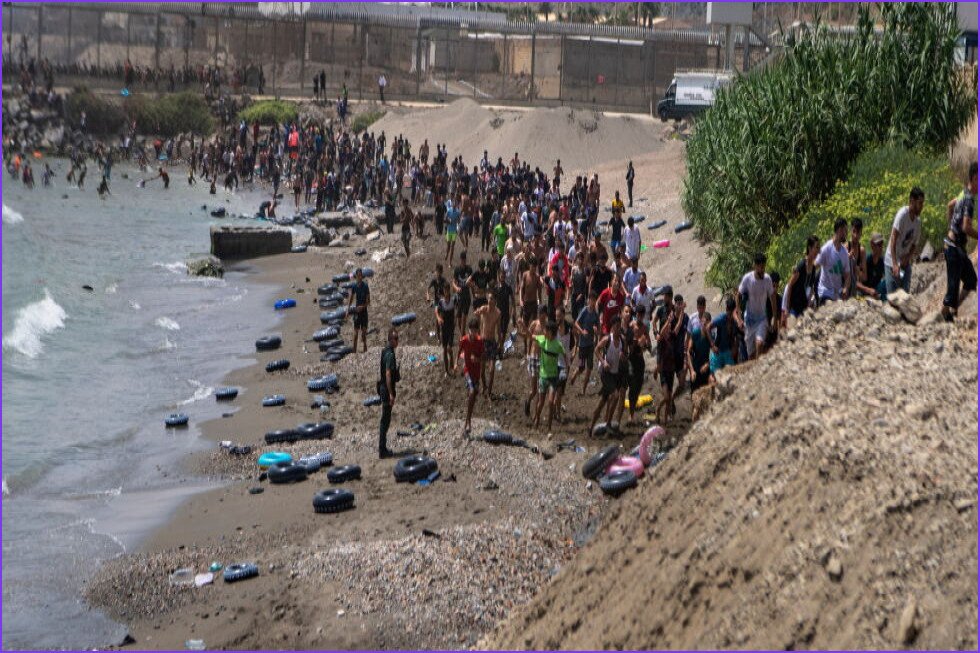
Spain has moved to reinforce its border at the North African enclave of Ceuta by deploying the Armed Forces to assist the Civil Guard. This decision follows a surge of thousands of migrants who entered the Spanish territory from Morocco, an incident that has resulted in at least nine deaths during the crossing attempts.
Visual evidence from the frontier, dated July 30, 2026, depicted large crowds—primarily young men, alongside families with women and children—navigating around breakwaters at an urban beach to reach local roads near the border checkpoint. The sudden escalation followed a spike in attempted crossings the previous day, many of which involved migrants swimming from the Moroccan towns of Fnideq and Belyounech. While it remains unclear what specifically triggered such a significant and rapid influx of people, the event has prompted Spanish Prime Minister Pedro Sánchez to schedule a visit to the city on Friday.
Ceuta, a territory held by Spain since 1580, is home to a population of approximately 85,000, consisting of a mix of Christians and Muslims, alongside Spanish and Moroccan residents. The city has frequently served as a point of diplomatic tension between Madrid and Rabat, as Morocco does not formally recognize the sovereignty of Ceuta or the sister city of Melilla, often describing them as occupied lands.
The current situation echoes the diplomatic crisis of May 2021, when Moroccan authorities suspended border controls, allowing roughly 8,000 people to enter Ceuta within 48 hours. That event was widely viewed as a retaliatory measure by Morocco after Spain permitted a pro-independence leader from Western Sahara to receive medical treatment in a Spanish hospital. Tensions only subsided after Prime Minister Sánchez altered Spain’s historical stance on Western Sahara and held meetings with Moroccan King Mohammed VI the following year.
While Ceuta and Melilla are heavily fortified, they remain a destination for individuals seeking to enter Europe from Africa. Migrants who reach these territories often face immediate return, though some are processed in shelters and may apply for asylum. Statistically, however, the number of arrivals in Ceuta and Melilla remains lower than those recorded for the Canary and Balearic Islands.
Spain, which has seen its immigrant population grow to include roughly 10 million foreign-born residents out of a total population of 50 million, relies on these individuals to support key sectors such as agriculture, tourism, and services. Many of these residents originate from Venezuela, Colombia, and Morocco, contributing significantly to the nation's economic landscape.