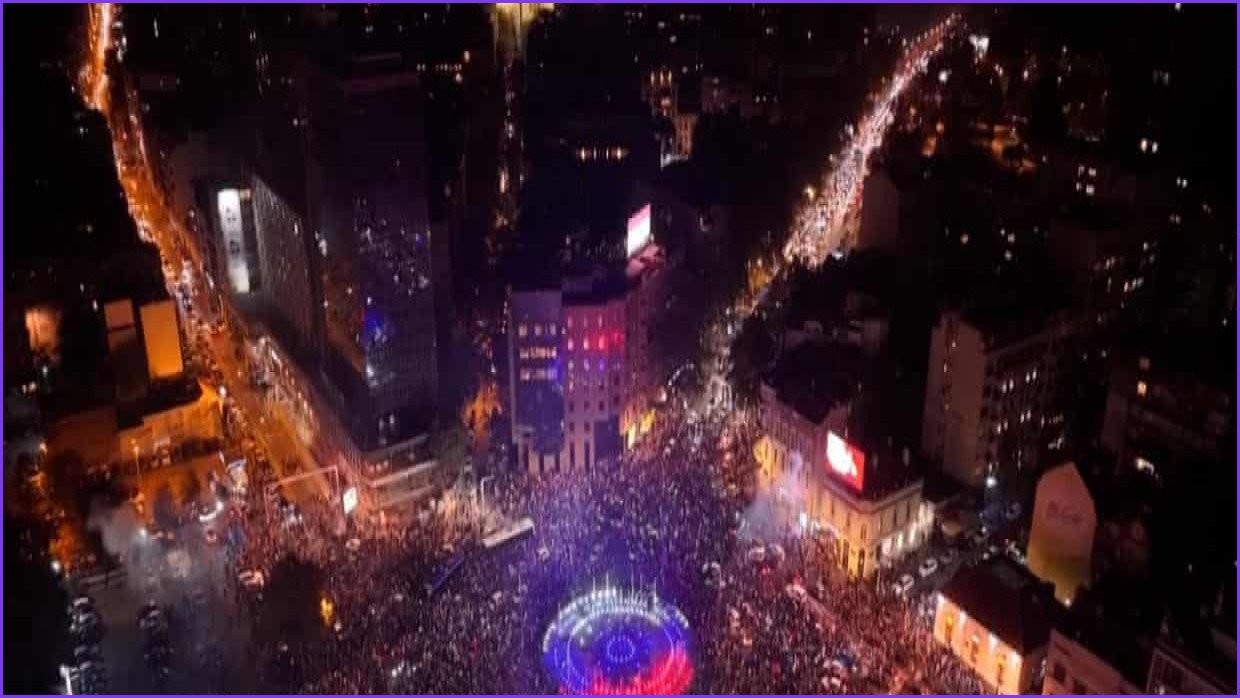
Following a historic victory at the polls, Serbia's newly victorious Student List movement is preparing to begin negotiations to form a government. The non-hierarchical political group aims to reverse 14 years of increasingly autocratic nationalist rule under former president Aleksandar Vučić, who conceded defeat late on Sunday. On Monday, supporters gathered in the streets across the West Balkan nation to celebrate the election outcome, which brought an end to Vučić’s long-standing political dominance and concluded two years of widespread anti-government protests sparked by the collapse of a railway station canopy in Novi Sad that killed 16 people.
Projected results from the Belgrade-based Centre for Free Elections and Democracy, with 100 percent of ballot samples counted, show the Student List securing 53 percent of the vote. This victory awards the movement 141 seats in the 250-member parliament. Vučić’s ruling Serbian Progressive Party (SNS) captured 39 percent, translating to 103 parliamentary seats, while the remaining seats were won by national minority party lists.
Despite its decisive win, questions remain regarding how the movement will govern given its collective decision-making model and lack of government experience. The Student List intentionally operates without a central leader or formal hierarchy, leaving its choices for prime minister and cabinet ministers unannounced. Its roster of candidates spans students, academics, actors, and farmers. Key prominent figures in the movement include Ilija Srdanović, a cardiologist who led the candidate list; Dejan Šoškić, a former governor of the central bank; and Radomir Saičić, a chemistry professor at Belgrade University who spoke publicly on behalf of the List following the victory announcement.
Ana Mirković, a university educationist, psychologist, and Student List candidate, emphasized the weight of the task ahead. "Everyone in the student movement, and every candidate on the list, has a complete and very clear understanding of the weight of the responsibility before us," Mirković stated. She added, "We do not see the election result as gaining power and privileges, but as taking on a historic debt to our own people and to our own children." Speaking about immediate objectives, Mirković declared that the incoming administration's primary focus would be the "social and psychological detoxification" of Serbia.
The Student List faces an institutional environment staffed with civil servants loyal to the outgoing regime, creating governance hurdles similar to those encountered by Péter Magyar’s Tisza party, which ended Viktor Orbán’s 16-year illiberal reign in Hungary this spring. Over his 14 years in power, Vučić established what observers termed a "textbook regime" of autocracy marked by party control over state institutions, the judiciary, and media, as well as elections affected by voter bribes, registration irregularities, and media bias. To address this, the movement's platform centers on eradicating corruption and restoring the rule of law. Specific measures include creating an independent police unit accountable to prosecutors rather than the interior ministry, purging police officers tied to organized crime, banning party loyalist appointments to state enterprise management, and establishing new independent watchdog bodies to ensure public scrutiny and financial accountability for major state infrastructure projects.
Mirković explained that the new administration intends to dismantle a pervasive "system of intimidation" that fostered "fear and polarisation." She noted this would be achieved by "urgently opening up" the media, halting pressure on public-sector employees, and "stopping institutional violence." The broader goal, according to Mirković, is to "rebuild society from the ground up: full disclosure of all contracts and financial flows; depoliticising and strengthening the judiciary; renewing the education and healthcare systems," ensuring that state capture can "never again" occur.
Throughout the campaign, the Student List deliberately sidelined divisive foreign policy topics, such as diplomatic relations with Russia and the European Union. In response to the election outcome, the Kremlin expressed hope on Monday that the incoming leadership would "understand that cooperation with Russia is in Serbia’s interests." Meanwhile, Vučić—who preserved close ties with Moscow during his presidency—blamed his defeat on Sunday on "the direct support of various European countries and the US deep state, the one that is also against President Trump."
Western and European leaders offered strong endorsements of the political transition on Monday. Ukrainian President Volodymyr Zelenskyy welcomed the development, stating, "This is clearly a new chapter in the history of the country and its people. We wish Serbia success, real development, and warm relations with the European community. We in Ukraine thank Serbia for respecting our people, our state, and our independence. And we always celebrate our shared achievements." German Chancellor Friedrich Merz affirmed that Berlin would "actively support Serbia’s European path," noting that the students "with their demand for the rule of law, fighting corruption and fundamental freedoms, have reached the people."
Political analysts highlighted both the unique nature and the operational challenges of the student movement. Dušan Vučićević remarked that from its inception, the movement "insisted as much as possible that Serbia must first and foremost address domestic political issues – the literal dismantling of every institution, from the national to the local level." Vučićević told Agence France-Presse that while "this experiment in grassroots democracy ultimately secured more than 50% of the vote," it remains "unclear whether a similar model could work in other countries." Nikola Burazer, programme director at the Belgrade-based Centre for Contemporary Politics, noted on Monday that the movement's candidate selection "actually took a long time – months," suggesting that its decision-making mechanism needs to "be sped up." Burazer observed, "After people are done celebrating and thinking about what happened yesterday, we will focus a bit more on what’s coming up, and how the government will look. Twenty-four hours ago that all seemed like a fantasy."
According to Serbia's constitution, the newly elected parliament must convene within 30 days of the official election results being announced. Once parliament convenes, a 90-day deadline begins for the formation of a new government. Additionally, the nation is required to hold new presidential elections before December 27, as Vučić had previously resigned from the presidency to run for prime minister.