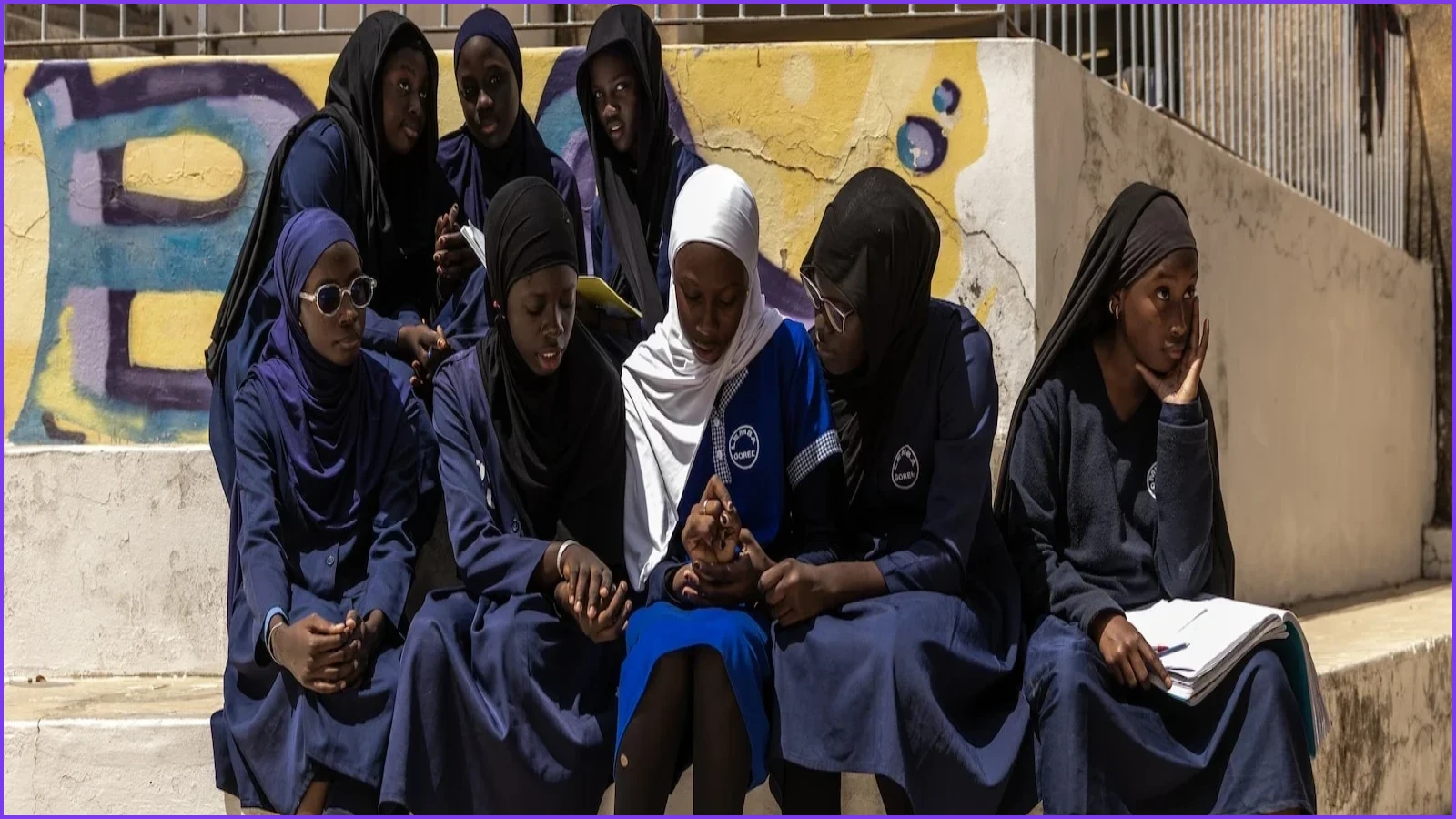
Ndeye Awa Diop was once so shy as a child that she could not look people in the eye. Raised in rural Senegal, she grew up expecting to conform to the traditional expectations of a young woman in the predominantly Muslim West African nation: to be seen but not heard, and to obey her elders. However, her life took a dramatic turn at age 12 when she was accepted into the country's premier elite boarding school for girls, located on Goree Island off the coast of the capital city, Dakar.
"So, here I am, coming here completely shy. I didn’t even dare raise my hand in class," Diop recalled, remembering how she was homesick and crying in her early days. Over the years, the sisterhood of her classmates helped her find her footing. Today, the 19-year-old serves as the president of the student council and is preparing to graduate. "I learned to be a leader," she said.
In Senegal, women must navigate a deeply complex social landscape where patriarchal norms are increasingly being challenged. Progressive legislation has introduced measures such as requiring political parties to reserve half of their candidate slots for women and guaranteeing female access to land ownership on paper. Additionally, the country has made significant strides in primary education, where girls are enrolled at a higher rate than boys.
Despite these early gains, completing secondary education remains a steep hurdle. Less than 20% of girls in Senegal manage to finish high school, resulting in a literacy gap where only 84 girls can read and write for every 100 literate boys. "The current challenge isn’t access to school for girls, but rather the completion of schooling up to secondary level and, of course, the transition to the job market," explained Maissa Abdellaoui, a girls' education specialist with UNICEF.
When family finances are constrained, households typically prioritize keeping boys in school, even if their daughters demonstrate greater academic promise, experts say. Furthermore, girls frequently miss school once they begin menstruating, and they face higher risks of teenage marriage and pregnancy.
To address these systemic disparities, Senegal's founding president, Leopold Sedar Senghor, established the elite boarding school on Goree Island in 1985. He named it after Mariama Ba, the nation's most celebrated female author. Ba's literature famously depicted women torn between traditional upbringings and modern ambitions, offering sharp critiques of patriarchy and the widespread practice of polygamy. Though she was a lifelong champion of gender equality and a three-time divorcee—a status virtually unheard of in her era—Ba rejected the "feminist" label, viewing it as a Western construct.
The school, which boasts a flawless 100% completion rate, is housed in a former French military barracks on Goree Island. Once the largest center of the trans-Atlantic slave trade as the westernmost point of Africa, the island is now a serene, car-free sanctuary with cobblestone streets. Admission is highly competitive: only 35 girls are admitted each year from a pool of 150 who are invited to take an entrance exam based on their academic grades. The state fully funds all tuition and boarding costs.
Over six years of middle and high school, students undergo a rigorous academic curriculum alongside art, sports, and seminars with successful female politicians, doctors, and writers, many of whom are alumni. On any given morning, students in crisp uniforms can be seen rushing through courtyards adorned with bougainvillea, baobabs, and palm trees, accompanied by the sounds of birds and ocean waves. Their daily routine is strictly structured: waking up, showering, praying, eating breakfast, attending classes, lunching, returning to classes, and studying in the hall before dinner.
Headmistress Ramatoulaye Diagne Sarr emphasized that this rigorous discipline is vital to preparing the students to become "the female elite on which Senegal is counting heavily." Sarr noted that the school serves as a model for girls "who are hesitating, who think it’s impossible to climb the ladder." Yet, despite the fact that all headmistresses in the school's history have been women, the majority of the teaching staff remains male.
In one classroom, 15-year-old students actively debate the history of slavery, a topic deeply connected to their school's physical location. Their teacher, Paul Felix Thiao, guides the discussion with a satisfied smile. "Often in society, we see that men tend to dominate women," Thiao remarked. "If we give them more freedom, if we give them more opportunities, they can go far."
Yet, the path to female empowerment in Senegal remains filled with obstacles. According to United Nations data, women own a mere 2% of agricultural land and constitute the majority of those working without formal employment arrangements. Furthermore, Senegalese law designates only men as heads of households. Marie Diop, an 18-year-old student, noted that the public mentality regarding female independence remains exceptionally strict. "In fact, each day you are fighting a battle to make people understand that … women have the capacity to manage, to be in charge," she said.
To bridge these gaps, the school's alumni association provides crucial mentorship. Matel Sow, the 27-year-old head of the association, described her admission to the school as "a radical change" from her upbringing in a village in eastern Senegal. It took considerable effort to convince her father to let her attend, but he eventually realized the value of her education, telling her, "You can do what you want, I trust you," as long as she remained true to her core values and roots of "tradition and religion."
Today, Sow is a graduate of Cheikh Anta Diop University in Dakar and the University of Texas, and she works as an associate at the nonprofit International Budget Partnership. As a working mother of a 2-year-old daughter, she credits her supportive husband, with whom she has formed "a genuine partnership," for helping her navigate her career.
Despite its success, the Mariama Ba school is the only institution of its kind in Senegal, and experts emphasize that broader systemic changes are required for true national empowerment. Abdellaoui, the UNICEF specialist, pointed out that while the school is excellent, similar opportunities must be extended to the "most vulnerable" girls. Sarr also acknowledged that most of the school's students currently come from the capital city.
For Ndeye Awa Diop, who was the first girl from her village to attend the school, the future holds plans to become an international business lawyer. Expressing a perspective that remains rare in Senegal, she noted that having a family is not her immediate priority. "To be a strong woman is not to be afraid to be alone," she said.