Moscow and Tehran have launched joint criticism against the United States military following its deployment of a new task force aimed at blocking trade and transport routes across the Caspian Sea and land corridors. The Russian Foreign Ministry formally condemned Washington's initiative as "a clear threat" to the sovereignty and interests of Caspian littoral nations, maintaining that security across the inland sea remains an internal affair concerning only the five states bordering it.
The diplomatic friction follows an official announcement on November 7 by United States Central Command (CENTCOM) detailing the establishment of the "Iron Gate" task force. According to CENTCOM statements released on X, the specialized unit was formed to prevent the Islamic Revolutionary Guard Corps (IRGC) from utilizing land routes and the Caspian Sea to move advanced weapons systems, dual-use technology, sanctioned goods, and illicit revenue streams. CENTCOM further stressed that American forces are working around the clock to keep the Strait of Hormuz open to commercial shipping while enforcing a strict "Iron Maritime Blockade" against Iran.
In response to the American campaign, Iranian Deputy Foreign Minister for Legal and International Affairs Kazem Gharibabadi met with the Russian ambassador in Tehran to outline a coordinated defense against what he termed "unilateral US measures." Gharibabadi declared that Tehran and Moscow stress the need for coordination and cooperation in the face of common threats, adding that maintaining stability and security across the Caspian directly serves the broader interests of all littoral countries.
According to recent findings by the Institute for the Study of War (ISW), Tehran has repeatedly used its Caspian trade routes to import Russian arms prior to and during the 2026 US-Israel-Iran War. The study highlighted that the Caspian Sea operates outside the reach of Western monitoring bodies. Maritime tracking data shows that sanctioned Russian cargo ships regularly transport consignments from the ports of Astrakhan and Olya directly to the Iranian ports of Anzali, Nowshahr, and Amirabad, frequently disabling their Automatic Identification Systems (AIS) near coastal areas to conceal the nature of their cargo.
Ukrainian military forces have previously targeted these northern maritime supply lines. Last summer, the Security Service of Ukraine announced that its long-range strike drones successfully hit two cargo vessels operating in the Caspian Sea, claiming both ships were actively transferring military hardware between Iran and Russia. Ukraine had also struck a separate shipment along the corridor in July 2026.
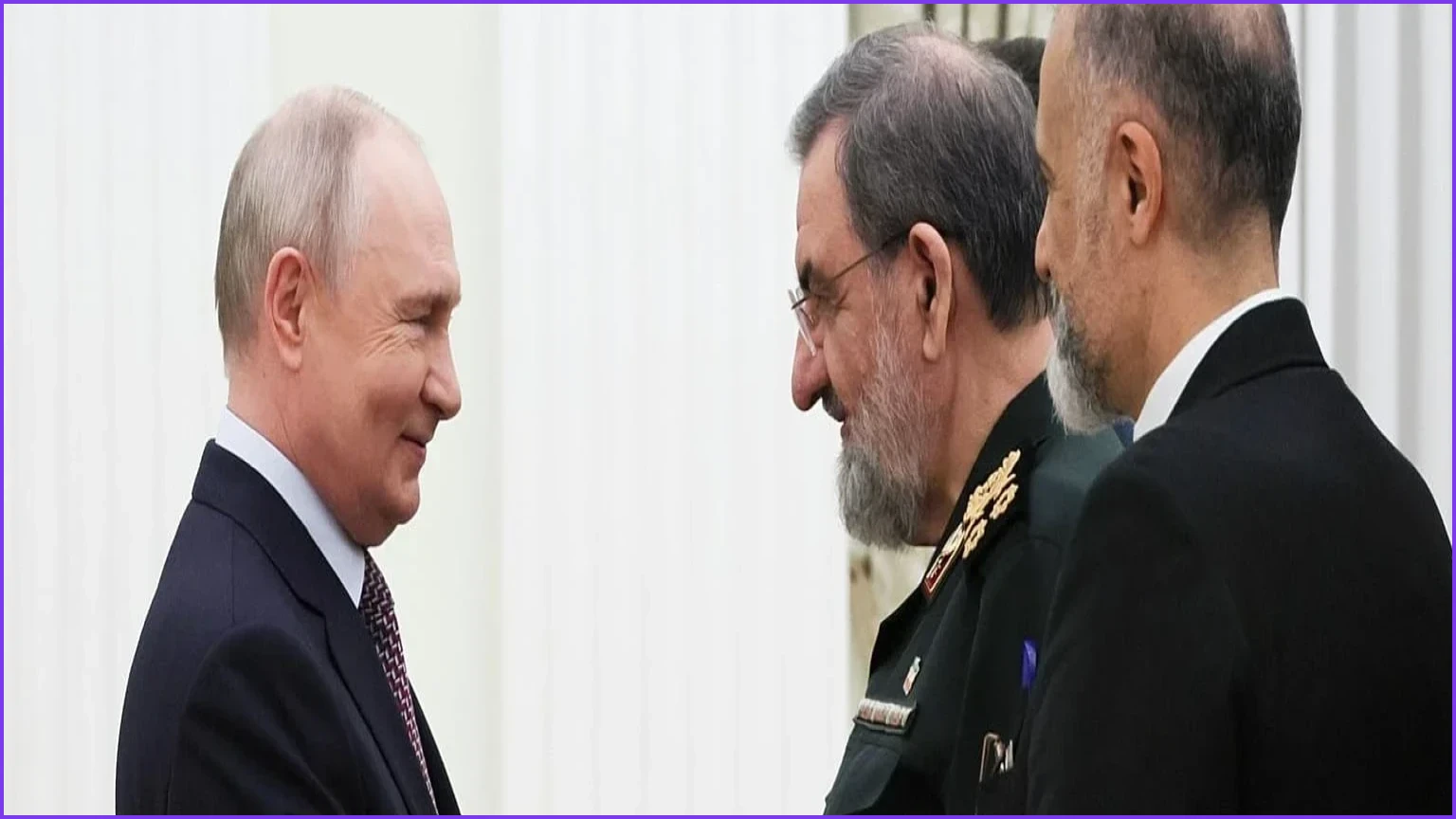
Beyond immediate security ties, Moscow and Tehran are actively expanding economic and transit links through the framework of the International North-South Transport Corridor. Secretary of Iran's Supreme National Security Council Mohsen Rezaei recently met with Russian President Vladimir Putin in Moscow, later confirming that the Iranian council approved the executive agreement to construct the Rasht-Astara railway. The rail link represents the missing connection needed to join Russian infrastructure directly to ports along the Persian Gulf. Rezaei added that discussions with Putin also covered building natural gas pipelines from Russia to Iran, intended to resolve domestic fuel shortages and facilitate gas exports to neighboring countries.
Strategic friction along northern trade channels comes as conditions in southern maritime waters remain volatile under an environment described by observers as a "no war, no peace" situation. On Thursday, the public relations office of the Revolutionary Guard Navy announced that two supertankers carrying over four million barrels of oil in total were halted by a "massive explosion" the previous night while navigating the southern route of the Strait of Hormuz. Iranian naval authorities stated the vessels had ignored repeated warnings that the southern route was unauthorized and unsafe, reiterating that commercial ships must navigate strictly along Iranian-designated channels or bear full responsibility for security consequences.
Simultaneously, joint analytical reports from the Institute for the Study of War and the Critical Threats Project indicate that Iran has abandoned its claimed 2,000-kilometer limit on ballistic missile ranges. This assessment coincided with reports from Iran's Tasnim news agency, an outlet close to the Revolutionary Guard, displaying a new ballistic missile inside the Guard's missile city. By combining the warhead of the "Fattah" missile with a "Kheibarshekan 2" booster, Iranian engineers increased the operational range of the Fattah hypersonic missile from 1,400 to 2,000 kilometers.
Reaffirming this military stance, Security Council Secretary Mohsen Rezaei highlighted an order attributed to Iran's Supreme Leader Ayatollah Mojtaba Khamenei mandating "no geographical limitations in confronting the enemy." In a post on X, Rezaei warned European governments that should the United States initiate another war against Iran, every military base involved in the aggression from West Asia to Europe would become a legitimate target of Iranian attacks, leaving no safe distance, safe haven, or immunity.
Meanwhile, Speaker of the Iranian Parliament Mohammad Bagher Ghalibaf directed criticism toward Washington's regional posture. Writing on social media, Ghalibaf argued that despite the slogan "America First," American strategies have consistently prioritized "Israel First." He asserted that Washington's acceptance of Israeli intelligence and operational plans remains the root cause of current American military, political, and economic challenges in the region.