With the warning of a yet-to-materialize missile test in the Southern Ocean, is Russia playing an old joke on New Zealand? In 2010, at an APEC meeting in Japan, New Zealand Prime Minister John Key, in an awkward attempt to break the ice, asked Russian President Dmitry Medvedev how long it would take a Russian missile to reach New Zealand. Medvedev immediately asked a staffer to calculate it. He turned back to Key and said, “22 minutes,” then added with a smirk, “I will call you in advance.” The exchange became a New Zealand urban legend. This week, the Russians seem to have replayed the joke – for real this time.
On August 18, the Russian Air Traffic Management Corporation gave the New Zealand Civil Aviation Authority (CAA) an alarming warning of planned “space activity” in an area of the Southern Ocean managed by New Zealand authorities. The CAA’s follow-up Notice to Airmen (NOTAM) identified the activity as a missile launch. New Zealand has experienced the landing of Russian space debris in its territory before, but never a missile launch. New Zealand’s Starboard says there are no Russian vessels in the area of the supposed launch.
When China launched a long-range nuclear-capable ballistic missile into the South Pacific in June, it sent three space-tracking vessels to observe the trajectory and collect the debris. So it appears that Russia’s warning is a dummy warning of a dummy missile – an information operation and another example of Russia’s reckless hybrid warfare. The New Zealand government has asked for more information about the launch. Foreign Minister Winston Peters said the information Russia provided was unclear.
NOTAM NZZO B3996/26 reported a foreign agency missile launch and returning space debris until August 27, imposing flight restrictions from 58 and 68 degrees south. The area is approximately 1,900 km southwest of New Zealand’s South Island, in the Southern Ocean-Antarctic flight region, near the Ross Sea. There is no international law specifically regulating submarines conducting missile launches in international waters, let alone fake missile launches. Russia, like China, appears to be using international rules – and the gaps in those rules – as a shield for an act of intimidation and show of force.
The only flights that travel in the Ross Sea are U.S., New Zealand, and Australian military planes. They form an international Antarctic flight pool carrying scientists to bases in the Ross Sea area: the U.S. McMurdo and South Pole stations; New Zealand’s Scott Base; South Korea’s Jang Bogo Station and Italy’s Mario Zucchelli Station. Personnel from China’s two Ross Sea bases, one of them only 30 kilometers from South Korea’s base, are not included in this logistics pool. This is likely no accident, but a response to China’s aggressive acts elsewhere including military support for Russia’s war against Ukraine.
After Russia issued its warning, a U.S. Air Force C-17 Antarctic flight was turned back from Christchurch a few hours into its journey on the afternoon of August 18. The Antarctic C-17s are flown by active-duty and Air Force Reserve crews from the 62nd and 446th Airlift Wings at Joint Base Lewis-McChord in the U.S. state of Washington. The international Antarctic programs based in Christchurch had only just begun their Antarctic season and regular flights to the ice; the C-17 flight on August 18 was to be the first.
Antarctic analysts have often speculated that the bases there could be an early target in a global conflict. The U.S., Russian, and Chinese Antarctic programs all host global navigation satellite system (GNSS) ground stations – GPS, GLONASS and BeiDou – which are used for nuclear missile timing and positioning, as well as other facilities with dual civil-military capabilities.
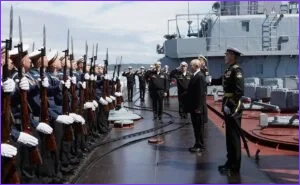
Polar ground stations are an essential part of C4ISR – Command, Control, Communications, Computers, Intelligence, Surveillance, and Reconnaissance – the nerve centers of modern defense. Last week, Russian military forces engaged in a major naval exercise in the Kuril Islands, off the Pacific coast. President Vladimir Putin watched on the final day of the exercises.
But Putin had something else on his mind. Addressing naval personnel he said: “We can see that the officials of some countries are attempting to restrict the movement of our economic operators’ vessels by peaceful means in violation of International Maritime Law, but recently it occurred to them that they can seize our vessels and sell our looted property. This is nothing short of piracy and plunder. If this happens, we will have to reciprocate – not necessarily in the waters where they plan to raid our own ships but anywhere we consider necessary or reasonable, including in the Pacific Fleet’s area of responsibility.”
Only days earlier, the Italian navy led an EU-team boarding a tanker belonging to Russia’s “shadow fleet,” which helps Moscow circumvent sanctions. New Zealand has also participated in sanctions, through maritime restrictions. Russia’s Pacific Fleet is responsible for more than near-seas border protection. It provides Russia’s nuclear and non-nuclear deterrence in the Asia-Pacific and protects sea lines of communication. Russia has also strengthened its position in the Blue Pacific through recently announced joint patrols with the People’s Liberation Army Navy (PLAN), as well as cooperation with India and North Korea.
Since the Cold War, the U.S.-led strategic architecture in the Pacific has sought to limit Russian and Chinese strategic access through a network of hub-and-spoke defense pacts and installations along the three island chains.
Antarctica represents the southernmost reach of the Third Island Chain. That architecture appeared somewhat frayed this week, with the last U.S. aircraft carrier stationed in the Pacific departing for duties in the Middle East. Last year after launching military exercises in the Tasman Sea, China boasted of the “normalization of the deployment” of PLA forces in the South Pacific.
The removal of the U.S. aircraft carrier has thus unnerved the U.S. Indo-Pacific allies considerably. Their navies combined are no match for the PLAN’s 234 vessels and six nuclear-powered ballistic missile submarines (SSBNs) plus the Russian Pacific fleet’s 80 major warships and submarines, which include six SSBNs.
TASS coverage of last week’s Russian naval exercises near the Kurils used a picture of a Borei-class (Project 955) ballistic-missile submarine, RFS Vladimir Monomakh (K-551). The submarine is equipped with the very SLBMs that could get to New Zealand in the proverbial 22 minutes. It is not known if the Monomakh participated in the exercise; only Kilo-class submarines were observed departing for its start.
Could Russia’s fake missile-launch warning this week have revived Medvedev’s joke as a lesson for the coalition of states imposing sanctions on the Russian shadow fleet? A warning about a fake missile launch, apparently from a submarine that may itself have only been pretending to take part in a naval exercise, would be an elaborate – and menacing – Russian prank.
Russia’s missile warning did not make the evening news in New Zealand, nor did it feature on the national radio bulletin. Instead, the news carried the familiar stories of everyday life in our bucolic corner of the world. Perhaps it is time we stopped assuming that the moat of our vast exclusive economic zone can shield us from a strategic environment unlike any we have faced in living memory. We need to think about how to future-proof New Zealand and protect our interests over the long term.