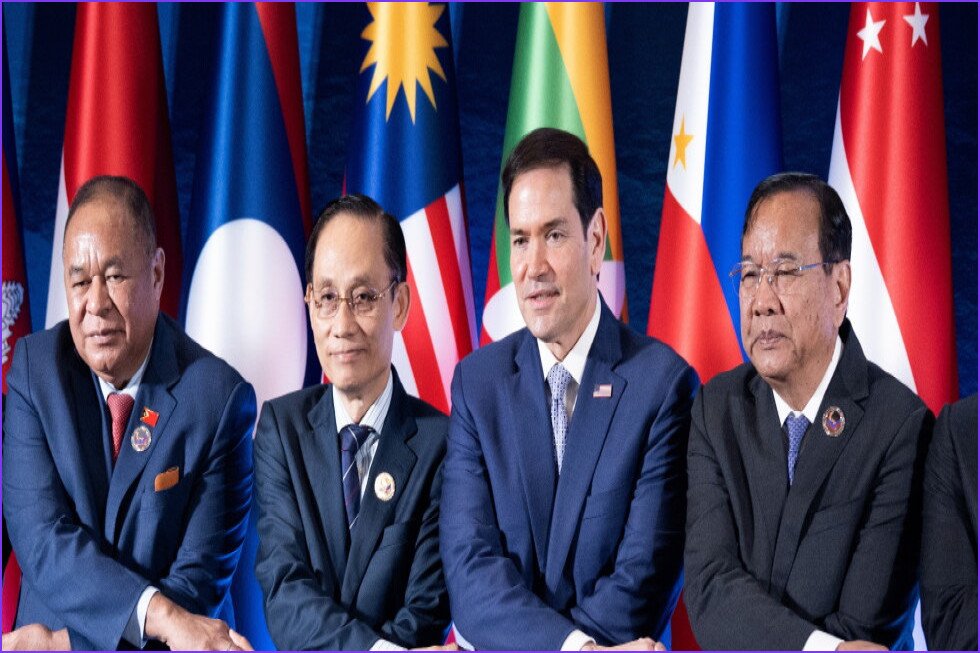
U.S. Secretary of State Marco Rubio issued a stern warning to Asian leaders on Wednesday, July 22, 2026, stating that Iran's insistence on controlling and collecting tolls in the Strait of Hormuz would pose a significant threat to the global economy and undermine the fundamental principle of freedom of navigation. Speaking in Manila, the Philippine capital, during an annual meeting with foreign ministers from the Association of Southeast Asian Nations (ASEAN), Rubio cautioned that such a move could establish a dangerous precedent with far-reaching implications, potentially repeating itself in other strategic waterways worldwide, including within the Asian region.
“If we create a precedent in the Middle East where a nation-state can decide that they are going to control an international waterway, charge a toll and if you don’t pay them, blow up your ships, we have created a very dangerous precedent which will repeat itself in other parts of the world, including in this region,” Rubio stated.
The U.S. Secretary of State, who joined Russian Foreign Minister Sergey Lavrov and Chinese Foreign Minister Wang Yi at the gathering, acknowledged Washington’s preoccupation with Iran but assured ASEAN counterparts, who have voiced alarm over the resurgent conflict in the Middle East, that “We’re with ASEAN 100%.” He reiterated the U.S.'s willingness to engage in dialogue with Iran to resolve differences, noting, “We are open-minded and always willing to engage in negotiated settlements of differences.” However, he expressed disappointment that despite direct and indirect outreaches and previous agreements, Iran “has not kept their commitments.”
The renewed fighting in the Middle East has significantly impacted the Southeast Asian region, particularly due to its heavy reliance on fossil fuel imports. The International Energy Agency (IEA) highlighted that Asian markets imported approximately 80% of their crude oil and nearly 90% of liquefied natural gas (LNG) transiting through the Strait of Hormuz in 2025. The IEA described the crisis as a “stark wake-up call” for the region’s energy security.
Other top diplomats present echoed concerns over the Middle East conflict. Russian Foreign Minister Sergey Lavrov expressed Moscow’s desire for a swift settlement between the U.S. and Iran. “There are those eager to incite each party to keep the conflict going, but we aren’t one of those,” Lavrov told reporters. He emphasized that the conflict impacts the global economy, of which Russia is a part, and that Moscow is “interested in stable global energy prices to pursue long-term economic policies.”
Australian Foreign Minister Penny Wong underscored her country’s apprehension regarding the renewed attacks, warning that “the situation could deteriorate further without much warning.” Wong called for an end to the war, a ceasefire, negotiations, and the reopening of the Strait of Hormuz, noting the direct and personal impact on people affected by global energy markets.
Beyond the Middle East, Rubio engaged in a series of high-level discussions. He met with counterparts from the four-nation Quad partnership, comprising the U.S., Australia, India, and Japan. Their agenda included maritime and transnational security, culminating in a joint statement reaffirming their commitment to initiatives aimed at countering China’s growing influence in the region.
During these discussions, Japanese Foreign Minister Toshimitsu Motegi voiced strong opposition to any attempts to alter the status quo by force in the region, specifically mentioning the disputed South China Sea and East China Sea, where China’s increasingly assertive actions have raised concerns. Tokyo maintains a long-running dispute with Beijing over Japan-controlled islands in the East China Sea, which China also claims. Australian Foreign Minister Wong echoed this sentiment, stating, “We have real concerns about behavior that is destabilizing and risky.” The Trump administration has consistently criticized China’s assertive actions in the South China Sea, particularly to the disadvantage of smaller claimant countries like the Philippines, a long-standing U.S. treaty ally in Asia.
Rubio also held a separate meeting with Chinese Foreign Minister Wang Yi, where they discussed a recent “escalatory” altercation between Chinese and Filipino forces in a disputed shoal. Rubio commented that the incident “speaks to areas of disagreement when it comes to our policies with China,” stressing the need to manage these carefully due to the potential for a “dramatic global impact” from any U.S.-China conflict, economic or otherwise. They also talked about a proposed trade board intended for discussions on specific goods, which Rubio hopes will be a “deliverable” from a planned meeting in the U.S. in September between President Donald Trump and Chinese leader Xi Jinping. Separately, ASEAN foreign ministers had discussed territorial disputes on Tuesday, welcoming progress in their years-long negotiations with China on a proposed non-aggression pact.
Looking ahead, Rubio is scheduled to meet with Russian Foreign Minister Lavrov on Thursday to discuss the war in Ukraine. He indicated an intention to explore other potential areas of cooperation between the U.S. and Russia, noting that efforts to end the conflict in Ukraine “kind of fallen off a little bit over the last few months” and hoping to renew talks. Lavrov, for his part, plans to inquire about President Trump’s claim that a settlement on the war in Ukraine is nearing. Additionally, Rubio met with his Indian counterpart, External Affairs Minister Subrahmanyam Jaishankar, to address regional issues, the Iran war, and a pending trade agreement aimed at lowering Trump’s tariffs on Indian goods.