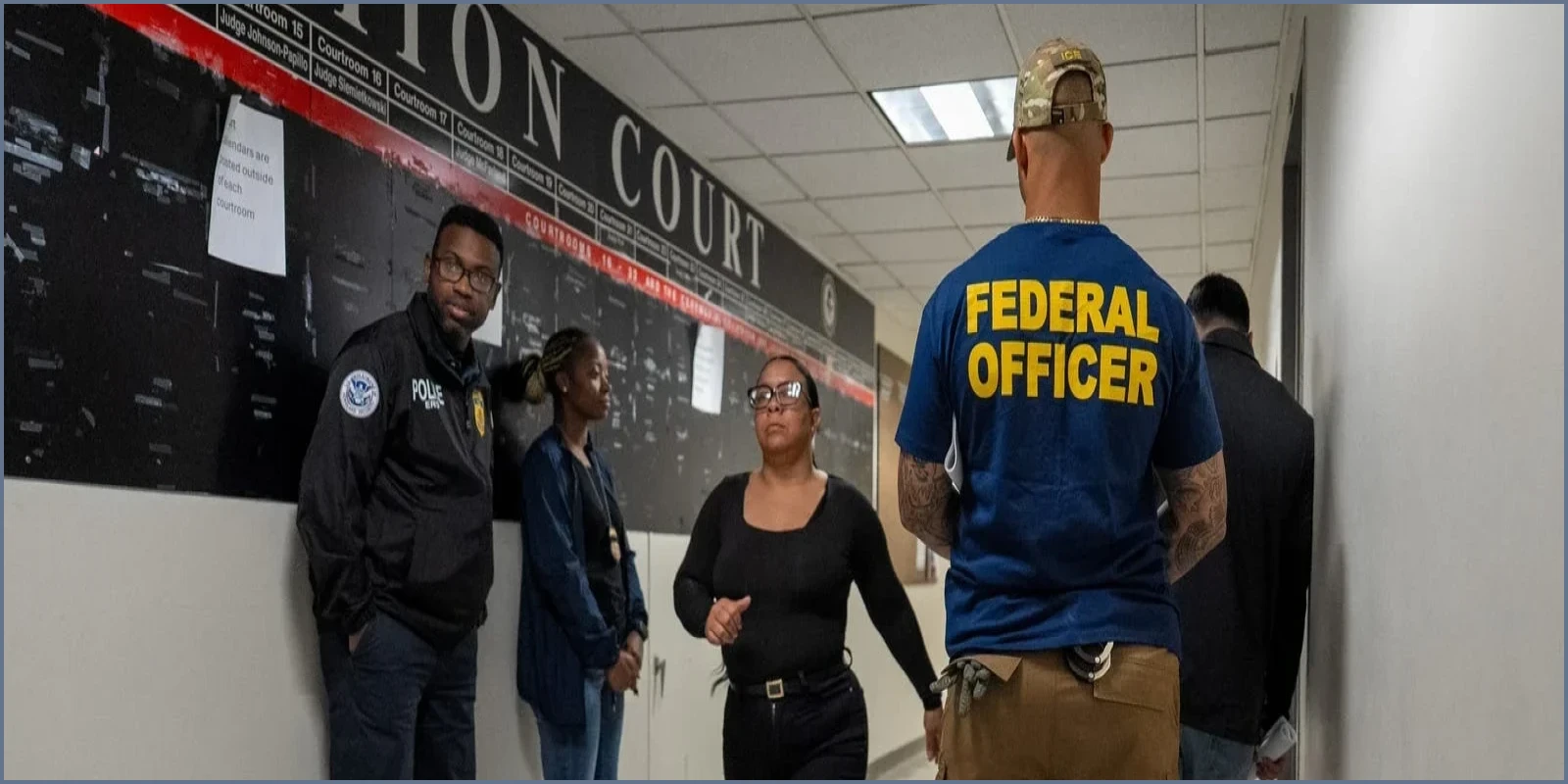
The Trump administration has announced a significant modification to the U.S. asylum system that could funnel hundreds of thousands of asylum seekers into deportation proceedings without an initial interview to plead their case. The rule, which officially took effect on July 27, eliminates the requirement for trained asylum officers to interview asylum seekers who entered the country legally or have not been charged with an immigration violation.
In a joint statement, the Department of Homeland Security and U.S. Citizenship and Immigration Services (USCIS) explained that the new rule is designed to reduce a significant backlog in the asylum system, which currently has an estimated 1.4 million cases pending. USCIS Director Joseph Edlow stated that for far too long, the asylum system has been exploited for purposes of delay and work authorization rather than for legitimate claims of protection.
DHS General Counsel James Percival added that one of the greatest barriers to effective immigration enforcement is intentional delay by illegal aliens and the attorneys who represent them. Percival noted that his office works daily to improve efficiency and fulfill the President’s mandate, and that this rule would achieve that goal.
However, immigration law experts have criticized the new rule as an effort to boost the administration’s deportation agenda by stripping immigrants of their already limited protections. Ingrid Eagly, an immigration law professor at the University of California, Los Angeles, warned that the policy could prevent people from having a meaningful review of their asylum claims.
She stated that the rule risks placing credible asylum seekers into an immigration court system that is increasingly denying asylum claims, and noted that the policy allows this to happen without even granting people an interview. Eagly highlighted the severe risk that asylum seekers face if they are deported to countries they have fled for fear of persecution.
Historically, foreign nationals who entered the country legally or were never charged with an immigration violation could apply for asylum through USCIS and enter the affirmative asylum process. This process has long featured an in-person interview with one of the agency’s trained asylum officers. These interviews are non-adversarial in nature and provided immigrants with a chance to discuss their case and clear up any discrepancies in their application. Asylum officers would then decide whether to grant asylum or refer cases to immigration court for deportation proceedings.
Michael Valverde, a former top official at USCIS who worked for several years in the department that oversaw asylum applications, stated that the affirmative asylum program was largely built around these interviews. He explained that officers received specialized training on how to vet applications, explore contradictions, and assess the credibility of asylum seekers, calling the interview process a foundational bedrock of the program and describing the new rule as a massive shift away from that.
Under the new rule, authorities could bypass the interview process altogether and refer cases directly to immigration court, which is a much more challenging environment in which to win asylum. In immigration court, asylum applicants go up against government attorneys who are seeking to get their cases denied. The proceedings are overseen by immigration judges, who are appointees of the executive branch and lack the specialized training of USCIS asylum officers.
As of late April, immigration courts were experiencing a large backlog with over 3.5 million cases pending, including asylum claims referred by USCIS, according to the Executive Office for Immigration Review, which is part of the Department of Justice.
In recent months, immigration officials have turned to mass hearings to speed through the backlog, with judges seeing more than 100 cases in a single court proceeding. Critics have described these "mega master" hearings as a blunt tool being used to fast-track deportations. Furthermore, the administration has carried out a record hiring spree of immigration judges, many of whom have no clear immigration law experience, according to an analysis by The Washington Post.
Joseph Perez, an immigration attorney based in Virginia who has represented hundreds of asylum seekers, said that foreign nationals who go before an immigration court are at a significant disadvantage compared with those who can speak with a USCIS asylum officer. He noted that if a minor deviation in paperwork occurs in an asylum office, it can be worked out or explained, but in court, every minor discrepancy is held against the applicant. The funneling of cases to immigration court also raises the risk that asylum seekers could be detained for weeks or months as they wait for their case to be heard.
Under the Trump administration, detained migrants have been moved to several facilities before appearing before a judge, making it difficult for foreign nationals to manage their case, especially without a lawyer. Asylum seekers who are detained and cannot afford legal representation face what some immigration lawyers described as a nearly impossible challenge as they seek a path to citizenship.
Ernesto Castaneda, the director of the Center for Latin American & Latino Studies at American University, stated that this is just another way for the administration to make it almost impossible to get asylum in the U.S. He added that it is going to result in more people becoming undocumented and not having permission to work. Castaneda acknowledged that the backlog is undeniable, noting that the immigration court backlog more than doubled from fiscal 2021 to 2024, reaching 3.8 million cases amid record border arrivals and mass asylum filings.
The average wait time for asylum cases is an estimated four to seven years, according to the Migration Policy Institute, with some experts saying they have seen cases run longer than that.
Several experts said the rule change, if implemented judiciously, could alleviate the backlog without leading to a surge in detentions or denials of valid asylum claims. Perez noted that there are many cases in which there is clear evidence that someone does not meet the standard for asylum, such as those involving people convicted of serious crimes. However, he added that implementing the rule beyond those cases and doing so without the advice of trained asylum officers could punish law-abiding asylum seekers who have worked for years to gain a path toward citizenship.
The administration’s broader immigration policies have also included significant restrictions. Last year, President Donald Trump shut the border to asylum seekers and suspended the refugee program before later lowering the cap on refugee admissions from 125,000 to 7,500, the lowest level in history. He eventually raised the cap to 17,500, but those slots were only made available to Afrikaners, members of South Africa’s White minority.
In recent days, the temporary protected status of hundreds of thousands of Haitians and Syrians expired after a U.S. Supreme Court decision that allowed the administration to terminate the designation for both countries, stripping recipients of work authorization and protections from deportation.
The risks for asylum seekers remain immense. On July 28, authorities in Guatemala said a man deported from the U.S. and his wife, who had self-deported, were found dead in a sugarcane field with their hands tied behind their backs. The couple’s infant daughter was found alive beside them. The wife, Glendy Marisol Gonzalez, had an active asylum case with a hearing scheduled for next year, according to the Missouri Workers Center, a group of which the couple were members.