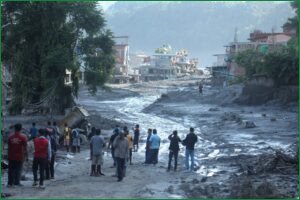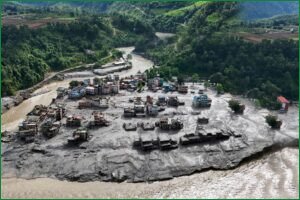
A catastrophic glacier collapse near Langtang Lirung on August 26, 2026, has triggered a devastating sequence of flash floods and mudslides along Nepal's Trishuli and Bhotekoshi river systems. The disaster has decimated existing infrastructure, halted ongoing construction, and crippled local small and medium enterprises. Total economic losses from the event are estimated at more than $5 billion, representing nearly one-third of Nepal's annual national budget.
The human toll of the disaster is immense, with more than 1,300 people confirmed dead and over 4,000 others still missing. For the survivors, the catastrophe has wiped out not only their homes but also their livelihoods, including farmland, livestock, food stocks, shops, vehicles, and personal savings. Entire local economies across the hard-hit districts of Rasuwa, Nuwakot, Dhading, and downstream areas have been completely disrupted, severely impacting the region's vital tourism and agricultural sectors.
The Trishuli-Bhotekoshi corridor serves as a critical lifeline connecting mountain communities to Kathmandu, national markets, and cross-border trade with China. The destruction of this corridor has escalated a local tragedy into a national economic crisis. Crucially, the Gyirong Port border complex, Nepal's primary trade and tourism gateway with China, has been completely destroyed. Following the destruction of the Rasuwagadhi border point linking Rasuwa and Gyirong, China also closed the Tatopani customs point. Consequently, Nepal currently has no fully functional border crossing with China, halting supply chains, cutting off customs revenue, and threatening to drive up consumer prices across the country.
Physical damage along the border is extensive. When the flood struck, more than 300 vehicles waiting at the border were swept away. Approximately 42 kilometers of road and 41 bridges were damaged, with road and bridge repairs alone projected to cost 15 billion rupees ($99.4 million). Blockages along sections of the Prithvi Highway continue to delay emergency relief operations and disrupt the transport of essential goods, fuel, and food. The loss of the Gyirong-Rasuwagadhi trade route has left importers, exporters, freight companies, customs agents, and local businesses in a state of financial ruin, with numerous shipping containers entirely wiped out.
Nepal's energy sector has also suffered a severe blow. The flooding removed approximately 431 megawatts of electricity from the national grid and damaged another 470 megawatts of hydropower projects currently under construction. This massive disruption threatens electricity reliability as the country enters the high-demand dry season. In the short term, Nepal will be forced to rely heavily on electricity imports, worsening its trade balance and raising energy costs for households and businesses. The direct damage to infrastructure is estimated at 200 billion rupees ($1.3 billion), but the comprehensive cost to restore homes, schools, hospitals, power systems, and livelihoods could reach up to $8 billion.
The long-term recovery is particularly challenging because many of the affected areas, including Syabrubesi, Betrawati, Trishuli, and Rasuwagadhi, were still rebuilding from the devastating 2015 earthquake. Scientists note that this disaster was of historic proportions. Paleo-flood studies suggest the Trishuli event may be the largest flood to hit the valley in approximately 5,000 years, matching hydrological instability last seen during the Early Holocene Climate Optimum. Rising temperatures are melting glaciers and weakening permafrost—the "cryospheric glue" that stabilizes mountain slopes—making Himalayan hazards increasingly severe and unpredictable.
In response to the crisis, experts suggest that Nepal cannot afford to rebuild vulnerable infrastructure in the same high-risk locations. Future reconstruction must utilize a green, resilient, and climate-informed approach, incorporating updated flood-risk projections, stronger foundations, and safer alignments. Hydropower planning must also account for hazards like glacier collapses, permafrost thaw, and landslides, rather than relying solely on historical monsoon data. Investments in natural infrastructure, such as wetlands and forest restoration, alongside decentralized solar systems and local microgrids, could help keep critical services functioning during future system failures.
To finance this transition, the establishment of a permanent Himalayan Climate Resilience and Recovery Financing Facility has been proposed. Led by the Ministry of Finance in coordination with local governments, private investors, and development partners, the facility would manage two primary funding windows: a rapid-response window for immediate post-disaster recovery and a resilience-investment window. The resilience window would feature sub-windows to channel public, private, and donor resources into climate-resilient energy, watershed management, and early-warning systems.
Though Nepal contributes negligibly to global greenhouse gas emissions, it continues to suffer some of the most severe consequences of climate change. High-emitting nations, which have historically benefited from carbon-intensive development, bear a moral and financial responsibility to support the recovery of communities in Thame, Langtang, Rasuwa, Nuwakot, Dhading, and Chitwan through rapid, predictable, and grant-based climate finance, ensuring the country is not forced into deeper debt to survive a crisis it did not cause.