Yes, the Indo-Pacific leaders were absent for the second year in a row. But that’s not because of a lack of interest in the partnership. A notable feature of the July 2026 NATO Summit in Ankara was the absence of the four leaders of NATO’s Indo-Pacific partner countries, collectively known as the IP4: Australia, Japan, New Zealand, and South Korea. While it may be tempting to view this as evidence of a downturn in relations, a deeper analysis does not support such a conclusion. The main variable affecting their presence was not a lack of interest in engagement, but the nature of the summits themselves.
The key difference between the summits in 2022, 2023, and 2024 and those in 2025 and 2026 lies in their structure. The earlier summits involved two days of North Atlantic Council (NAC) meetings at the leader level, whereas the latter two were condensed into a single day. This attenuated timeline required cutting out the NAC leaders’ meetings with partner countries. This change primarily reflects the realities of the United States; as one allied official noted, NATO understands that President Donald Trump does not have the interest or attention span for a two-day summit, necessitating shorter, more realistic events.
While the IP4 leaders were invited, their absence is understandable in context. Without an opportunity to participate in NAC discussions, they were effectively invited to the rehearsal dinner but not the wedding. For busy heads of state, such an invitation does not carry the weight necessary to displace domestic and regional priorities, especially when their defense ministers were attending complementary summit events. It would be a mistake to equate summit representation with the health of the alliance. The goals of the 2022-2024 summits—establishing importance and creating momentum—have been met. By 2024, all four partners had signed new Individually Tailored Partnership Program (ITPP) documents, appointed dedicated ambassadors to NATO in Belgium, and engaged in priority areas like Ukraine, cyber defense, disinformation, and technology.
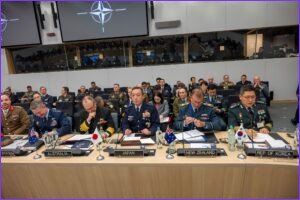
Certainly, leader-level attention is the best driver for internal momentum, but this can be offset by greater involvement from defense and foreign ministers and high-level visits. In 2025, new NATO Secretary General Mark Rutte traveled to Tokyo to meet with Japan’s prime minister. At the Ankara summit, IP4 defense ministers—and Australia’s minister for the defense industry—met with NATO counterparts at a NAC working dinner and a defense industry forum. The relationships are already deeply institutionalized at the ambassador and working levels.
Geopolitical drivers for continued engagement remain significant. As close U.S. allies, the IP4 and NATO nations can exchange best practices regarding the fragile U.S. alliance relationship, coordinating messaging on how to keep the United States engaged constructively. This was evident in Trump’s calls for increased regional burden-sharing and assistance with the Israeli-U.S. war against Iran. Furthermore, mutually shared concerns about multi-theater conflict involving China and Russia underscore the need for coordination. The IP4 partners are incorporating lessons from the war in Ukraine into their security assessments, with Japan expected to feature these findings in upcoming national security and defense documents.
Practical coordination on defense industrial cooperation is also expanding. NATO is reportedly in talks with IP4 partners about participating in its Starlift project for space satellite launch capabilities. Japan is exploring access to NATO’s Defense Innovation Accelerator for the North Atlantic (DIANA) to foster next-generation technology, which could open new export opportunities for Tokyo. Additionally, South Korea and NATO are in talks for a joint procurement agreement, and Australia signed an agreement with NATO’s Support and Procurement Organization in 2025. You have reached the limit of 2 free articles this month.