Graduation rates at federally funded Native American schools have reached a record high, with 79% of high schoolers at U.S. Bureau of Indian Education (BIE) schools graduating within four years by 2025. This marks a significant increase from just over half in 2015, reflecting progress driven by local innovations and improved data collection.
The BIE oversees 183 primary and secondary schools, serving more than 40,000 students. While some BIE educators credit local innovations for this surge, Assistant Secretary of Indian Affairs Billy Kirkland attributes the gains to the Trump administration’s commitment to Native American students, including efforts to strengthen teacher training. Additionally, changes in how graduation rates are reported across BIE schools have addressed previously flawed data collection methods that depressed the numbers.
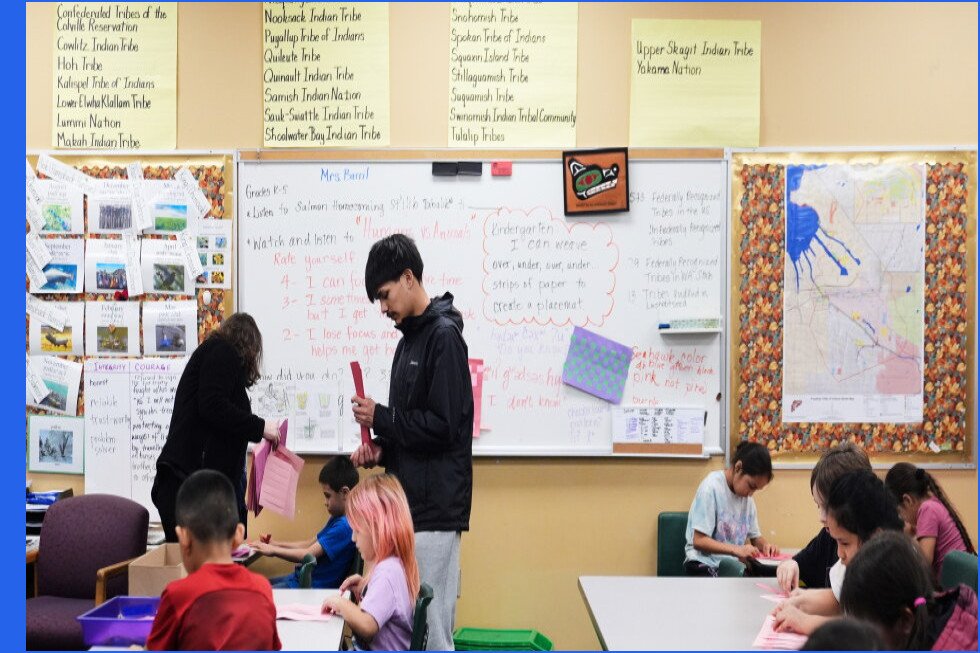
One example of this success is Chief Leschi Schools in Puyallup, Washington, where 18-year-old Gerald Dillon found renewed purpose in his senior year. Dillon, who once found classes boring, traded much of his academic coursework for career training, serving as a teaching assistant in a second-grade classroom. He graduated in June and is now considering a college degree in teaching.
“It motivates me. I like making connections with the kids, I like helping them,” Dillon said, adding that hands-on job training better matched his learning style. “It was kind of the first time I felt excited to go to school,” he reflected on helping students with reading and learning the life cycle of a frog.
Administrators at Chief Leschi Schools credit a shift in focus to technical training and career readiness for their improved outcomes. Superintendent Don Brummett acknowledged a past “disconnect” between the school’s emphasis on college preparedness and many students’ goals of finding a job after graduation. “We devalued the trades. That was a mistake,” Brummett stated. The school launched its career and technical curriculum in 2020 with funding from the Puyallup Tribal Council, leading to students entering fields like health sciences, education, and fisheries management. Between 2019 and 2025, Chief Leschi Schools saw its four-year graduation rates climb from 53% to 87%.
Agency officials confirm that a more accurate reporting system, rather than solely a sudden leap in academic improvement, partly accounts for the surge in graduation rates. For years, school administrators often miscounted students who transferred to other schools as dropouts. “We had to come to a consensus and set an accountability framework for our schools,” said Carmelia Becenti, the BIE’s chief academic officer. Starting in 2018, the BIE began standardizing data collection methods, which Becenti says has since painted a more accurate and encouraging picture. An analysis of BIE data found that graduation rates across the system are up 55% since new reporting standards were implemented, with nine secondary schools reporting 100% growth or higher.
Beyond career training, tribal-controlled BIE schools have innovated in other ways. At Choctaw Central High School, a BIE school operated by the Mississippi Band of Choctaw, a COVID-era experiment with virtual learning contributed to a rise in graduation rates from roughly 70% to 93%. Principal Alaric Keams noted that virtual learning offered a flexible schedule for students with home responsibilities or jobs, allowing them to earn diplomas. The district maintained this virtual option for high schoolers even after pandemic lockdowns lifted.
However, concerns persist that changes under the Trump administration could undermine this progress. These include the planned dismantling of the U.S. Department of Education (DOGE) and ongoing fallout from DOGE cuts that removed longtime staffers, alongside repeated threats of deep funding reductions. Less than one-third of BIE schools are operated directly by the agency; the majority are run by tribes and receive federal funding.
Not all tribal governments possess the resources to fund such programs or manage BIE schools. Peter Lengkeek, chairman of the Crow Creek Sioux Tribe in South Dakota, highlighted the challenges faced by the BIE-operated high school in his community, which is chronically understaffed and burdened by deferred maintenance, including a gymnasium with sinking walls and a rodent infestation. This school has reported graduating fewer than 60% of students on time in recent years.
“If we were able to, we would step in and try to remedy a lot of these things,” Lengkeek said. “We have to rely on the government to fulfill its treaty promise.”
Further compounding these anxieties, the Department of Education began handing off oversight of dozens of programs serving Native students to the BIE in November 2025. During a tribal consultation session in Washington, D.C., in February, dozens of tribal leaders voiced opposition, fearing the transition would overwhelm an already understaffed BIE with additional responsibilities. Several leaders accused the department of ignoring its legal responsibility to seek their input before proceeding. “We are here too late,” said Herschel Gorham, lieutenant governor of the Cheyenne and Arapaho Tribes. “The ink was dry on the agreements before the tribes were ever notified. That should never, ever happen.”
Jason Dropik, executive director of the National Indian Education Association, warned that turmoil within the agency’s Washington office affects schools on the ground. He pointed to a Trump administration executive order that aimed to convert the BIE into a school choice system, which was scaled back after tribal outcry. “That caused some delays and disruptions to services,” Dropik explained. “When drastic changes go into motion without tribal consultation, there can be unintended consequences for our students.”
Lengkeek expressed concern that the BIE could become consumed by political upheaval, leaving schools like the one serving his community to continue underperforming. “This system holds the future of our nations in its hands,” Lengkeek asserted. “We need stability. We need increased funding. We need infrastructure.”