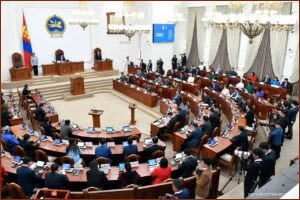
Mongolia’s parliament, the State Great Khural, commenced its autumn session on September 15 under intense political pressure. The young administration of Prime Minister Uchral Nyam-Osor, which took office on March 31 of this year, has introduced a highly ambitious legislative and economic agenda. However, these big-ticket initiatives face a deeply divided legislature still grappling with the political instability that followed the ousting of Oyun-Erdene Luvsannamsrai’s administration in June 2025.
At the center of the legislative debate is one of the largest state budget proposals in Mongolia’s history. The government has requested 41.3 trillion tugrik for the 2027 fiscal year, projecting a deficit of 2.3 trillion tugrik. With domestic inflation currently standing at 12.5 percent, economists and political skeptics have expressed concern that the massive deficit will drive up national debt and ultimately force the state to raise taxes on businesses and citizens. The budget proposal has already encountered significant pushback within parliamentary committees, and the government suffered an early setback last week when parliament failed to reach a required quorum.
To address the projected 2.3 trillion tugrik deficit, the Uchral government has proposed leveraging increased dividends from the Oyu Tolgoi copper and gold mine. On September 11, Mongolia and Rio Tinto agreed to amend their 17-year-old Shareholder’s Agreement. Under the new terms, Mongolia is set to receive 13 trillion tugrik, or approximately $3.6 billion, while Rio Tinto has agreed to reduce operational costs by roughly 30 trillion tugrik, equivalent to $8.4 billion.
Another major battleground in parliament is the future of Mongolia’s Sovereign Wealth Fund. The fund was established under laws passed by the Oyun-Erdene administration in 2024. In February 2026, shortly before being forced from power, the government of Zandanshatar Gombojav signed a preliminary agreement to direct 60 percent of the benefits from Mongolia's strategic natural resource deposits into the fund, establishing a profit-sharing mechanism to support the public welfare. However, critics argue that the current administration is pivoting the fund away from direct public assistance toward a corporate governance model.
This shift aligns with a broader reform effort targeting Mongolia’s state-owned enterprises. On September 10, the Mongolian government signed a Memorandum of Understanding (MoU) with U.S.-based BlackRock Financial Markets Advisory to explore selling shares of state-owned companies in domestic and international capital markets. Critics have questioned whether BlackRock’s corporate restructuring model is compatible with Mongolia’s semi-welfare system, which relies on state funds to support the elderly, disabled, children, the impoverished, and public healthcare and education. The stakes are high, following a wave of protests and strikes in 2025 by educators and medical workers demanding higher wages.
Energy security also remains a critical concern. Global energy markets have been severely disrupted by the Iran-U.S. conflict and repeated Ukrainian strikes on Russian energy infrastructure. Mongolia is highly vulnerable, importing over 95 percent of its refined petroleum products from Russia. Severe domestic fuel shortages during the summer and autumn of 2026 forced Mongolian officials to seek alternative supplies from China. In September, representatives from the Ministry of Industry and Mineral Resources met with the China National Petroleum Corporation (CNPC) to negotiate the import of 10,000 tonnes of refined petroleum, 4,000 tonnes of jet fuel, and 3,000 tonnes of diesel.
Concurrently, China is financing the construction of the Erdeneburen Hydropower Plant in Khovd province through a soft loan of approximately $288 million. The construction contract was awarded to Engineering, Procurement, and Construction (EPC) and PowerChina in 2023. In mid-September, Mongolian President Khurelsukh Ukhnaa inspected the project, which is now reported to be 40 percent complete. Once operational, the plant is designed to provide reliable electricity to five provinces: Khovd, Bayan-Ulgii, Uvs, Zavkhan, and Govi Altai. While complete energy independence remains a distant goal, diversifying partners is increasingly viewed as a national priority.
The government has also looked to modern technology to drive development. In August, Deputy Prime Minister Dorjkhand Togmid announced plans to build data centers powered by renewable energy, modeling the initiative after similar projects in China's Inner Mongolia region. However, this proposal has drawn skepticism due to its environmental impact. Data centers require massive amounts of water, with typical facilities using 300,000 gallons daily and larger operations consuming up to 5 million gallons per day. A 2025 study by the OECD highlighted Mongolia's severe water scarcity and geographic disparities, raising serious questions about the feasibility of maintaining such infrastructure.
As the State Great Khural begins its autumn session, internal divisions within the ruling Mongolian People’s Party (MPP) threaten to stall progress. Despite holding a majority with 68 seats, the MPP is effectively fractured into rival factions of 30 and 38 legislators. Observers warn that unless the government directly addresses systemic issues like corruption, air pollution, water scarcity, and energy security, public trust in leadership will remain fragile.