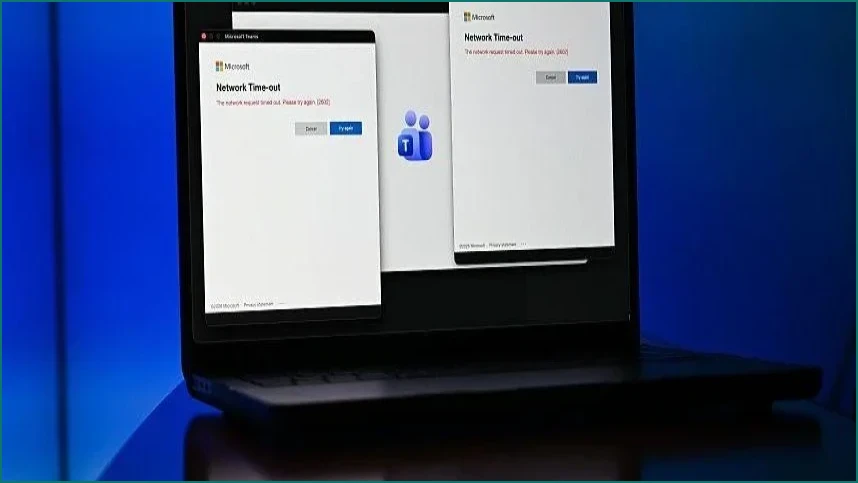
Microsoft has officially declared it is "deeply sorry" for a widespread service outage that crippled its products, including Outlook and Teams, and caused significant disruption across the globe. By Friday afternoon, nearly 24 hours after the initial issues emerged, services were broadly recovering. Although the company reported "encouraging progress," it maintained that it does not yet know when its services will be fully restored.
The outage spanned more than 70 countries, impacting a diverse range of sectors from government services and business operations to personal users. With more than 430 million people relying on the affected products worldwide, the event served as what experts labeled a "stark reminder" of the heavy reliance that businesses and vital services place on a small group of major technology providers.
Users first reported difficulties accessing Microsoft 365 products on Thursday.
By Friday, the far-reaching technical failure had impacted institutions including the Japanese government, the Philippines Supreme Court, and the Australian spy agency. In North America, the disruption affected hospitals, courts, and transportation networks.
In the United Kingdom, UK cyber minister Liz Lloyd stated that the incident had a "limited" impact on critical frontline services such as 999 calls, and noted that the transport network remained unaffected.
However, in Canada, the national rail network reported that passengers might be unable to receive email updates regarding their trips, and hospitals across the country also faced email-related issues.
In the United States, staff members from the House of Representatives told Politico that the outage had set back an entire day of legislative work because operations were heavily reliant on Outlook. Similar disruptions were reported in Singapore and India, while in Turkey, officials and advisers attending the COP31 climate summit in Antalya were left unable to access their email accounts.
The outage also brought smaller businesses and individuals to a standstill. Peter Pentz, a winemaker in South Africa, stated that his entire business was brought to a "standstill," with critical production work and communication with exports halted.
In England, Georgia from Staffordshire reported that her first house purchase, which she had been waiting eight months to complete, was delayed because her solicitor could not contact other agencies.
She noted that because hundreds of house completions were scheduled for the same day, it was unfeasible for solicitors to contact everyone in time.
Microsoft first acknowledged that users in the Americas were unable to access Exchange Online mailboxes at 17:54 GMT on Thursday, and shortly thereafter warned that the disruption was likely affecting Microsoft 365 globally. While engineers launched an investigation and began working to restore services, Microsoft reported only a "partial recovery" in some parts of the world by 04:36 on Friday.
By 13:32, the company reported "broader improvements" in North America, "sustained improvements" across much of Europe, and "encouraging recovery signals" in the Asia Pacific region.
A Microsoft spokesperson stated, "We are deeply sorry for the disruption this incident has caused our customers and partners," adding that the company takes the trust placed in its services "extremely seriously." Microsoft noted that it restored services gradually to ensure stability and confirmed that a full post-incident report will be released once a review is completed.
Industry experts noted that while some workers might have welcomed a day without email, the incident highlighted the dangerous dependence many organizations have on cloud-based services. Rob Demain, chief executive of cybersecurity firm e2e-assure, reiterated that the outage was a "stark reminder" of the reliance on a handful of big tech providers.
Matt Saunders, field chief technology officer at tech consultancy Adaptavist, noted that while classic IT disaster planning suggests using a second service for resilience, it is "almost impossible" for a business to function without tools like Microsoft.
He concluded that organizations must now have a plan in place for how to operate without such tools when incidents occur.
In the UK, some parts of the NHS, including GPs and hospitals, were affected, as were some schools and police forces.
"We're not the only one completing today, there are hundreds of houses and for them to ring everyone in time is unfeasible," Georgia said.