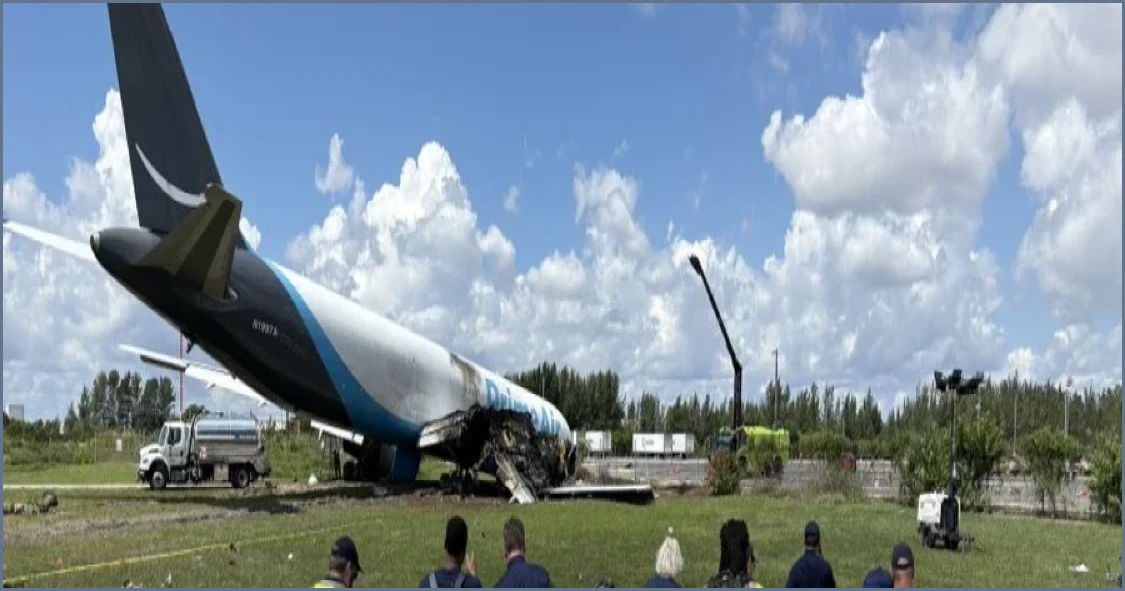
The National Transportation Safety Board (NTSB) announced on Monday that all five people killed when an Amazon cargo plane overshot a runway at Miami International Airport were occupants of two ground vehicles struck by the aircraft. The crash, which occurred on Sunday, also left at least five others injured when the Boeing 767-33 Alpha overran the runway, plowed through airport fencing, and burst into flames.
NTSB Chair Jennifer Homendy, speaking during a Monday afternoon press conference, confirmed that investigators have successfully recovered both the flight data recorder and the cockpit voice recorder. Both devices are being transported to the agency's headquarters for download and analysis.
The flight, operating as Amazon Air Flight 7598, was operated by 21 Air LLC on behalf of Amazon. The aircraft, manufactured in 1994, was completing its third leg of the day. It had previously flown from Cincinnati to Miami, then from Miami to San Juan, Puerto Rico, before attempting to land back in Miami. Upon landing, the plane overran runway 30, destroyed navigational aids, and collided with a 2012 white Ford Econoline van. The van, owned by Professional Ocean Service Corporation—a contract airline cleaning company—had seven people inside at the time of the collision.
After striking the van inside the airport perimeter, the cargo plane crashed through a perimeter fence and hit a Toyota Corolla Cross LE driving on Northwest 67 Avenue outside the airport. The aircraft continued its path into a grassy area, striking another fence line where Tesla robotaxis were stationed. In total, the plane traveled approximately 1,300 feet past the end of the paved runway before coming to a stop.
Homendy described the crash site as a scene of "utter devastation," noting that the Econoline van was completely torn apart, with vehicle components, aircraft debris, and fencing scattered across the area. Cellphone video captured by bystanders showed emergency responders rescuing a survivor from the crushed Toyota.
Of the five injured survivors, the Miami-Dade Sheriff's Office reported that two were taken to Jackson Memorial Hospital, where their conditions remain unknown. Three other victims were transported in critical condition to Jackson's Ryder Trauma Center.
Witnesses described the terrifying aftermath of the crash. Grace Mercado, who was driving near the airport, recalled seeing massive plumes of black smoke billowing into the air, describing the scene as "absolutely insane" and resembling a movie. Another witness, Abraham Altamar, who works near the crash site, reported seeing a man he believed to be the pilot shortly after the incident. Altamar described the pilot as visibly shaken but with only minor injuries to his forehead and hand. According to Altamar, the pilot was able to use a phone to call his wife, telling her, "I'm fine. I was in the accident, but I'm already out of the plane."
Local leaders praised the rapid response of emergency services. Miami-Dade County Commissioner Natalie Milan Orbis, representing District 6, highlighted that Miami-Dade Fire Rescue reached the scene in a record time of 30 seconds, while also praising the sheriff's office for its investigative efforts. Professional Ocean Service Corporation, when contacted, declined to comment on the crash.
The NTSB has deployed 32 investigators to the scene. Homendy stated that recovery operations are still active, and crews are working to safely drain fuel from the aircraft, which has temporarily restricted investigators from fully accessing the wreckage. The agency has not yet conducted formal interviews, but its transportation disaster assistance team is currently coordinating those schedules.
Beginning Tuesday, the NTSB's team will divide into specialized groups to analyze various aspects of the crash, including human performance, airplane systems, power plants, air traffic control, aircraft performance, structures, meteorology, and airport survival factors.
A key focus of the investigation will be whether an Engineered Materials Arresting System (EMAS) should have been installed at the end of runway 30. EMAS uses lightweight, crushable materials designed to safely stop aircraft that overrun runways. Homendy pointed out that EMAS is not a requirement at all airports. Investigators will also scrutinize the contractual agreements and safety provisions between Amazon and 21 Air LLC, as well as the age and maintenance history of the 1994 Boeing aircraft.
You can see airbags, the surrounding airbags.
You can see components from vehicles, both passenger vehicles and the aircraft itself.