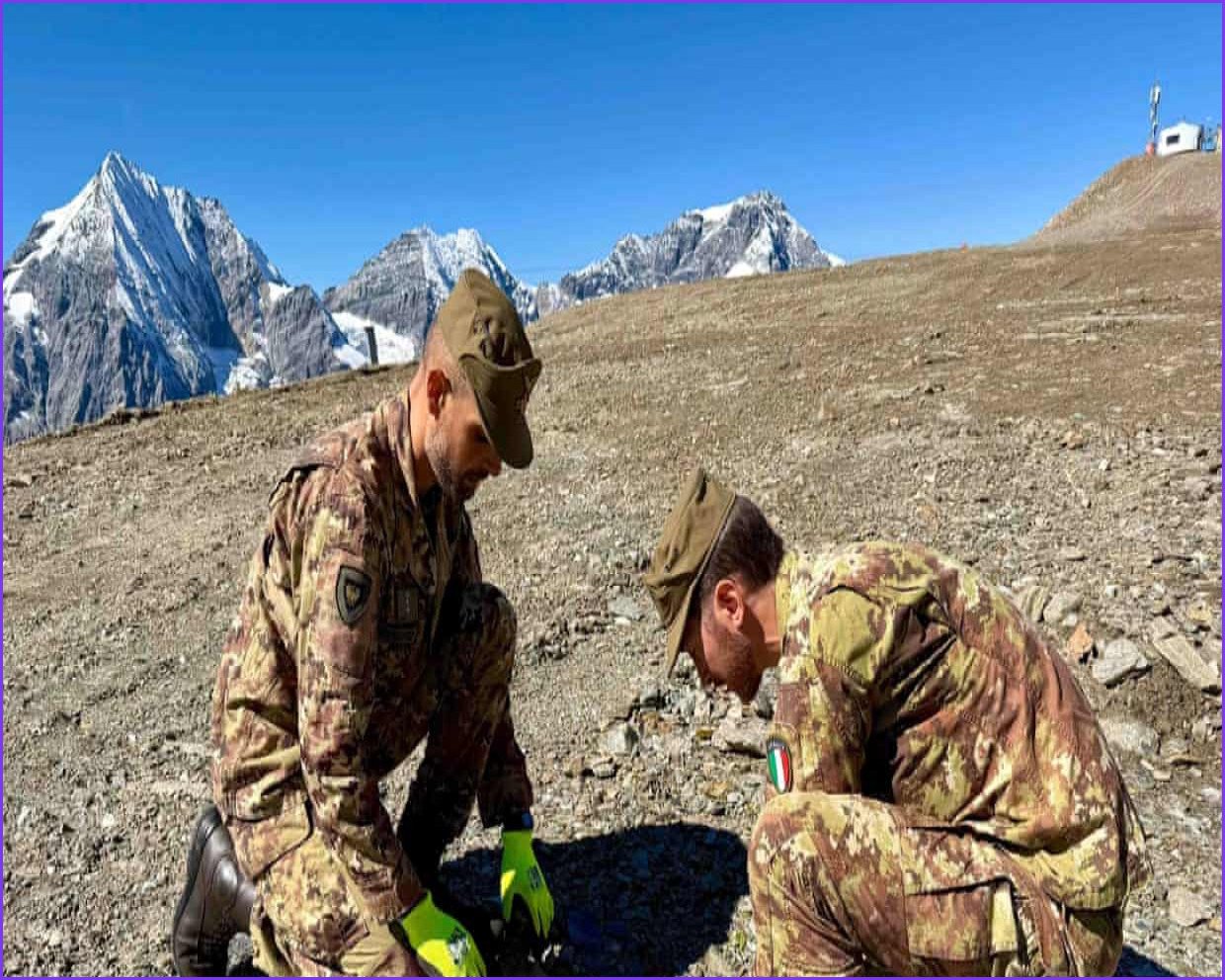
Italian military specialists have cleared and defused 250 unexploded First World War munitions that emerged from rapidly melting glaciers in the Dolomites this summer, army officials reported. Members of the Italian army's Julia Alpine brigade conducted extensive sweeps across high-altitude glacier zones throughout the Trentino-Alto Adige region after hikers reported several exposed explosive devices.
The military operation recovered a wide variety of armaments left behind from the white war, a brutal high-altitude conflict fought between Italian troops and the Austro-Hungarian army across treacherous, frozen Alpine terrain between 1915 and 1918. Among the neutralised devices were 18 Italian 75mm artillery shells and 37 French-made Thevetot mortar shells, a model supplied to the Italian royal army during the conflict.
Most initial sightings were concentrated around Canal San Bovo in eastern Trentino's Primiero Valley before soldiers expanded their search across elevated glacial locations in the region.
Experts attribute the growing frequency of such dangerous discoveries directly to accelerating global warming. Stefano Morosini, a professor at the University of Bergamo and heritage project coordinator for Stelvio National Park—where some munitions were found—noted that rising temperatures at high altitudes are exposing long-frozen armaments every year.
"It is very much a consequence of global heating," Morosini explained, emphasizing that while some devices had previously detonated, many remained active.
He warned that after being preserved in ice for over a century, the re-emerging explosives present serious hazards. Authorities strongly advise hikers and mountaineers never to touch any suspected military ordinance regardless of location and to report discoveries immediately to local police.
The white war is estimated to have claimed more than a million lives, though the majority of military casualties resulted from extreme weather, hypothermia, mountain falls, and deadly avalanches rather than direct combat. Until the 1990s, the battleground remained largely preserved in ice.
However, sustained glacier retreat over recent decades has steadily unveiled an array of historical items, including weapons, sledges, personal letters, and diaries.
Over the past 15 years, dozens of fallen soldiers' bodies—some still wearing their military uniforms—have emerged from the ice. In one case in 2017, the family of an Italian soldier was finally able to conduct a formal burial after identifying documents were recovered alongside his body on the Presena glacier.
Physical structures from the war have also re-emerged as ice sheets disappear. In 2015, a wooden military barracks embedded in a cave atop Mount Scorluzzo—a peak reaching 3,095 metres (10,154 feet) above the Stelvio Pass—reappeared after its ice seal melted completely.
Soldiers had hastily locked up the shelter when fighting ended in November 1918, leaving behind straw beds, clothing, lanterns, newspapers, postcards, coins, and tinned food.
To showcase these historical artifacts, a dedicated white war museum is scheduled to open in Bormio in June 2027.
Beyond uncovering historical artifacts, intense summer heatwaves are making access to Alpine glaciers increasingly dangerous for visitors. In 2022, 11 people lost their lives when a massive chunk of the Marmolada glacier collapsed. Morosini cautioned that high-altitude heatwaves are making glacier access increasingly impossible during summer months, pointing to the rapid retreat of ice as visible proof of climate change's severe impact.