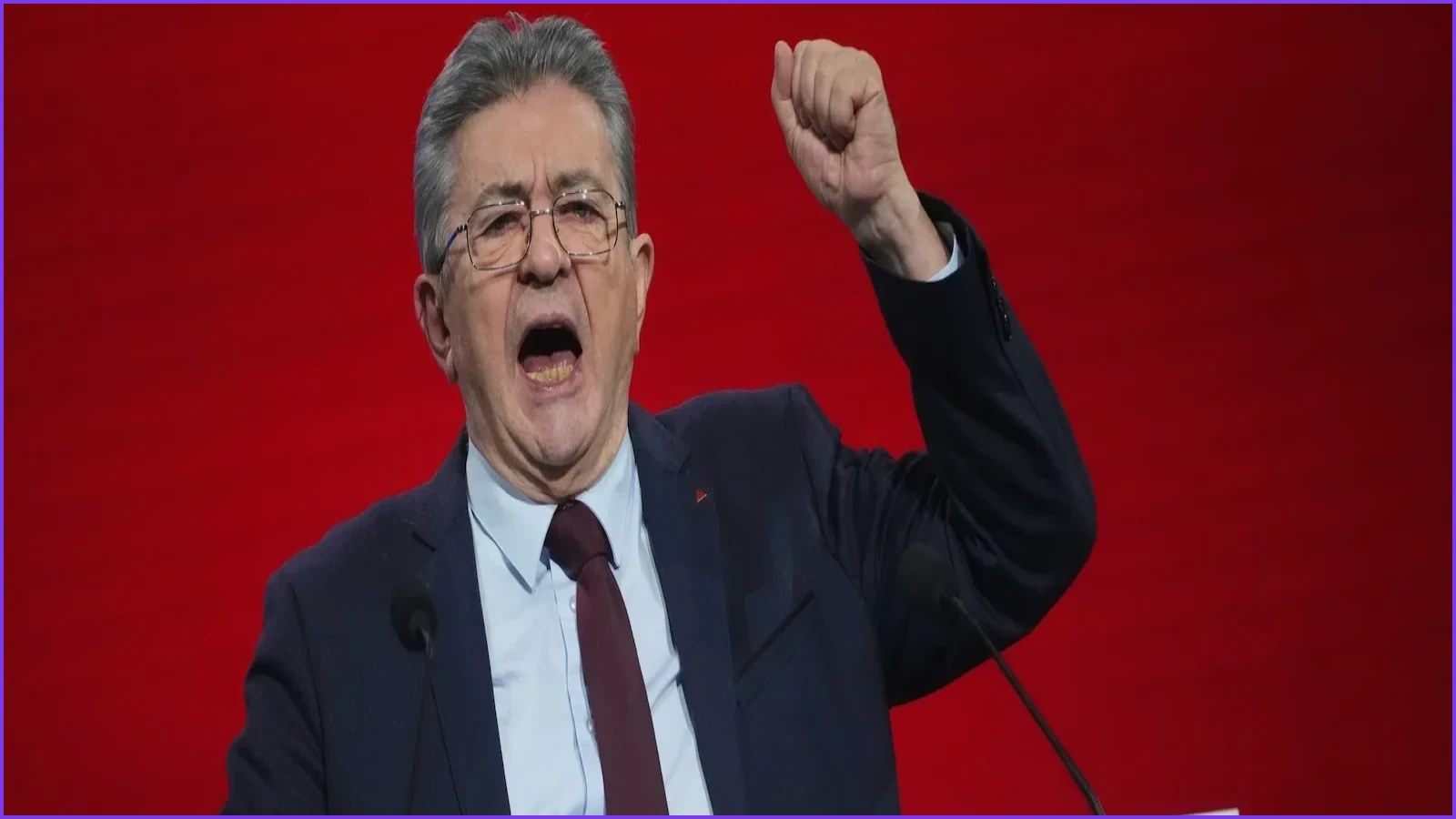
Veteran leftist Jean-Luc Mélenchon, 75, is making his fourth attempt at the French presidency, banking on a younger generation to carry him to power. At a recent rally in Le Bourget, north of Paris, 20,000 supporters, many young and wearing his name on their backs with the number 27, gathered to hear him speak.
“I have only one sensible thing to propose,” Mélenchon told the crowd on Saturday. “Everything must change.”
This presidential bid could be his final opportunity, following three previous attempts that fell short of the runoff. In 2022, he missed the second round by a narrow margin of just 421,308 votes. Now, with a surge in support, Mélenchon is eyeing a potential runoff against far-right front-runner Marine Le Pen.
The bespectacled and booming politician seeks not only the presidency but also a fundamental rewrite of the French republic's rules, invoking the unfulfilled promise of the 1789 Revolution. A victory could have significant international repercussions, including pulling France, the EU’s only nuclear-armed power, out of NATO’s military command. His proposed debt plans could also lead to a confrontation with Europe’s central bank, potentially unsettling markets.
Mélenchon’s detractors view his proposals as a significant risk, accusing him of inciting unrest and antisemitism, disrespecting police and the press, and being lenient towards Moscow—charges he consistently denies.
Born in Tangier, Morocco, in 1951, Mélenchon’s political journey began as a Trotskyist student. He spent three decades as a Socialist, rising to senator and junior minister, before leaving in 2008 to establish his own movement.
His rallies, known as the “Mélenshow,” are elaborate affairs. Saturday’s event featured cameras sweeping over the crowd on cables and a film depicting a woman’s life struggles, with his lieutenants presenting solutions. Mélenchon described it as a campaign rally staged as a government in waiting. “Enjoy it,” he told French media, “It’s not often in a lifetime that you see something like this.”
He recalled a 1972 rally where Socialist François Mitterrand and Communist Georges Marchais shared the stage, boasting, “I’m doing this all by myself!” He also took a jab at former Socialist President François Hollande, who rallied in the same hall on his path to power, stating, “They only filled a third of the room.” Some observers have noted a “Trumpian ring” to his boasts, with one far-right mayor labeling him “the Donald Trump of the left.” In 2018, during a police search of his party’s offices, he famously declared, “I am the Republic!” He was later convicted for the confrontation. An investigative book from 2025 described him as a leader demanding absolute loyalty and viewing skeptics as traitors.
Mélenchon’s strategy for this election cycle hinges on the support of young people and residents of the suburbs. Le Bourget is located in Seine-Saint-Denis, mainland France’s poorest department. While the far right often associates this area with crime and failed immigration, Mélenchon, a white veteran of the old Left, sees it as representing the future: a younger, more diverse “New France” whose votes could propel him to power.
During the rally, a moment of silence was observed for Pengo Bossio Wangi, a 26-year-old Frenchman of African descent who was shot dead last month in what the government described as a racist terror attack.
Since September, a high school protest movement has swept across France, driven by concerns over crumbling schools and teacher shortages, leading to thousands of arrests. Mélenchon has championed this movement from its inception. “Don’t touch our young people,” he warned the government. Jamal Santos, a 22-year-old student who participated in the protests, affirmed, “We are the future, and he listens to us.”
Last month, cost-of-living protests escalated into looting and arson in over 20 cities, including the torching of the 19th-century City Hall in Limoges. Marine Le Pen accused Mélenchon’s party of causing chaos, but he attributed the unrest to police tactics and denied his party organized the protests.
France’s traditional political landscape is fracturing. The Socialists and conservative Republicans, who historically alternated power, collectively secured only 6.5% of the first-round presidential vote in 2022. A potential Le Pen-Mélenchon runoff would see two movements that have never governed France vying for the presidency, leaving the old parties on the sidelines.
Mélenchon is working to consolidate this energy before mainstream rivals can regroup. Center-right former Prime Minister Édouard Philippe is also positioning himself to face Le Pen. If the political center unites or voters rally to prevent a runoff between the two extremes, Mélenchon’s chances of securing second place could diminish.
His program, comprising over 1,000 points, outlines a vision for a transformed France. Key proposals include lowering the voting age to 16, reinstating retirement at 60, increasing taxes on the wealthy, and imposing a moratorium on artificial intelligence. Central to his platform is the creation of a new constitution to replace the Fifth Republic, established by Charles de Gaulle in 1958. He proposes a special assembly of citizens, excluding current lawmakers, to draft this new constitution for voter approval. Furthermore, ordinary French citizens could gather signatures between elections to force votes to overturn laws, amend the constitution, or even remove a sitting president. “We are no longer in 1958,” noted Hicham En-Naji, 27.
Few French politicians evoke such strong devotion or fury. Mélenchon has made Gaza a rallying cry for young people, stating on Saturday that “genocide must be called genocide.” Activists, who accuse him of fanning antisemitism—a charge he denies—disrupted the rally with whistles. “Some commentators are advising me to tone things down,” he said. “I won’t do that.”
He concluded his speech by transforming President Emmanuel Macron’s well-known 2017 gaffe about “people who are nothing” into a powerful line from the “Internationale,” the historic anthem of communists and socialists: “Macron told you that you are nothing. So let us be everything!” The hall responded by singing “La Marseillaise.”
Whether teenagers in No. 27 jerseys remember him as the leader who finally brought his revolution to the Elysee Palace or as the one who inadvertently paved the way for the far right may ultimately depend on the one thing he refuses to do: soften his stance.