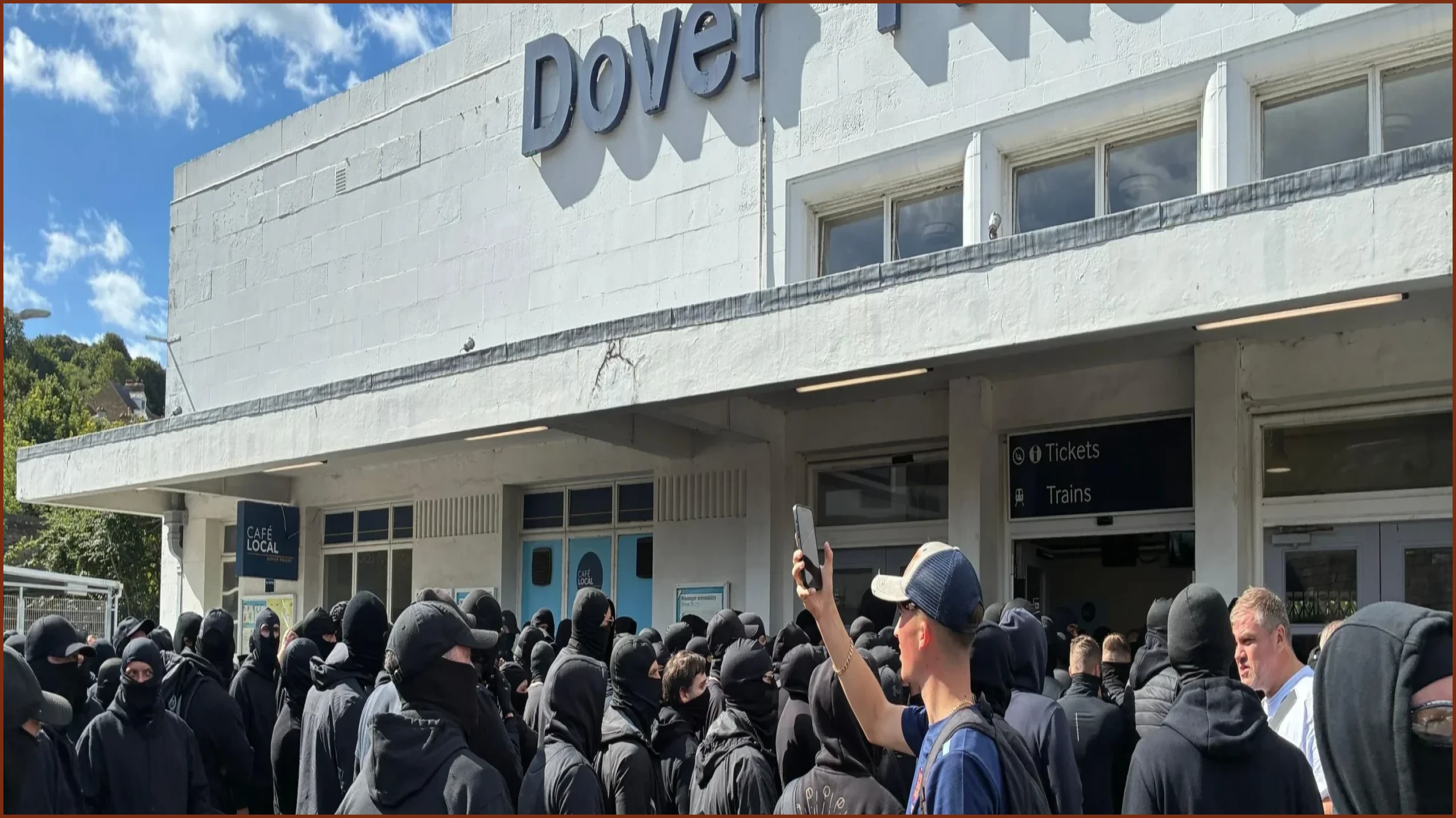
A spontaneous and unannounced demonstration by hundreds of masked men dressed in black caused major travel chaos at the Port of Dover on Saturday morning, blocking key transport routes and drawing sharp condemnation from government officials and local political figures.
The protest began around 07:00 BST, with demonstrators chanting "stop the boats" and obstructing traffic entering and exiting the UK's busiest international ferry and passenger port. The blockade lasted for several hours, leaving routes in and out of the town temporarily impassable. According to the Port of Dover's website, the hub is a critical transit point, having handled more than nine million road passengers and two million freight vehicles in 2025.
Travelers caught in the gridlock described scenes of confusion. Remco van Schellen, a passenger who arrived by ferry from the Netherlands at approximately 08:00, recounted his experience trying to exit the terminal. "When we wanted to leave the ferry terminal with the car, we couldn't go any further," he said, noting that masked individuals in black clothing were blocking the roads and a nearby roundabout. "There were people in black clothing, their faces masked, so we couldn't see who they were."
Rafael Pittman, a tour guide from London who was waiting to pick up a group of tourists, characterized the situation as "absolute chaos" during his three-hour wait. He noted that passengers were unable to disembark and vehicles could not enter the terminal because freight trucks blocked the entrance. According to Pittman, the hooded protesters arrived en masse, passed the trucks, and headed towards the cruise terminal under police escort. While he described their appearance as "quite frightening," he added that they were "friendly-ish" when explaining they were protesting illegal migration.
The demonstration also disrupted local residents and visitors. Lania Tkaczyk, who traveled from Cheshire, spotted the black-clad men outside her hotel, which delayed her departure to nearby Folkestone where her two children were participating in a Channel swimming relay. "It was quite intimidating seeing the men head-to-toe in black," she said. "Because of the protest I've been delayed but I hope to get to Folkstone to see my children soon." Meanwhile, some local residents were seen leaning out of their flat windows, waving to the masked demonstrators as they were marched through the streets.
While anti-immigration protests are a frequent occurrence in Dover—where migrants rescued from small boats crossing the English Channel are routinely brought ashore—they are typically announced in advance. Saturday’s demonstration was notable for both its scale and its sudden, unadvertised nature. Sir Roger Gale, the MP for Herne Bay and Sandwich, revealed that the protesters had orchestrated the event overnight, driving into his constituency and parking on a village green before descending on Dover. He described the gathering as a "clearly orchestrated demonstration." While acknowledging that the issue of migration "does need to be addressed," Gale emphasized that it should not be done by young men in balaclavas "seeking to terrorise the local population of east Kent."
Chris Vinson, the leader of the Conservative group on the Dover District Council, added that several hundred masked men had packed into rental vans before targeting the access roads. He reported that night-shift workers at the port were prevented from leaving due to concerns over their safety.
Kent Police made no arrests during the incident, characterizing the demonstration as a "spontaneous" protest. Officers eventually escorted the crowd from the port area toward the Dover Priory railway station at around 11:30 BST, reporting that all participants had dispersed by 12:00. However, the lack of prior warning sparked criticism of the police response. Mike Tapp, the local MP, questioned why authorities seemed unaware of the impending demonstration. "I will be looking urgently on Monday to ask questions around why we didn't know about this," Tapp stated, adding that police resources appeared "pretty thin on the ground, to be quite honest from what I saw." He also challenged the protesters' awareness, writing, "I bet if you asked any one of those 'protesters' they wouldn't know small boat crossing are down by 40% and we are working hard to fix the mess. I am fed up with idiots coming to Dover."
Kevin Mills, the Labour leader of Dover District Council, also pointed to "pretty low" initial policing levels as a factor that heightened the disruption, though he noted the police presence improved as the day progressed.
The anti-hate organization Hope Not Hate claimed that the demonstration was organized by the Patriot Platform network, a group that reportedly began meeting in July to bring together anti-migrant factions from across the country. Although the demonstrators largely refused to speak to reporters, one individual approached by the media shouted "send them back" while another repeated the "stop the boats" slogan. Far-right figures Tommy Robinson and Danny Thomas both took to social media to praise the action. Thomas claimed that local sentiment was supportive, writing, "The experience on the ground today, was the overwhelming majority of the women and local people we spoke to were thankful that people were actually doing something." Replying to Tapp's criticisms, Thomas added that the MP "might want to take a look at what your own constituents are saying. The comments from people in and around Dover speak for themselves."
The protest drew strong condemnation from national political figures. Paul King, the Reform UK councillor for Dover West, confirmed he had been told it was a "stop the boats" protest. However, Reform UK leader Nigel Farage expressed his disapproval of the protesters' tactics, stating that he "deplored" the use of masks and balaclavas at public demonstrations. "You should not be allowed to be masked-up, balaclavaed-up and go out and protest on the streets of our country," Farage said. "It is wrong at every level. So I deplore what is happening in Dover today."
The use of face coverings at protests has been a subject of recent legislative action. Under the Crime and Policing Act 2026, which saw its provisions on concealing identity come into force in June, it is an offence to mask one's face at a demonstration, but only if a police officer of the rank of inspector or higher has formally designated the area. Such a designation requires the officer to believe that offences are likely to be committed in that location.
By Saturday afternoon, operations at the port had returned to normal, and all blocked roads were reopened. Ferry operators P&O and DFDS both confirmed they would accommodate passengers who missed their scheduled departures on the next available sailings. The Port of Dover released a statement thanking its customers and the local community for their patience while police managed the public order incident.
The government also issued a statement condemning the disruption: "The right to peaceful protest is fundamental to our democracy, but we condemn the behaviour in Dover and the travel disruption it has caused. We appreciate the frustration of those who have been impacted today. Access to the port is now restored and traffic is flowing. Those travelling to the port are advised to allow for extra travel time and to follow guidance from providers. We thank policing partners and travel providers who we continue to work with to ensure the safety of passengers and the wider community."