The U.S. Marine Corps has confirmed that a pilot is expected to live after successfully ejecting from an F-35B stealth fighter before the aircraft crashed on Friday near the Marine Corps Air Station Miramar in San Diego, California. Following the ejection, the pilot was transported to a local medical facility in stable condition for evaluation and treatment of injuries described as non-life-threatening.
The incident, which the Marine Corps has officially designated as a "Class A mishap," occurred near the flight line. This classification is the military's most severe category, applied when an aircraft is destroyed, a service member is killed, or damages exceed $2 million. A single F-35B fighter jet has an approximate unit cost of $109 million.
Witness Wade Lott, 36, who was driving to his job at a concrete company located just south of the flight line, observed the crash as it unfolded. According to Lott, he watched as two jets descended toward the runway in tandem. While the first jet landed without issue, the second aircraft appeared to struggle, slowing down as if attempting to hover. Lott recounted that when the jet was roughly 100 feet (30 meters) above the ground, the pilot ejected. The parachute deployed as the pilot rose to about 200 feet (61 meters) in the air, just before the aircraft struck the ground near another plane, plowed into the runway, and exploded.
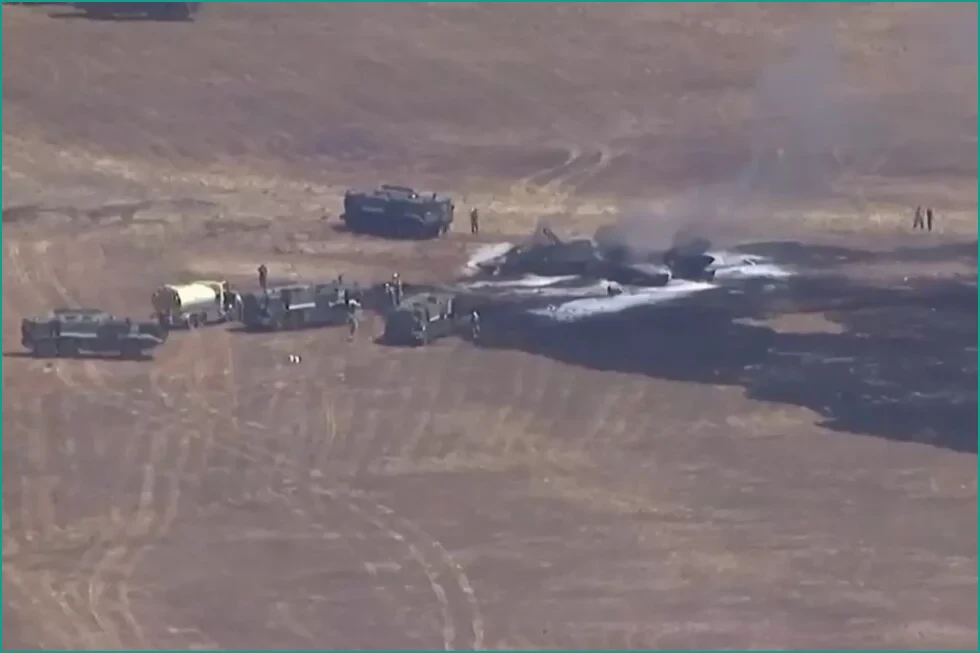
Aerial video footage captured by a news helicopter showed a plume of black smoke rising from the wreckage in a dirt field. The scene was crowded with military and firefighting vehicles, with personnel visible near the site. White flame retardant covered the ground, and at least one individual was seen spraying the wreckage with a fire hose. Candace Hadley, a spokesperson for San Diego Fire, confirmed that firefighters were on the scene to address a vegetation fire that had sparked near the crash site, though she directed further inquiries to the Marine Corps Air Station Miramar.
The Miramar base holds historical significance as the former home of the Navy fighter pilot training school famously depicted in the original "Top Gun" movie, where it was known as "Fightertown USA." The school was relocated to Naval Air Station Fallon in Nevada in 1996 after the base was transferred to the Marine Corps.
Data from the Government Accounting Office in a 2024 analysis indicates that the U.S. Marine Corps, Navy, and Air Force collectively operate more than 630 F-35 aircraft. The F-35B, which features an engine designed for short takeoffs and vertical landings, is one of several versions of the jet. The total F-35 program is projected to cost approximately $2 trillion as the military continues to acquire more than 1,800 additional jets for operation over the coming decades.
According to the Air Force Safety Center, there have been at least 17 other "Class A mishaps" involving F-35 aircraft since 2000. Furthermore, the Flight Safety Foundation’s Aviation Safety Network database reports that at least seven other military aircraft mishaps have occurred within the United States this year. Despite these incidents, the Lexington Institute, a think tank focused on defense technology, maintains that the F-35s are among the safest and most capable fighter jets in the military fleet. Fatalities involving the F-35 are rare, and the jet has experienced fewer crashes since its 2015 adoption compared to other fighters during their early service years. In five previous F-35 crashes, all pilots were able to eject, though at least one pilot was injured during a crash near the international airport in Albuquerque, New Mexico, in May 2024 while the jet was en route to an Air Force base in California.