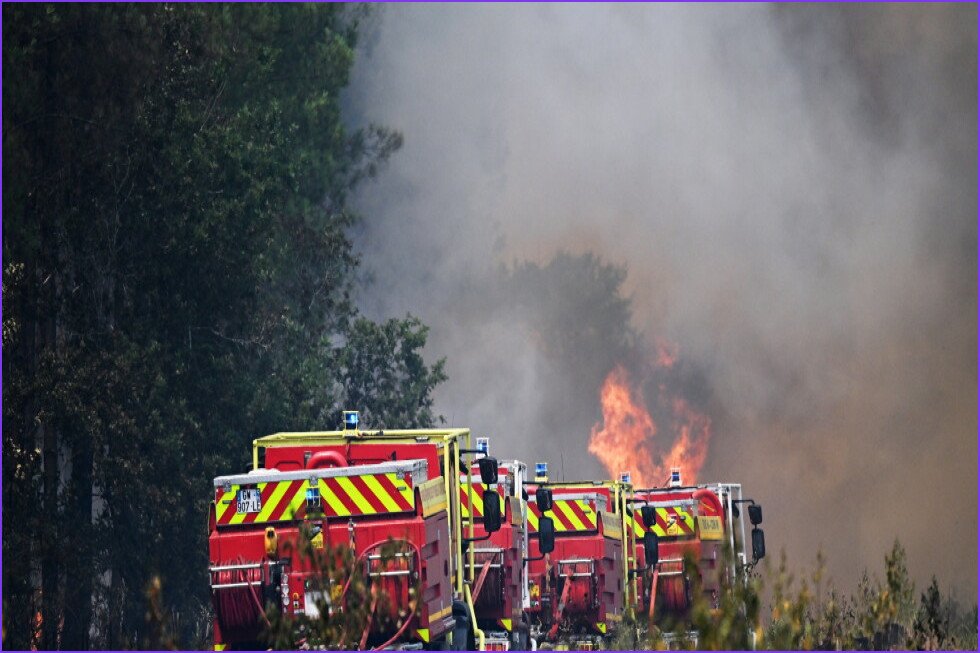
French President Emmanuel Macron traveled to the Gironde region on Monday to express solidarity with exhausted firefighting teams, urging them to stay strong as they battle a massive, unpredictable wildfire. While acknowledging that the effort will be lengthy, the president vowed that the nation would win the battle together. During his visit to a coordination center, Macron received briefings on how the inferno, which has been raging since last week, has occasionally transformed into a self-feeding firestorm. The blaze has already consumed an area four times the size of Paris, forcing 220,000 people to flee their homes in the region alone. Macron praised the teams for stopping the inferno’s progression on Monday, though he and other officials warned that the battle is far from over, as forests remain tinder-dry following successive heat waves this year.
The firefighting effort, which involves thousands of personnel on the ground and constant rotations of water- and retardant-dropping aircraft, is currently in a desperate race against time. Forecasters from the national weather service have warned of a temperature surge reaching 35 C (95 F) or higher in southwest France starting Tuesday, which threatens to make the flames significantly more difficult to contain. Crews have been utilizing heavy machinery to tear up strips of forest and scrubland, creating barren spaces intended to block the flames, which officials noted had come within 15 kilometers (10 miles) of the outskirts of Bordeaux. Local farmers have also played a vital role, keeping fire crews supplied with water by transporting it to the front lines in tanks.
The Gironde region’s fire chief briefed Macron on the unique challenges of this event, describing the blaze as extraordinarily virulent and capricious. The chief explained that it is a fire that seems to go everywhere, even generating its own electrical storms that spark additional flare-ups. Macron acknowledged the difficulty of the situation, telling firefighters that while the last 24 hours went well thanks to their work, the coming days would likely be more complicated. He also spoke of the displaced people, describing them as traumatized by the sudden upheaval and noting that many have lost everything.
The crisis extends well beyond France, with Spain also fighting unprecedented blazes. In Spain, wildfires have burned out of control around Madrid and in the Valencia region, forcing authorities to evacuate 79,000 people and confine another 30,000 to their homes. King Felipe VI and Queen Letizia visited an evacuation center on Sunday to meet with those displaced by the fires around Madrid. A fire raging in hilly, rural terrain in Ávila, west of Madrid, has become Spain’s largest on record, scorching 500 square kilometers (193 square miles)—an area five times the size of Barcelona. David Gonzalez, a 48-year-old gardener who used his van to run supplies to firefighters in Ávila, expressed the widespread sense of anger and helplessness, describing the scene as inhuman.
According to Spain’s ecology minister, Sara Aagesen, fires have burned 1,530 square kilometers (590 square miles) in Spain this year, which is six times the area scorched during the first half of 2025. With another heat wave forecast to bring temperatures above 40 C (104 F), the danger remains extreme. Spanish Prime Minister Pedro Sánchez linked these disasters to a broader climate emergency, stating that these are not isolated incidents but the consequence of a climate emergency making wildfires more violent and heat waves more frequent. Across both France and Spain, more than 330,000 people have been forced to flee their homes due to the fires.
International cooperation has been a key part of the response, with around a dozen countries providing planes, helicopters, and additional firefighters to assist both nations. Meanwhile, in Italy, a wildfire driven by strong winds broke out on Sunday afternoon near Peschici in the southern Puglia region. The blaze burned through pine forests and scrub, forcing the evacuation of about 300 tourists from beaches and campgrounds. The Italian Coast Guard evacuated these individuals by sea to nearby Vieste, where authorities established temporary shelters. Three Canadair water-bombing planes and ground crews continued to battle the Italian blaze on Monday, an event that has revived memories of devastating wildfires that struck the same coastal area in 2007.
Authorities also are working to feed, shelter and care for evacuees who fled in staggering numbers: 250,000 in the southwest, driven away by two fires.
“The last 24 hours went well, thanks to your work” Macron told firefighters. “Doubtless, tomorrow will be more complicated than today.”