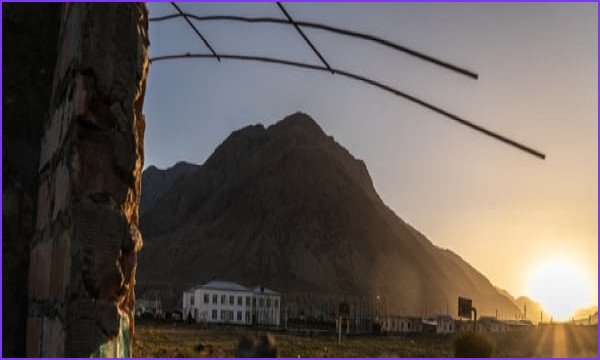
Engilchek, a former Soviet-era mining boomtown nestled in Kyrgyzstan's Tien Shan mountains, is far from being solely a collection of ruins. A small but vibrant community continues to call this remote settlement home, adapting and thriving amidst the abandoned structures left behind after the Soviet Union's collapse.
The town, which once housed 5,000 people, saw its population dwindle significantly after 1991. Residents faced an uncertain future, with abandoned buildings and shattered lives as the primary legacy. Today, approximately five dozen people actively reside in Engilchek, though official registrations list around 200. The village is situated in a rare broad valley within the rugged mountain region, surrounded by peaks exceeding 7,000 meters. The nearest major settlement is Karakol, about a four-hour drive away. You have reached the limit of 2 free articles this month.
Access to Engilchek is challenging. The only route is via Ashuu Pass, a mountain pass at 3,800 meters that is almost permanently snow-covered. The road from Karakol winds through lush valleys and pine forests before ascending to the pass. Beyond it, the gravel road traverses wide valleys, occasionally passing shepherds with their livestock. Travelers must obtain a special permit to enter the area due to its proximity to the Chinese border, with Kyrgyz and Chinese border posts present, though the mountains themselves serve as the de facto border. The pass is 1.5 hours away from Engilchek.
At the heart of Engilchek stand three imposing, abandoned Soviet-era apartment blocks. The living village has grown around these structures, with inhabited houses connected by footpaths, small yards, and a modest playground. Interspersed with these are derelict homes with collapsed roofs, buildings with shattered windows, and piles of rubble. Children often play with scraps of metal found among the ruins.
Ashuu, 65, who was named after the mountain pass that serves as the sole access route, remembers when Engilchek was a summer pasture for nomads. His parents lived in yurts, following traditional Kyrgyz practices. The discovery of tin, tungsten, molybdenum, and alluvial gold by Soviet geologists in the 1960s led to the town's development. Full-scale operations began in the early 1980s, with significant Soviet investment in infrastructure, including mines, processing facilities, an airstrip, apartment blocks, schools, and a hospital.
Following the Soviet collapse, desperation led many residents to strip buildings for valuable materials like metal and electrical wiring. Ashuu himself participated in this salvage effort. Others returned to traditional livelihoods, raising livestock for survival. Leaving Engilchek was difficult for many, especially those without the means to establish themselves elsewhere. The roads out often became impassable due to lack of maintenance, particularly in winter or due to rockfalls. Furthermore, economic hardship, lack of work, and food shortages were prevalent across the former Soviet Union, making relocation a daunting prospect.
While many older residents have left due to the harsh climate, younger families have recently moved to Engilchek. Nelli relocated from Karakol a decade ago with her husband, seeking opportunities to raise cattle. Noticing the occasional traveler, she opened a guesthouse, recognizing a potential for tourism. Her two youngest children live with her and her husband in Engilchek, while two older children attend school in Karakol, where around 30 children are educated.
Nelli finds appeal in the town's silence and spectacular mountain scenery, and she hopes tourism can sustain its future. Three additional guesthouses have opened, attracting international visitors and Kyrgyz tourists interested in hot springs, hiking, and glacier treks. However, Nelli expresses concern about potential government attention and the environmental impact of renewed mining activities.
The town's operational public institutions include a kindergarten, a school, and a small medical center. A small mosque and a community center, which also serves as a library, have been recently established or rebuilt. A new football pitch has been added beside the remnants of basketball courts.
Eliza, the librarian, remains optimistic about Engilchek's future, aiming to restore it to its former status as a bustling city with shops, restaurants, a cinema, and a hospital. She highlights the community's efforts to rebuild and the library's role, now stocked with books in Kyrgyz, Russian, and English, serving residents, herders, and border guards. The community also has a small gym and facilities for billiards and table tennis.
Eliza acknowledges the difficult post-Soviet years but expresses contentment with current life, stating she would not wish to return to the Soviet era due to its suppression of Kyrgyz culture and language. Despite the complex history, Central Asia and Russia maintain close ties, with Kyrgyzstan being a key partner. However, new powers are expanding their influence. A Soviet monument commemorates the soldiers fallen in the fight against the Basmachi, an uprising against Russian Imperial and Soviet rule in Central Asia, lasting from roughly 1916 to the early 1930s.
This shifting geopolitical landscape is evident in Engilchek. Approximately four years ago, a Chinese company took over the old mines and resumed tin and tungsten extraction. This development has raised concerns among some residents. Nelli worries about environmental consequences, while her husband questions the profit distribution, arguing that Kyrgyzstan should benefit most from its own resources.
As old powers recede and new ones emerge, the mountains of Engilchek continue to yield their resources, and life in the resilient community persists. The true number of residents is closer to 60.
Beyond Engilcheck there are no more villages, only the occasional shepherd.
A cow peeks through the window of an abandoned house in Engilcheck. Photo by Thijs Broekkamp.