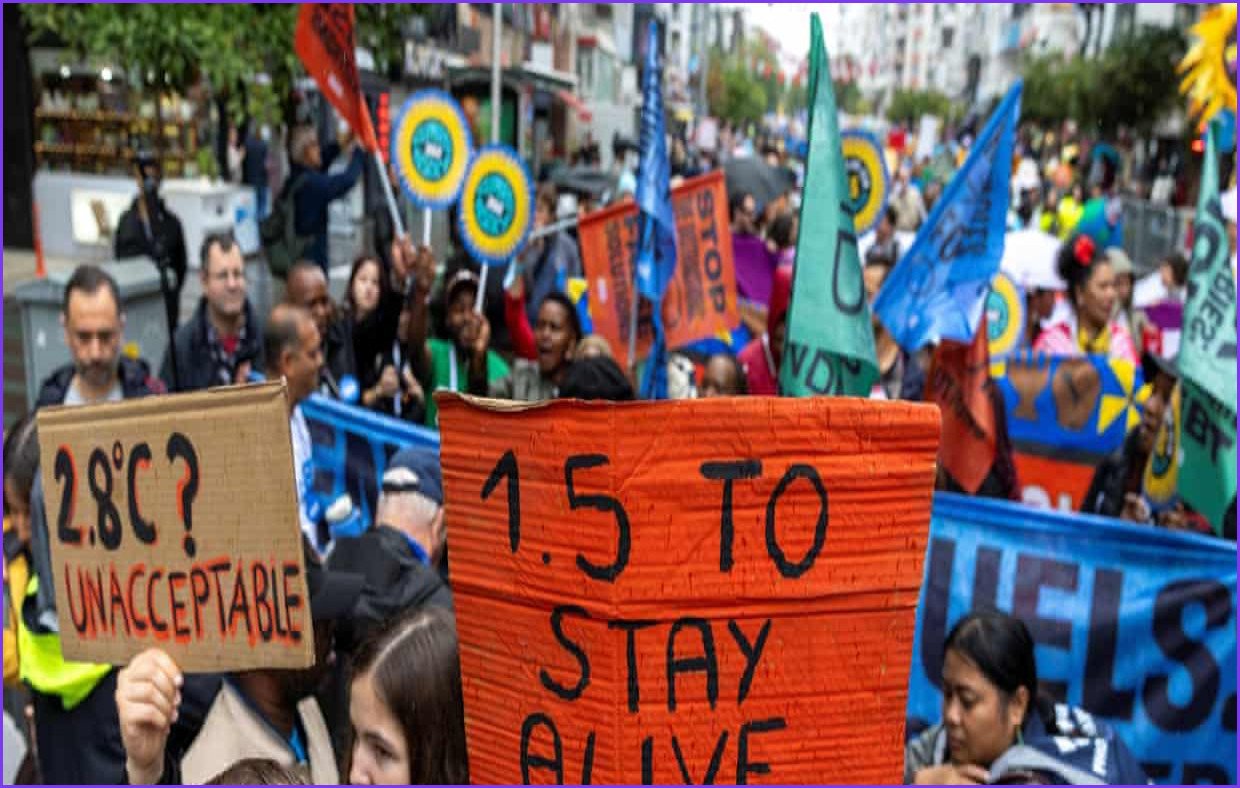
International climate campaigners gathered for the UN COP31 summit in Antalya, Turkey, formed a protective ring around local LGBTQ+ activists on Saturday, enabling them to lead a joint demonstration against climate inaction and state repression.
Turkish queer and gay campaigners unfurled rainbow flags during the afternoon rally amid heightened security. LGBTQ+ organizations in Turkey have faced an intensifying crackdown since September, with law enforcement targeting activists in their homes and at the offices of non-governmental organizations. To help safeguard the participants, international activists shielded the LGBTQ+ contingent from potential police intervention before flags were raised.
Özgür, a 20-year-old Turkish LGBTQ+ activist who marched with a rainbow flag wrapped over her shoulders, acknowledged that displaying the symbol carried risk under normal circumstances. She described feeling as though she lives in a prison in her own country, adding that she is constantly running from authorities. She noted that the presence of global media at COP31 made the demonstration possible. Another demonstrator, who gave her name as Beren, expressed excitement at waving the flag publicly but shared that her friend could not attend because she was currently detained for being transgender.
Turkish police deployed a heavy security operation around the protest, which assembled at Aydin Kanza Park. Officers subjected participants to double body frisks, searched bags, and examined placard slogans, taking photographs of placards in several instances. Steel barriers cordoned off the entire protest route to restrict movement until the march concluded. Asad Rehman, chief executive of Friends of the Earth England, Wales and Northern Ireland, stated that attendees were required to bring their passports while undergoing bag searches, describing the event as a vital moment for international movements to support Turkish activists facing a wave of repression.
Organizers pre-arranged the inclusion of the LGBTQ+ block to protect participants before flags were displayed. Lucia Posteraro, a consultant with the International Federation of Human Rights, explained that global organizations closely monitored the group to deter coercion from security forces. Local environmentalists also utilized the march to draw attention to domestic ecological struggles. Özlem Katısöz of Climate Action Network in Turkey emphasized that grassroots groups fighting to protect local villages and forests urgently needed solidarity from international attendees.
The demonstration featured vibrant displays, including stilt-walkers, trombone players, and banners reading "We defend life." Protesters also displayed a gold-plated bronze statue depicting a diminutive figure carrying a naked Donald Trump, symbolizing the exploitation of poor nations by wealthy countries. Participating in a full polar bear costume during a muggy afternoon rainstorm, Greenpeace volunteer Ufuk Anil travelled from Istanbul to highlight rising temperatures and demand action to keep the 1.5-degree limit alive. Anil criticized Turkey's underwhelming climate agenda and plastic imports, emphasizing that he marched for his young daughter's future on a cooler planet.
Activists from other nations facing civic restrictions also joined the march. Triana Kurnia Wardani of the Indonesian democratic women's organization Seruni highlighted months of forest and land fires causing severe haze in her home country, noting that domestic protests often trigger police harassment and social media censorship. Meanwhile, as COP31 reached its midpoint with major negotiations unresolved, youth engagement leader Aditi Tiwari of Voice of Aroha expressed hope that world leaders would deliver meaningful outcomes. Louise Hutchins, co-convener of the Make Polluters Pay coalition, recalled UN Secretary-General encouragement from the previous day, affirming that thousands on the streets would continue demanding climate justice.
Inside the summit venue, official negotiations continued as UN chief climate negotiator Simon Stiell called on participating nations to move swiftly to the hardest issues without tactical delays, warning that achieving collective success required compromise from all parties.
“Despite all the controversies, I think this is where we have the most influence, where we can make our voices heard by the world leaders who make those influential decisions,” she said. “So here’s to hoping that this Cop is way different than the rest and we can [have] some hopeful outcomes.”
“Today, we’re back on the streets at Cop31 with thousands of people from around the world, demanding that governments make polluters pay. We promised to keep up the fight. And we won’t stop until we win climate justice.”