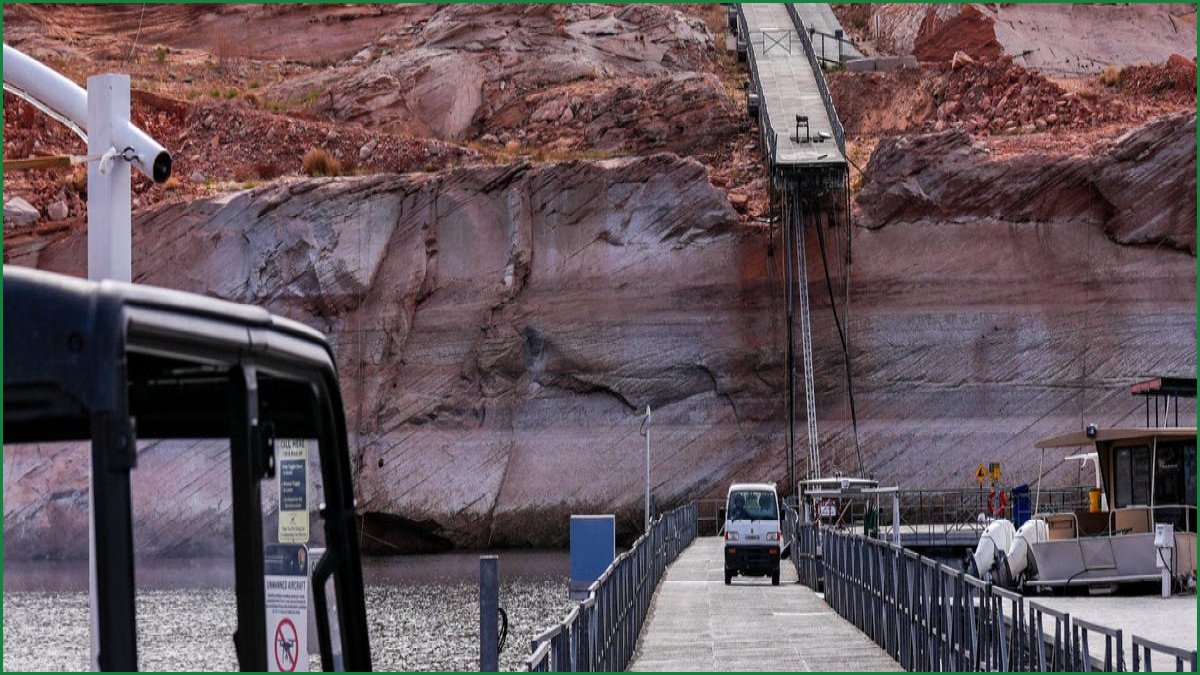
Lake Powell, the massive reservoir situated on the border of Utah and Arizona that serves as a vital energy and water source for millions, has dropped to its lowest level since its creation. According to the Bureau of Reclamation's automated gauge system, the water surface reached 3,519.91 feet above sea level on August 15. This figure surpasses the previous record low of 3,519.92 feet, which was documented in April 2023.
Federal officials have been actively managing the crisis by drawing water from smaller upstream reservoirs to delay reaching the 3,490-foot threshold, a point that would critically imperil the lake's ability to generate hydroelectricity. Current federal projections indicate the reservoir may approach this "minimum power pool" level by early next spring. Beyond that, further declines could lead to a "dead pool" state, where water levels become too low to flow downstream, potentially triggering severe water restrictions for millions of residents and impacting agricultural operations as far as 500 miles away in California's Imperial Valley.
While the Bureau of Reclamation notes that daily gauge readings are subject to revision, the downward trend has been consistent for months. The reservoir system, which includes Lake Mead outside Las Vegas, is currently under immense pressure. Lake Mead itself hit a new record-low on August 7 and continues to decline daily. These reservoirs are essential for storing Colorado River water, providing electricity, irrigation, and drinking water to seven Western states, two northern Mexican states, and various Native American tribes.
The current situation is largely driven by long-term drought conditions exacerbated by climate change, which is altering snowpack patterns in the Rocky Mountains. Peter Goble, assistant state climatologist for Colorado, noted that the West is warming at a rate faster than the rest of the nation, leading to less available water. "There's no way to look at the numbers and think the Colorado River is doing well right now," Goble said. "In a world that's warmer, all signs point to droughts that will be more intense and more frequent."
Addressing the crisis has become a matter of urgency. Aaron Weiss, executive director of the Center for Western Priorities, emphasized that solutions must be implemented rapidly. Potential proposals currently under consideration range from limiting lawn irrigation and compensating farmers for reduced water usage to more drastic measures such as building nuclear-powered desalination plants, hauling polar icebergs, or piping water from the Mississippi River. Some environmental organizations have even suggested bypassing or removing the Glen Canyon Dam, which created Lake Powell, to allow the remaining water to flow into Lake Mead.
The reservoir system was originally engineered to store water during wet years and release it during dry ones, but the combination of climate shifts and rapid population growth in the West has placed unprecedented demand on the infrastructure. A new federal plan released in July aims to reduce water outflows from Lake Mead, which will likely force stricter conservation measures in cities and impact crop irrigation in California and Arizona. Experts state that significant relief is unlikely until at least next spring, and only if the region experiences a notably wet winter. While a wet fall influenced by a super El Niño pattern in the Pacific could offer minor help, it is not expected to reverse the long-term declining trends for the Colorado River.
"Whatever the solutions are, they're going to have to happen rapidly," he said.