In early September 2026, Kyrgyzstan transformed itself into a highly choreographed stage of national pride and political power, simultaneously hosting the World Nomad Games and a Shanghai Cooperation Organization (SCO) summit. The dual events served as a massive state showcase, projecting an image of a strong, modernized nation both to the international community and to domestic voters ahead of the country’s upcoming presidential election.
The spectacle kicked off at the brand-new Bishkek Arena, a 51,000-seat stadium built specifically for the games' opening ceremony. In the stands sat a powerful lineup of global leaders, including Russian President Vladimir Putin, Chinese leader Xi Jinping, Indian Prime Minister Narendra Modi, and Turkish President Recep Tayyip Erdogan. Kyrgyz President Sadyr Japarov used the grand opening to outline his vision for the country, stating that independence is their foundation, roots lie in nomadic civilization, and their future is in building a developed, strong new Kyrgyzstan. Japarov also announced that Kazan, in Russia’s Tatarstan, will host the next games in 2028, following a formal request from Moscow for which he thanked Putin.
The high-profile gathering required intense security, with snipers stationed on the arena roof and a three-kilometer radius completely locked down. For Japarov, the event marked a display of consolidated authority. In February 2026, he dismissed his longtime ally Kamchybek Tashiev, the former head of the State Committee for National Security, ending a ruling partnership that had governed Kyrgyzstan since 2020. With Japarov set to run for re-election in January 2027, political analysts view the massive events as a calculated domestic message. Political analyst Temur Umarov noted that while the overlapping schedules of the games and the SCO summit were a lucky coincidence, Japarov capitalized on them to demonstrate order and regional parity with neighbors like Kazakhstan and Uzbekistan, targeting Kyrgyz citizens as his primary audience. Political scientist Asel Doolotkeldieva added that the timing, aligned with Independence Day, was designed to signal a stronger state identity, triggering an explosion of pride and a sense of belonging among locals and Kyrgyz migrants abroad.
To accommodate the global leaders and secure the SCO summit, the capital city of Bishkek was effectively silenced. On September 1, major roads from the airport and through the city center were shut down, public transit was rerouted, and large markets and shopping malls were closed. Security forces cleared the streets, directing pedestrians onto side roads or down into underpasses when motorcades passed. The strict measures bewildered visitors, including a German tourist who questioned why the government was hiding its own people. Meanwhile, traffic cameras showed a completely emptied capital.
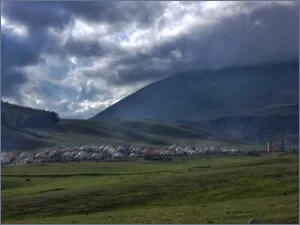
In stark contrast to the quiet capital, the Kyrchyn gorge came alive as a bustling ethno-village. Covered in yurts and featuring clay fortresses designed to evoke the ancient Silk Road, the venue drew 150,000 visitors on its first day. Each of Kyrgyzstan's seven regions, along with the cities of Bishkek and Osh, established its own camp featuring dancers, traditional food, and regional crafts. Despite rain, crowds danced and celebrated. Reaching the gorge proved difficult, as private cars were turned away and visitors faced long waits and arguments over limited bus seats. Nevertheless, the festival gained massive traction online, with international social media creators sharing videos that went viral globally, and users in neighboring countries copying the choreography of the opening ceremony's dance.
While the games showcased cultural heritage, they also highlighted ongoing struggles with gender equality in traditional sports. The athletic program has expanded significantly, growing from 23 sports in 2016 to 43 in 2026, and incorporating more women's events. The horseback archery competition featured 45 women from 32 countries and became a favorite subject for journalists. However, the reality on the ground was more challenging. The Kyrgyz women's horseback archery team was assembled just two weeks before the competition, sharing a single coach with the men's team while resources and attention remained focused on male athletes. Aidana Usenbekova, a 28-year-old member of the national team, expressed deep frustration, revealing that right before the competition, their assigned horses were taken away and given to guest riders, leaving the local team with whatever mounts remained. Usenbekova described the incident as an insult and an example of the contempt and stereotypes women still face in equestrian sports, which are traditionally treated as male territory.
The athletic peak of the games occurred on September 6 at the hippodrome in Cholpon-Ata, where Kyrgyzstan dominated its neighbor Kazakhstan, winning 12-0 in Kok Boru and 7-2 in Kokpar. The traditional equestrian games drew passionate fans from across the country, including 75-year-old Tashtan, who traveled from Uzgen to watch. However, the final matches were marred by ticketing issues, with more tickets sold than the stadium could hold. To resolve the resulting crowd chaos, President Japarov ordered the gates opened to everyone, which meant some fans who had purchased valid tickets and waited in line were unable to get inside.
The scale of the 2026 games stands in sharp contrast to the event's modest beginnings. At the inaugural World Nomad Games in 2014, initiated by then-President Almazbek Atambayev, there was little grandeur, few local spectators, and minimal media presence. The Kyrchyn venue was then a simple mountain pasture reached by a dirt road, and the yurts belonged to actual herders living the nomadic lifestyle. By 2026, the venue had expanded into a 52-hectare staged park equipped with asphalt roads and helipads. While the commercialized and state-controlled nature of the modern games lacks some of the spontaneous, authentic spirit of the early editions, the massive spectacle successfully delivered the image Kyrgyzstan's leadership wanted to project: a nation capable of welcoming the world while celebrating its nomadic roots at full volume.
You have reached the limit of 2 free articles this month.
Anyone still on the main streets when the motorcades passed by was taken out of the shot. Pedestrians were told to duck onto side streets. If they were already in the roadway, they were sent down into the underpasses. Tourists who had come for the games stood underground alongside locals and tried to work out what was happening.