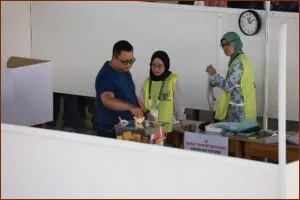
In the Johor state election held on July 11, 2026, Barisan Nasional (BN) secured a decisive victory, winning 48 of the 56 available seats. Pakatan Harapan (PH), the coalition led by Malaysian Prime Minister Anwar Ibrahim, managed to win only eight seats. While some observers have labeled this outcome a "Blue Wave," the results are deeply rooted in Johor’s specific local context rather than a nationwide shift in voter loyalty. It is important to note that BN already held 40 seats and the state government before the dissolution of the state assembly, meaning they increased their majority by eight seats. Historically, Johor is the birthplace of the United Malays National Organization (UMNO) and has long served as BN’s primary support base. Following the 2018 political tsunami, the party appears to have returned to its historical baseline.
The real implications of the election are found in ethnically mixed constituencies rather than the overall seat count. PH maintained its ground in areas where Malay voters constituted less than 45 percent of the electorate, but lost to BN in mixed seats where the Malay population fell within the 45-55 percent range. For instance, in Jementah (N02), BN’s See Ann Giap won with 12,522 votes (46.3 percent), narrowly defeating PH’s Ng Kor Sim, who received 11,609 votes (42.9 percent), a margin of just 913 votes. Similarly, in Bukit Batu (N51), BN’s Kumaran Ramakrishnan won with 16,899 votes (47.7 percent) against PH’s Arthur Chiong Sen Sern’s 16,725 votes (47.2 percent), a thin margin of 174 votes. Even in urban, higher-income (T20) dense areas, BN emerged victorious wherever the ethnic makeup was mixed.
Voter turnout patterns were a critical factor in the outcome. While the 2022 election recorded a 54.92 percent turnout, participation jumped to 69.57 percent this time. Rural, Malay-majority areas, which are BN strongholds, recorded higher turnouts averaging 65.7 to 68 percent. Conversely, urban PH strongholds, particularly those associated with the Democratic Action Party (DAP), lagged with an average of 60 percent. In urban seats like Johor Jaya (N42), which flipped from PH to BN, turnout was relatively high. A local Chinese voter noted that support within families was split between PH and BN. As non-Malay voter intensity waned into ambivalence, a highly mobilized Malay voting bloc successfully pushed BN to victory. The direct electoral impact of the flagship Johor-Singapore Special Economic Zone (JS-SEZ) policy remains difficult to quantify, as the affected areas saw a mix of seats where PH held strong and seats where BN flipped.
The election also highlighted the internal dysfunction within the opposition. Perikatan Nasional (PN) was weakened by friction between Parti Islam Se-Malaysia (PAS) and Parti Pribumi Bersatu Malaysia (Bersatu), preventing them from fielding candidates in all 56 seats. Furthermore, PAS’s decision to quietly back BN significantly altered the race. This was most symbolic in Bukit Kepong (N07), the stronghold of former Prime Minister Muhyiddin Yassin, where BN’s Ahmad Syarie Yusof won with 16,386 votes (61.4 percent), defeating Bersatu’s Sahruddin Jamal, who managed only 5,625 votes (21.1 percent). This result suggests an eradication of Bersatu’s foothold in its own backyard.
Campaign strategies focused heavily on party branding. BN strategically fronted Chief Minister Onn Hafiz Ghazi rather than national chairman Ahmad Zahid Hamidi, utilizing the "Onn Tak Onn" slogan to frame the election as a referendum on the state government. PH, conversely, struggled to leverage Prime Minister Anwar Ibrahim as a focal point. The failure of the newly formed Bersama party to gain any traction, despite flying its yellow Kancil flags in Johor Bahru, further illustrates that micro-parties are struggling for relevance. As the reader may have reached the limit of 2 free articles this month, it is worth noting that the Johor results suggest Peninsular politics is reverting to a two-party system, with third forces struggling to survive. The future of PH likely depends on its ability to increase voter turnout in semi-urban, ethnically mixed battlegrounds as the next electoral battles unfold in other peninsular states and at the federal level.