A landmark delegation of Jamaican officials has formally lodged a petition to King Charles during a visit to the United Kingdom, defending the legal validity of their route to seek reparations for transatlantic slavery. Backed by leaders of other Caribbean nations, the petition asks the monarch, who remains Jamaica’s head of state, to request legal advice from the Privy Council. As the final court of appeal for several Commonwealth countries and UK overseas territories, the Privy Council is being asked to provide guidance on three central questions: whether the forced transport of Africans to Jamaica was lawful, whether it constituted a crime against humanity, and whether Britain is obligated to provide restitution for slavery and its enduring consequences.
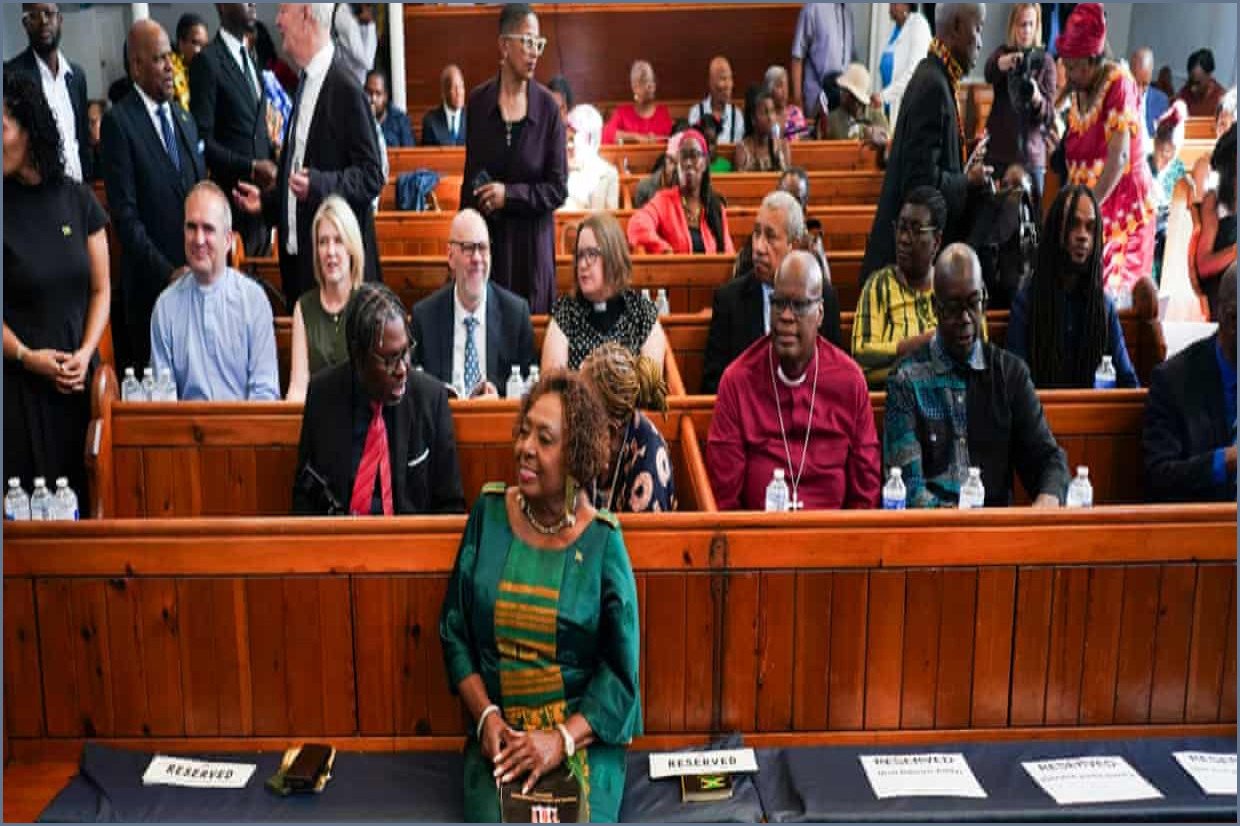
The delegation's visit was marked by a deeply emotional service at Brixton’s New Park Road Baptist Church, where a packed congregation rose to sing Bob Marley’s "Redemption Song." The service commemorated the anniversary of the 1781 Zong massacre, an atrocity in which more than 100 enslaved Africans were thrown overboard so the ship's owners could claim insurance for "lost cargo." Led by Culture Minister Olivia Grange, the visiting delegation included prominent lawyers and members of Jamaica’s national council on reparations. Throughout their stay, the group met with diaspora communities, UK politicians, church leaders, and major cultural institutions, including the British Museum, from which Jamaica is seeking the return of historical artefacts. Grange also held talks with the UK’s Foreign, Commonwealth and Development Office, though sources indicated those discussions did not focus on reparations.
The legal strategy behind the petition has sparked intense debate. Lord Sumption, a former member of the Privy Council, dismissed the initiative as "nonsense" and argued that the issue of reparations is "not a question of law at all" but rather a moral and political matter. However, Jamaican legal experts have strongly defended the petition's legal basis. Speaking at a briefing for UK parliamentarians, Edward Fitzgerald KC explained that Jamaica is utilizing a little-used mechanism within the Judicial Committee Act 1833, which empowers the King to refer questions of a "legal or constitutional nature" to the Privy Council when they cannot be resolved through ordinary courts. Harj Narulla, a member of the UK counsel team, described this as an "obvious jurisdictional route," noting that a judicial review of a government decision is not possible because the issue lies directly with the United Kingdom as the state responsible for slavery in Jamaica.
Adding to the legal defense, UK legal team member Ulele Burnham emphasized that while the violent subjugation and forced uprooting of people for profit was undeniably immoral, the petition specifically aims to show it was also inconsistent with the law of the time. Burnham noted: "The petition argues that the atrocities, the forced uprooting, the violent subjugation for profit was of course immoral, everyone knows that. But the petition’s very focus is to show that it was also clearly inconsistent with the law of the time. Non-Europeans did not suddenly become human when slavery ended. They always were. And even in those days, humans had some rights in English and international law."
In Jamaica, the pursuit of reparations enjoys bipartisan support from the two main political parties. However, members of the opposition People’s National Party raised concerns that the delegation did not secure a face-to-face meeting with King Charles. Grange clarified that a meeting with the monarch "was not part of the plan," explaining that they had consulted with both the Palace and the Privy Council beforehand to confirm the correct legal process, which dictated filing the petition via post and email. This diplomatic effort comes as Jamaica's government continues to navigate its relationship with the monarchy, having tabled a bill in parliament in December 2024 to remove the King as head of state, though the bill has not yet progressed into law.
The delegation's efforts received strong backing from Labour MP Bell Ribeiro-Addy, chair of the all-party parliamentary group for Afrikan Reparations. Ribeiro-Addy asserted that Jamaica is well within its rights under English law to petition the monarch, arguing that the UK cannot retain Jamaica within its realm without granting them the right to ask these questions. Pointing to global momentum, including a UN resolution supported by 123 nations that described chattel slavery as the gravest crime against humanity, she urged Britain to confront its history. She dismissed media focus on massive reparation figures as a distraction from the core reality, noting that while reparative justice could eventually include payments, the immediate issue is that the UK refuses to even offer an apology or take cost-free symbolic steps.
As the petition was officially submitted, the British government maintained its resistance. A spokesperson for the prime minister, Andy Burnham, reiterated the long-held official stance that "the UK does not and will not pay reparations." Ribeiro-Addy warned that a refusal by Britain to discuss the issue at the upcoming Commonwealth heads of government meeting in Antigua, which King Charles is scheduled to attend, would be an insult to African and Caribbean nations. She cautioned that stopping such discussions could lead to the "crumbling of the Commonwealth," emphasizing that member states are meant to be treated as equals with a shared history rather than subjects of an empire.