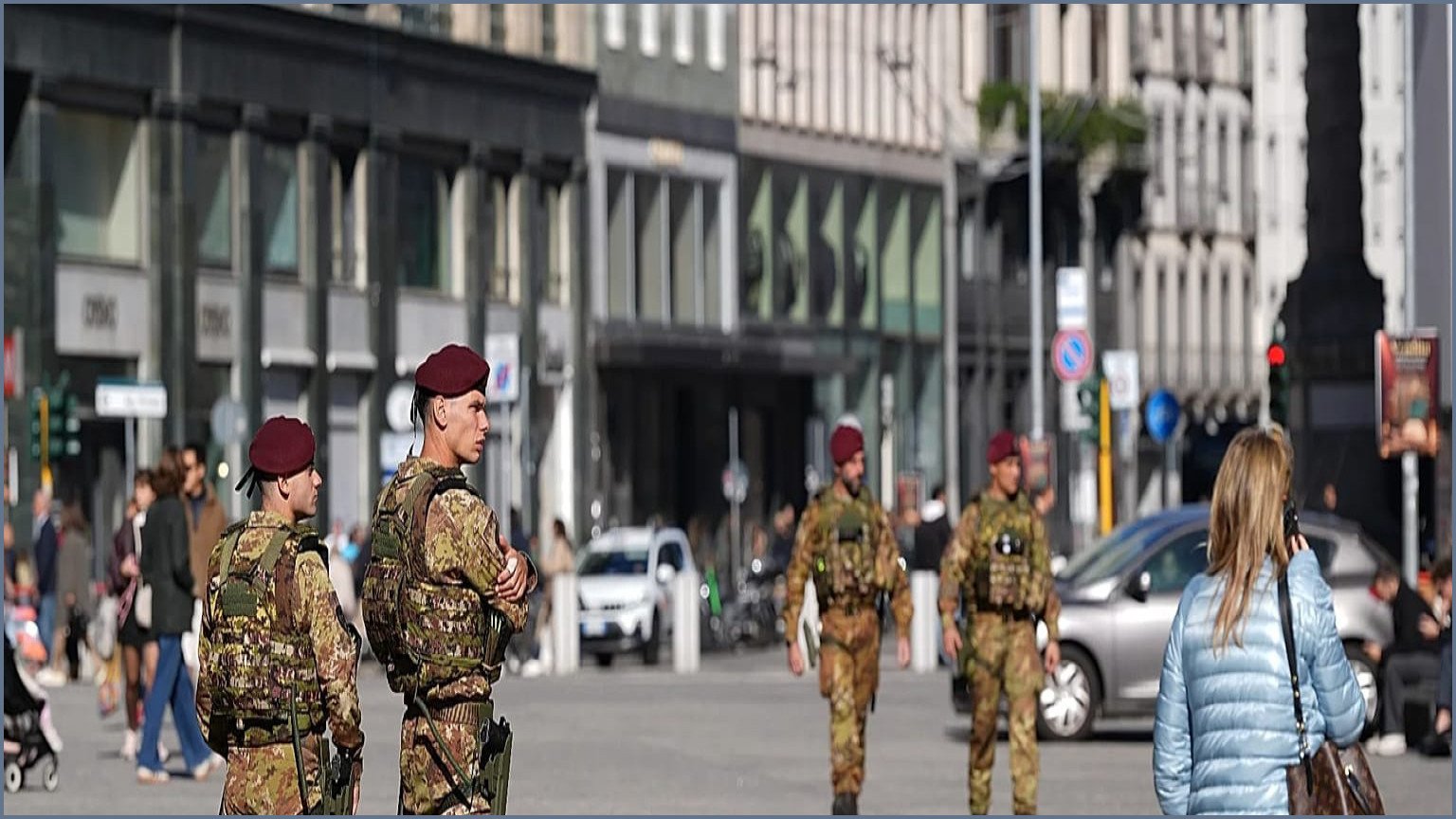
Italian authorities deployed hundreds of additional soldiers and heightened security across several major cities on Saturday as a fresh wave of nationwide demonstrations triggered severe concerns over escalating street violence. Demonstrators gathered in urban centers including Rome, Milan, Turin, Bologna, Florence, and Naples to express frustration over soaring living costs, stagnant wages, expanding military spending, and broader government policies. The heightened police presence follows intense clashes between protesters and law enforcement during the previous weekend.
In Milan, security forces were placed on high alert following violent unrest on October 17 and 18, when clashes, vandalism, and looting caused extensive destruction across the city center. In response, Prime Minister Giorgia Meloni’s administration ordered an additional 500 soldiers to reinforce existing security forces stationed in the city. Italian authorities also instituted drone surveillance, stringent checks at railway stations, and rapid-response law enforcement units. On Saturday morning, police conducted more than 150 search warrants across Milan, Monza, and approximately 20 other municipalities, targeting individuals suspected of participating in the prior weekend's violence, including minors and students.
Despite the security operation, around 10,000 people participated in a combined march through Milan. The rally formed after two separate processions—composed of student groups, activists, and pro-Palestinian demonstrators—merged into a unified crowd heading toward Piazza Leonardo da Vinci, the site of the Polytechnic University of Milan. Earlier in the day, police halted a march that had set off from the square toward the city center, pushing participants back toward Corso Venezia, where some joined a second procession originating from the Piccolo Teatro. Meanwhile, security preparations were further complicated after the newly established "17 October Movement" announced it had canceled its previously published protest locations, stating that new meeting spots would only be shared shortly before the marches commenced. Law enforcement officials warned that the tactic raised the likelihood of spontaneous gatherings across the country.
Clashes erupted in Rome on Saturday evening as marchers moved through the capital for a national demonstration held under the slogan "Keep Italy out of the war," which opposed foreign military involvement and increased national defense spending. Demonstrators confronted a police cordon near Largo di Santa Susanna, hurling glass bottles, setting off firecrackers, and knocking down several street signs, prompting officers to respond with water cannons. In Florence, tensions similarly escalated during a procession through the city, where protesters threw firecrackers and glass bottles at law enforcement officers. Near the Santa Trinità Bridge, at its junction with Via Tornabuoni, some demonstrators attempted to breach a riot police line.
Violence was also reported in Turin, where student organizations and activist groups organized a march to protest against rearmament, rising fuel costs, and general economic hardship while demanding improved access to healthcare, education, and housing. As the march passed through the Aurora neighborhood, officers blocked the route toward the city center at the Mosca Bridge. Protesters threw stones, bottles, and smoke bombs at law enforcement personnel, who responded by firing tear gas into the crowd before the procession resumed along Via Cigna. In Bologna, emergency services responded to Via Marconi following confrontations between demonstrators and officers, where paramedics treated an injured young protester on-site.
In southern Italy, demonstrations erupted in Naples against rising consumer prices and economic hardship. Nearby in Castel Volturno, thousands of people were expected to assemble to protest government plans to construct a migrant detention and repatriation center. That demonstration drew backing from a broad coalition including migrant organizations, charities, religious groups, and agricultural workers.
The latest wave of civil unrest follows earlier disturbances in which police reported that approximately 2,000 young people participated, leading to 45 arrests, 34 of whom were minors. Prime Minister Meloni strongly condemned the violence and promised a firmer governmental stance against attacks targeting police officers and commercial businesses. Authorities remain concerned that Saturday's events could unite radical activist groups, trade unions, and student movements, potentially intensifying risks of further violence. The unrest has reignited national debates regarding public order policies, social exclusion, and systemic economic inequality, occurring alongside similar cost-of-living and public policy protests across France, Spain, Portugal, and Albania.