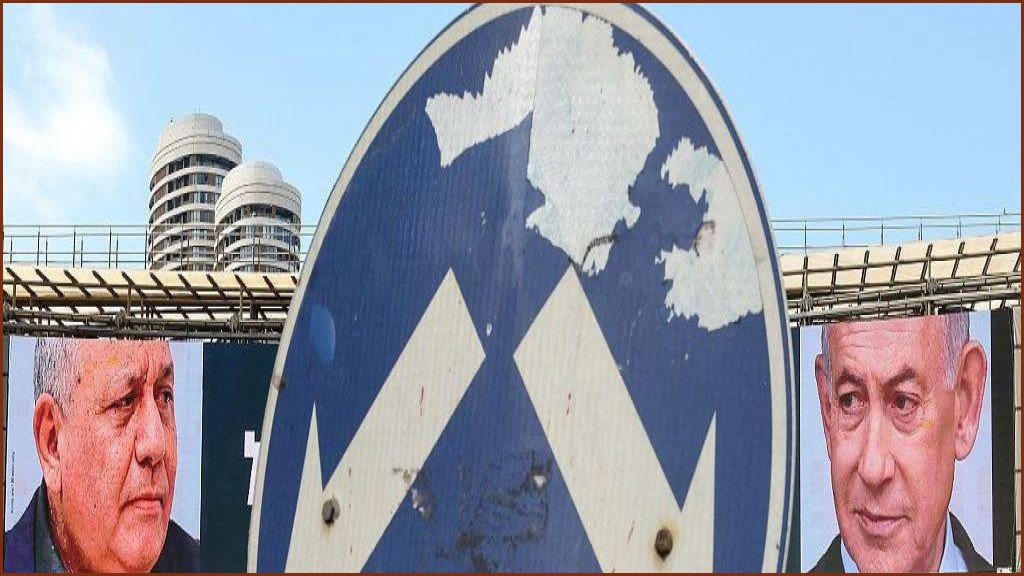
Israel faces a fresh political impasse following Tuesday's parliamentary election, with 85 percent of the ballots counted showing that neither incumbent Prime Minister Benjamin Netanyahu's coalition nor the opposition bloc headed by main challenger Gadi Eisenkot has secured a working majority.
To form a governing coalition, at least one major political faction will be forced to abandon core campaign promises, leaving political figures and analysts to evaluate four potential paths forward—or the prospect of another national vote.
The first potential resolution involves a national unity government uniting Netanyahu's Likud Party with Eisenkot's centrist Yashar Party. Achieving such an alliance would require Eisenkot to scrap his central campaign pledge. Throughout the race, Eisenkot positioned himself as the sole viable candidate to displace Netanyahu.
Speaking at his campaign headquarters before updated exit polls showed Likud overtaking his party, Eisenkot urged Netanyahu to "announce his retirement from political life today," asserting that Israeli citizens were exhausted by Netanyahu's "culture of lies," "division and incitement."
For Netanyahu to construct a unity administration with Yashar, he would likely need to dismantle his existing alliance with far-right and ultra-Orthodox partners. However, during an address at Likud headquarters, Netanyahu publicly thanked his "loyal partners" and demanded a "strong right-wing government," signaling an intent to maintain his current coalition ties. Analysts note that a renewed national security crisis involving Iran could push party leaders toward a coalition.
Reports in Israeli and American media prior to the election indicated Netanyahu had advocated for new military strikes against Iran and urged Donald Trump to authorize American participation—a move political opponents characterize as an effort to ensure his political survival through regional conflict.
A second scenario centers on an opposition coalition relying on independent Arab parties, which would mark a dramatic realignment in Israeli governance. Historically, only one independent Arab party has ever formally participated in a ruling coalition, a short-lived arrangement formed in 2021.
Although Eisenkot and nearly all Jewish parties within his alignment have explicitly rejected forming a government with Arab factions, it currently represents the opposition's only mathematical route to a majority.
Arab political parties emerged as a primary factor on election night, outperforming expectations to project a record 19 total seats in the legislature. This outcome was driven by unprecedented participation among Israel's Arab population, who make up roughly one-fifth of the nation and frequently self-identify as Palestinian citizens of Israel.
While many Arab voters previously boycotted national elections over allegations of second-class citizenship, voters turned out in large numbers to remove Israel's most right-wing coalition to date.
Among these groups, the United Arab List, projected to win around 7 seats, expressed willingness to join an opposition cabinet, while The Joint List, projected at 12 seats, offered to provide external backing. Among Jewish leaders, only Yair Golan of The Democrats has endorsed this arrangement, which would remain highly vulnerable to internal friction regarding policies toward Gaza and the occupied West Bank.
A third potential path involves Netanyahu persuading right-wing figures within Eisenkot's coalition to defect. Specifically, parties led by Naftali Bennett and Avigdor Lieberman could theoretically join Likud. However, both Bennett and Lieberman campaigned directly on removing Netanyahu from power and mandating military conscription for ultra-Orthodox citizens.
This position places them in direct confrontation with the two ultra-Orthodox parties in Netanyahu's current bloc. Furthermore, current parliamentary math suggests that even if Bennett and Lieberman replaced the ultra-Orthodox parties, the resulting coalition might still fall short of the required majority.
If negotiations across these options fail, the default outcome will be a return to the polls. A repeat election is widely viewed as advantageous to Netanyahu, who would remain in office as caretaker prime minister while preparing for a second contest. Strategists suggest that the record turnout among Arab voters might not recur if higher parliamentary representation fails to deliver political change, while a second election could mobilize right-wing voters who stayed home.
Additionally, an estimated 70,000 Israelis living abroad who flew home to vote—a demographic believed to lean heavily against Netanyahu—might not travel back for a second election.
Furthermore, several smaller right-wing parties that failed to clear the 3.25 percent electoral threshold might forfeit their bids or see diminished support, consolidating votes for Likud and its traditional allies. Israel previously underwent five separate elections between 2019 and 2022 amidst prolonged political deadlock.