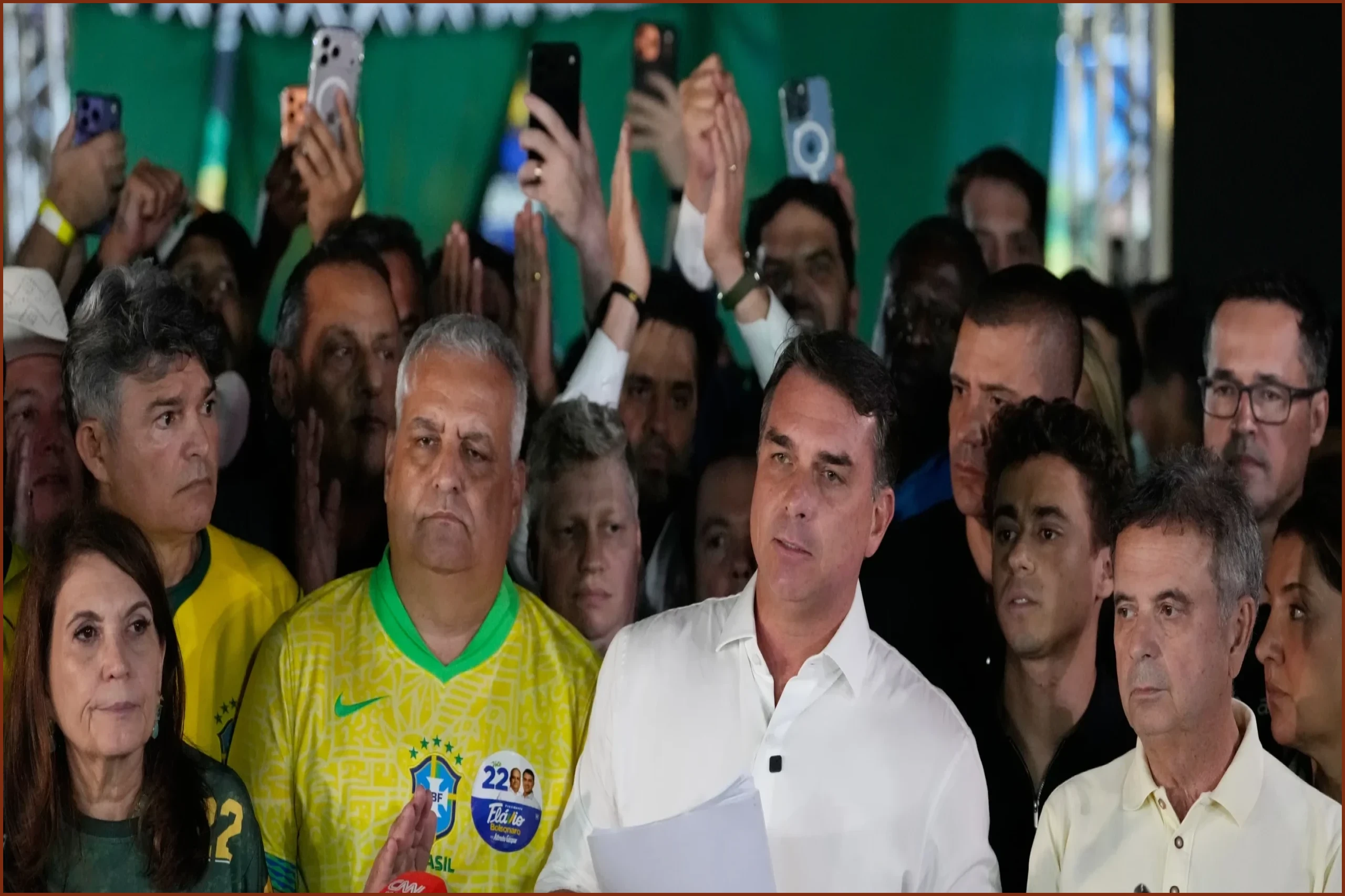
The Liberal Party of Brazil, which backed presidential candidate Flávio Bolsonaro, has formally acknowledged the results of Sunday’s runoff election, recognizing the victory of incumbent President Luiz Inácio Lula da Silva. Despite this institutional acknowledgment from his party, Flávio Bolsonaro has declined to issue a formal concession of his own.
Valdemar Costa Neto, the president of the Liberal Party, released a statement on Monday confirming the party's recognition of the electoral outcome. However, the statement noted that the party maintains that certain questions regarding the voting process still require clarification. This development occurs against a backdrop of external commentary, most notably from U.S.
President Donald Trump. Speaking to reporters on Monday, Trump questioned the legitimacy of the Brazilian election, stating, "I didn't take sides, but it looked like another rigged election," though he provided no evidence to support the claim of fraud.
Flávio Bolsonaro initially indicated plans to seek an annulment of the results, pointing to a last-minute extension of voting hours as evidence of irregularity. On Sunday, the Supreme Court had mandated that polling stations remain open for two additional hours, until 7 p.m., following an appeal by Lula’s campaign regarding public transportation disruptions. The Bolsonaro campaign had also requested an extension, citing heavy rainfall in the southern regions of the country.
In a video released on Monday, Flávio Bolsonaro pivoted his strategy, stating he would pursue the disqualification of Lula’s victory based on alleged abuses of political and economic power. "The law must apply to everyone," he asserted. "The competition must be fair and equal, which did not happen." He offered no evidence to substantiate these claims of unfairness.
During the same video, Bolsonaro mentioned that the Federal Police had instructed him to surrender his passports after he visited his father, former President Jair Bolsonaro, in Brasília.
The former president is currently under house arrest following a 27-year sentence for his role in the 2022 coup attempt against Lula. Flávio Bolsonaro stated, "I was ordered right on the street to hand over my passports, and I'm also prohibited from leaving the country," noting the order was issued by Supreme Court Justice Alexandre de Moraes in connection with a separate investigation.
The election results saw Lula secure just over 51% of the valid votes, totaling approximately 64.2 million, while Flávio Bolsonaro received nearly 48%, or roughly 59.8 million votes. This outcome represents a significant comeback for Lula, who had trailed in the first round, and interrupts a series of right-wing electoral successes across Latin America.
Celebrations erupted throughout Brazil on Sunday night, with supporters gathering in major cities like Rio de Janeiro and São Paulo. Lula, in his victory address in São Paulo, credited younger voters for their mobilization. "I wanted to thank the Brazilian people for the generosity they have shown me for a long time," Lula said. "And in this second round, I want to thank the Brazilian youth for their generosity in taking to the streets. They took to the streets to defend democracy in the country."
Voters like 17-year-old Brisa Pereira, who cast her first ballot in a suburb of Brasília, expressed that Lula’s path from factory worker to president served as a source of inspiration. She also pushed back against international interference, noting, "It's not the '90s anymore. We have rights, and Donald Trump can't speak for all of America."
Political analyst Thiago Vidal of Prospectiva consultants noted that Lula’s victory was broad-based, drawing support across various demographic groups and geographic regions. "No wonder pollsters said a Lula victory was almost impossible," Vidal remarked, describing the result as a "nationwide victory, a systemic victory — from top to bottom, and from left to right." While the margin provides a mandate, Vidal cautioned that the next four years will be difficult due to the Liberal Party's gains in Congress and a deeply polarized electorate.
He also highlighted that Lula’s pivot to a more digital campaign strategy in the final weeks proved decisive in communicating with the electorate. "Part of that has to do with communication, and part of that therefore has to do with Lula, setting aside the traditional media and becoming more digital," Vidal said. In an election-night Instagram post, lawmaker André Janones captured the spirit of the celebrations with a message summing up the campaign: "Nothing is more powerful than when the people unite."