President Prabowo Subianto’s approach to foreign policy is defined by the traditional Indonesian concept of “bebas aktif,” which emphasizes remaining free and active, avoiding permanent alignment, and maintaining open relations with competing powers. This diplomatic instinct is captured by the proverb, “A thousand friends are too few, one enemy is too many.” However, while this formula works in diplomacy, applying it to military modernization presents a much more difficult challenge.
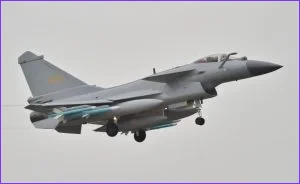
Indonesia’s defense strategy has increasingly moved toward incorporating Chinese-origin combat aircraft. In October 2025, Jakarta publicly announced plans to acquire at least 42 Chinese-made J-10C fighters. Furthermore, reports from a few months later indicated that Indonesia was in advanced talks with Pakistan to acquire more than 40 JF-17s, a fighter jet jointly developed by Pakistan and China. While the practical status of these acquisitions remains unclear, they confirm that Chinese-origin aircraft now play a serious role in Indonesia’s military modernization plans. For context, a J-10B fighter aircraft is capable of carrying PL-8 and PL-12 air-to-air missiles.
This shift occurs as Indonesia continues to receive French Rafales and has agreed to acquire Turkish KAAN fighters for the long term, even as the proposed F-15EX program with Boeing has been abandoned. Jakarta is actively searching for platforms across Europe, the United States, Türkiye, China, and Pakistan to modernize its aging force without relying on a single supplier. This strategy is part of an unusually active form of hedging. Indonesia joined BRICS in 2025, deepened defense ties with Japan, and participated in U.S.-led exercises such as Talisman Sabre and Super Garuda Shield. It is also joining Australia’s Pitch Black 2026 alongside the United States, Japan, France, the Philippines, and South Korea. Simultaneously, Jakarta has broadened security engagement with Beijing, including the resumption of joint military training and the establishment of a new “2+2” dialogue format in April 2025, which Beijing described as the first such mechanism it has created with another nation.
Jakarta maintains a similar balancing act economically. Chinese capital is central to Indonesia’s nickel processing, EV supply chain, and battery manufacturing ambitions, including a CATL-backed project and the construction of the Jakarta-Bandung high-speed railway. Despite this, Indonesia acts as a maritime rival to China near the Natuna Islands. While Jakarta denies the legal basis of Beijing’s maritime claims in the South China Sea and does not officially recognize a dispute, it manages the situation peacefully to avoid making it the defining issue of the relationship.
The primary concern is that this diplomatic prowess may not translate into coherent military capability. Indonesia’s inventory already includes Russian, American, French, and Korean-origin equipment. Adding Chinese and Turkish fighters would lead to a profusion of disparate combat systems. Further exacerbating this challenge is the feasibility of teaching Indonesian pilots to operate another fighter jet from a completely different supplier. The real challenge lies in securing enough spare parts, technicians, and weapons, and ensuring that secure data links are in place to keep all these aircraft effective and combat-ready during a prolonged crisis.
While the J-10 and JF-17 are not inherently bad choices—offering potential potency or cost-effective fleet expansion via Pakistan—there is a tipping point where diversification becomes extreme. When dependence on one supplier becomes reliance on too many, cost savings in procurement are outweighed by redundant infrastructure, separate maintenance facilities, smaller spare parts pools, and less efficient economies of scale. Thus, an expanded inventory may look impressive on an order sheet, but it could result in fewer mission-ready planes compared to a smaller, more integrated force.
The regional message sent by these purchases is perhaps more consequential than the logistical hurdles. Neighbors like the Philippines, Vietnam, and Malaysia, which have maritime border issues with China, will likely reach different conclusions about Jakarta’s reliability as a partner. They may worry about whether Jakarta would confront China or support regional partners, or if sensitive mission data could be shared if Indonesia operates Chinese planes during joint exercises. While Vietnam might offer a subtle critique and Malaysia’s response might be mild, the precedent of a major regional player balancing Chinese maritime pressure with deepening defense-industrial relations could fuel fears that such partnerships might lead China to insist that maritime disputes should not impede deeper integration into regional security.
While Finland during the Cold War serves as a limited comparison for juggling arms from both East and West, it eventually consolidated its fleet around a single Western platform after the Cold War. The lesson is that diverse military procurements should be subordinate to a clear and coherent force structure. Ultimately, purchasing Chinese fighters will only be viable if Jakarta clearly articulates the role of each aircraft, ensures they can integrate with a common command-and-control system, and sends a clear signal to ASEAN partners about its strategic orientation. Strategic autonomy requires a single, coordinated system that can train, communicate, and fight simultaneously.