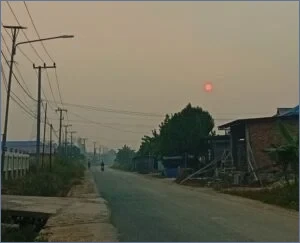
A coalition of indigenous and civil society groups in Indonesia's West Kalimantan province has launched a class-action lawsuit against the national government. The legal action accuses top officials of deliberate negligence in failing to prevent and manage the destructive wildfires currently sweeping across the region.
Filed on September 17 at the Pontianak District Court, the lawsuit was brought forward by a coalition known as Nafas Kalimantan Barat ("the breath of West Kalimantan"). The plaintiffs include the West Kalimantan chapter of the Indigenous Peoples Alliance of the Archipelago, the environmental group Laman Puyung Indonesia, the leadership of the West Kalimantan Catholic Youth, and citizen-activist Sisilius Rami.
The lawsuit names several high-ranking defendants, including President Prabowo Subianto, Vice President Gibran Rakabuming Raka, the national police chief, and the head of the National Disaster Management Agency (BNPB). It also targets the governor and police chief of West Kalimantan, along with the ministries of health, forestry, and environment. The plaintiffs argue that the fires have overwhelmed provincial capacity and are seeking a court order to compel the government to declare a national disaster, which would unlock crucial financial aid for the affected areas.
Kalimantan is currently enduring its most severe wildfire season since 2015. The thick, sepia-toned haze has choked cities, forced school children to wear masks in class, and required rescuers to administer oxygen to smoke-affected orangutans. Forest fires are also active in Sumatra and parts of Papua.
According to data from Nusantara Atlas, which monitors deforestation and fires in Asia, nearly 900,000 hectares have burned across Indonesia since January. While this is lower than the 2.6 million hectares destroyed in 2015 and the 1.65 million hectares lost in 2019, the organization noted that burning typically accelerates in August and peaks in September and October. As of July 20, cumulative hotspot activity in 2026 was higher than at the same point in any previous year.
"Indonesia has not yet entered the period when fire activity has historically accelerated most sharply," Nusantara Atlas stated, warning that the current hotspots are "an early warning, not yet the peak." Forestry Minister Raja Juli Antoni warned that with an extreme El Niño climate pattern beginning to peak, September could mark "when the real battle begins."
Glorio Sanen, the lawyer representing the plaintiffs, highlighted the severe consequences of the peatland and forest fires in West Kalimantan. He noted that the resulting air pollution continues to threaten public health and damage the environment. "Meanwhile, our assessment concludes that there has been no sufficient coordination between the central government, ministries and even local administrations to prevent and respond to the disaster in West Kalimantan," Sanen said.
Wildfires are an annual issue in Indonesia, often started deliberately to clear land for palm oil plantations. The country's environment ministry is currently investigating 19 companies suspected of links to the fires and has promised punishments. However, containing the blazes remains highly difficult, especially on dried-out peatlands where fires can burn underground for weeks. David Gaveau, a landscape ecologist who runs Nusantara Atlas, described these underground peat fires as "the legacy of 50 years of forest degradation [and] deforestation" in Indonesia.
The initial hearing for the class-action lawsuit is scheduled for October 7.