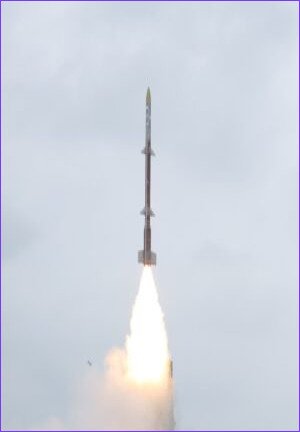
On July 23, 2026, India’s Defense Research and Development Organization (DRDO) successfully conducted the maiden flight test of the M1 long-range surface-to-air missile (SAM). The test, carried out from APJ Abdul Kalam Island off the coast of Odisha, represents a critical milestone for the Kusha program, which aims to establish a multi-layered long-range air defense architecture under Mission Sudarshan Chakra by 2035. During the operation, the system successfully intercepted an electronic target designed to simulate a high-speed, high-altitude aerial threat. According to the DRDO, the Kusha system is engineered to neutralize a diverse array of threats, including fighter jets, unmanned aerial vehicles (UAVs), missiles, and large aircraft across a broad range and altitude envelope. Defense Minister Rajnath Singh hailed the achievement, noting that only a select number of nations possess the technological capability to develop such advanced long-range SAM systems.
Project Kusha involves the development of three distinct interceptors. The M1 is designed for targets up to 150 km, the M2 for 250 km, and the M3 for distances between 350 and 400 km. While the kill vehicle remains consistent across the variants, boosters are added to extend the reach. Development is slated for completion within the next two years, with formal induction targeted for 2030. Key partners in this effort include Bharat Dynamics Limited and Solar Industries as development-cum-production partners, while Bharat Electronics Limited is collaborating on radar and control systems. The system is designed to integrate with the Indian Air Force’s Integrated Air Command and Control System (IACCS), which also links the networks of the Indian Army and Navy to provide a comprehensive aerial picture of the country’s airspace.
Apart from emerging threats, India faces a persistent threat from medium and long-range ballistic missiles of Pakistan and China, its nuclear-armed adversaries on the western and northern fronts, respectively. Hence, an anti-ballistic missile shield is critical. The S-400, which proved its worth during the May 2025 Operation Sindoor conflict by shooting down projectiles and a Pakistani early warning aircraft over 300 km away, will be complemented by Project Kusha to build redundancy. While Kusha will eventually reduce import dependence, it will work in tandem with the S-400 for the near-to-medium future. Long-range interceptors provide additional response time, allowing threats to be neutralized far from population clusters.
India has also developed an indigenous Anti-Ballistic Missile defense; Phase-I is validated for missiles up to 2000 km, while Phase-II for missiles up to 5000 km is under development. Regarding the current air defense tier, the 400 km S-400 is followed by the Barak-8 or Medium Range-SAM with a 70 km range. The naval variant of the Barak-8 is called LR-SAM and the land variant is MR-SAM. At shorter ranges are the indigenous Akash systems and the Israeli Spyder quick reaction systems. Project Kusha will bridge the gap between these systems. Officials confirmed that the entire project, including seekers, actuators, and computing systems, is indigenous, with DRDO working on Gallium Nitride (GaN)-based AESA radar systems. In addition to the three interceptions, DRDO is developing other short-range systems, including the Quick Reaction SAM and man-portable very short-range air defense systems, both of which have an important role in countering cruise missiles, loitering munitions, and unmanned systems on the modern battlefield.