On July 19, India’s Minister for Culture Gajendra Singh Shekhawat represented the nation in Cholpon-Ata, Kyrgyzstan, at a meeting of culture ministers from the Shanghai Cooperation Organization (SCO). During the event, he characterized culture as a vital mechanism for fostering dialogue, trust, and sustainable development. Shekhawat reaffirmed India’s dedication to protecting its shared civilizational heritage while bolstering cooperation among member states. The gathering concluded with a gala concert and a tour of the Rukh-Ordo cultural complex, alongside a proposal to establish an SCO international theater festival.
The cultural summit is part of a broader diplomatic sequence. Following an April meeting of defense ministers in Bishkek, foreign ministers are set to convene in Cholpon-Ata on July 23-24. Minister of State for External Affairs Kirti Vardhan Singh will lead the Indian delegation to prepare for the SCO Leadership Summit, which is scheduled for August 31 to September 1 in Bishkek. On September 1, Kyrgyzstan is slated to transfer the organization’s chairmanship to Pakistan. These meetings serve as a platform for member states to review progress and discuss issues of international significance.
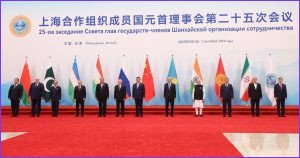
Marking its 25th anniversary, the SCO has evolved significantly since its 2001 inception as the “Shanghai Five.” Originally comprising China, Russia, Kazakhstan, Kyrgyzstan, and Tajikistan, the group expanded to include Uzbekistan, and later India, Pakistan, Iran, and Belarus, totaling 10 member states. Despite its status as the largest pan-Eurasian regional grouping, you have reached the limit of 2 free articles this month. The organization has often been criticized for functioning as a “talk shop” hindered by internal contradictions, divergent worldviews, and competing security interests.
In a discussion on July 20, Kirti Vardhan Singh emphasized that India views the SCO as a structured multilateral forum beneficial for expanding its outreach and visibility within Central Asia. He noted that India maintains a focus on common interests while resolutely defending against any moves that threaten its core interests emanating from certain SCO geographies. Nevertheless, beyond media headlines, the SCO’s actual performance and delivery potential on its 10 identified “goals and tasks” has remained suboptimal. Saddled with internal contradictions, divergent world views, and competing geoeconomic and security interests, the SCO has remained mostly a talk shop providing photo opportunities, diplomatic signaling, and at times hedging.
Tensions between India and Pakistan, as well as disagreements regarding the China-Pakistan Economic Corridor (CPEC), frequently complicate the SCO’s proceedings. During the Bishkek defense ministers’ meeting, India’s Defense Minister Rajnath Singh criticized “inward-looking countries” and underscored India’s resolve in addressing terrorism. Still, the fact remains that SCO mirrors most of the deficiencies that plague any large multilateral grouping. The lack of unanimity on key goals such as “joint[ly] combating terrorism” and “jointly searching for solutions to the problems that would arise in the 21st century” makes the SCO long on rhetoric but short on delivery. Furthermore, India participated in the 12th Meeting of the Heads of Border Services in Islamabad on July 17, where discussions centered on the “Solidarity 2026” joint border operation.
While global multilateralism faces strain, India continues to leverage the SCO to advance its national interests. This includes utilizing the Regional Anti-Terrorist Structure (RATS) to address extremism and advocating for connectivity projects like the International North South Transport Corridor (INSTC). By engaging in the forum, India aims to maintain regional influence and promote a rules-based order, balancing its participation against the inherent limitations of the grouping.