New Delhi is confronting a significant foreign policy challenge, dubbed the “Hasina dilemma,” following the overthrow of Bangladesh’s long-serving Prime Minister Sheikh Hasina in August 2024. Hasina, who now lives in exile on Indian soil, was convicted in absentia for crimes against humanity and sentenced to death by a Bangladeshi court, prompting Dhaka to officially demand her extradition.
The mass street uprising that led to Hasina’s ouster not only reshaped Bangladesh’s political landscape but also disrupted the security architecture of eastern South Asia. For 15 years, India’s foreign policy in the region was anchored on a singular principle: maintaining Hasina’s stability to ensure the security of India’s eastern border. This strategy, however, has culminated in a major crisis for India.
India’s dilemma is rooted in the fundamental principle of statecraft: credibility. For over a decade, Hasina jeopardized her domestic popularity to meet India’s core national security needs. Her government aggressively suppressed anti-India insurgent groups operating from Bangladesh, arresting their leaders and handing them over to New Delhi. She also facilitated critical transit routes, enabling Indian cargo ships and trucks to traverse Bangladesh to reach India’s landlocked northeastern states.
Extraditing Hasina to face a death sentence in Dhaka would send a perilous message to other neighboring countries like Bhutan, Nepal, and Sri Lanka, suggesting that India might abandon its closest allies when political circumstances shift. Conversely, continuing to protect Hasina within India carries an equally high cost. It perpetually fuels anti-India sentiment within Bangladesh’s civil society, making it easier for the new government, led by Prime Minister Tarique Rahman and the Bangladesh Nationalist Party (BNP), to portray New Delhi as an adversary of Bangladesh’s democracy. This public anger could immediately jeopardize India’s vital trade links and transit corridors.
The strain on the relationship has escalated beyond quiet, back-channel friction, manifesting in visible diplomatic boycotts. A clear example was Prime Minister Rahman’s decision to skip the high-profile BRICS Summit hosted by India in New Delhi. Dhaka perceived the invitation, extended to Rahman as the chair of a regional group (BIMSTEC) rather than a direct invitation to the premier, as a deliberate diplomatic snub by India. In response, Rahman declined to travel to New Delhi.
Instead, Rahman strategically focused his diplomatic efforts elsewhere, undertaking a high-profile trip to the United Nations General Assembly (UNGA), where he held a sideline meeting with the Pakistani leadership. Concurrently, Rahman’s administration deepened discussions with Beijing regarding significant infrastructure loans. By refusing a standalone visit to New Delhi, Rahman signaled that Bangladesh’s automatic alignment with India’s foreign policy goals is over. Dhaka is demonstrating its willingness to leverage its strategic geography to balance India’s influence, using closer ties with Islamabad and Beijing as a means to assert its independence from New Delhi’s approval.
For 15 years, India’s Ministry of External Affairs operated under the assumption that ensuring Hasina’s contentment equated to maintaining Bangladesh’s stability. New Delhi overlooked consecutive, highly controversial Bangladeshi elections, prioritizing immediate border security over the escalating domestic discontent against her regime. By tying its national interests so closely to one individual, India failed to cultivate deep institutional relationships with Bangladesh’s opposition parties, student movements, and broader civil society. Now, with Hasina’s fall, India faces significant repercussions for this policy. The new leadership in Dhaka views nearly every routine, technical bilateral issue, from border management to daily electricity grid sharing, through a lens of deep suspicion. India must now build diplomatic capital from scratch with a wary administration, all while managing the political liability of hosting the former leader.
Despite the current defensive stance, the relationship between India and Bangladesh cannot remain frozen indefinitely. Bangladesh heavily relies on India for daily essential food imports, medical tourism, and electricity. Conversely, India requires a cooperative Dhaka to ensure its northeastern states remain secure and connected. Signs of a realistic compromise are slowly emerging. Recognizing the risks of a complete breakdown in relations, Indian diplomats have adopted a quiet, disciplined approach, consistently expressing their desire for “constructive and forward-looking relations” with the new government. This back-channel diplomacy has successfully defused the initial freeze, paving the way for an official state visit by Prime Minister Rahman to New Delhi in late November or early December 2026.
To ensure the success of this upcoming visit and move beyond the current crisis, both nations must cooperate on a silent, two-part strategy. First, India must discreetly work to relocate Sheikh Hasina to a secure country outside South Asia, such as in the Middle East or parts of Europe, that is willing to provide her permanent asylum. This would allow Dhaka to claim a political victory domestically while sparing India the immense loss of face that direct extradition would entail. Second, India and Bangladesh must transition to transactional institutionalism. Both capitals need to agree to treat critical issues, such as the upcoming December 2026 Ganga Water Sharing Treaty deadline, as technical, non-negotiable economic necessities rather than emotional political weapons.
The current situation underscores a systemic warning for foreign policy planners globally: never mistake a single political leader for an entire country. While India-Bangladesh relations will likely not revert to the close, personal alliance of the past decade, having permanently shifted into a cooler, more transactional reality, both New Delhi and Dhaka can prevent the presence of a single deposed leader from escalating a temporary diplomatic crisis into a long-term regional disaster if they successfully separate their internal political rhetoric from their shared geographic realities.
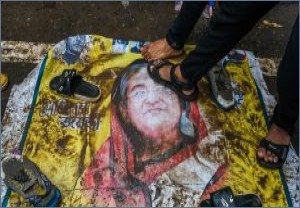
Protesters stamp the face of Prime Minister Sheikh Hasina in a poster on a street in Dhaka, Bangladesh, August 3, 2024.
You have reached the limit of 2 free articles this month.