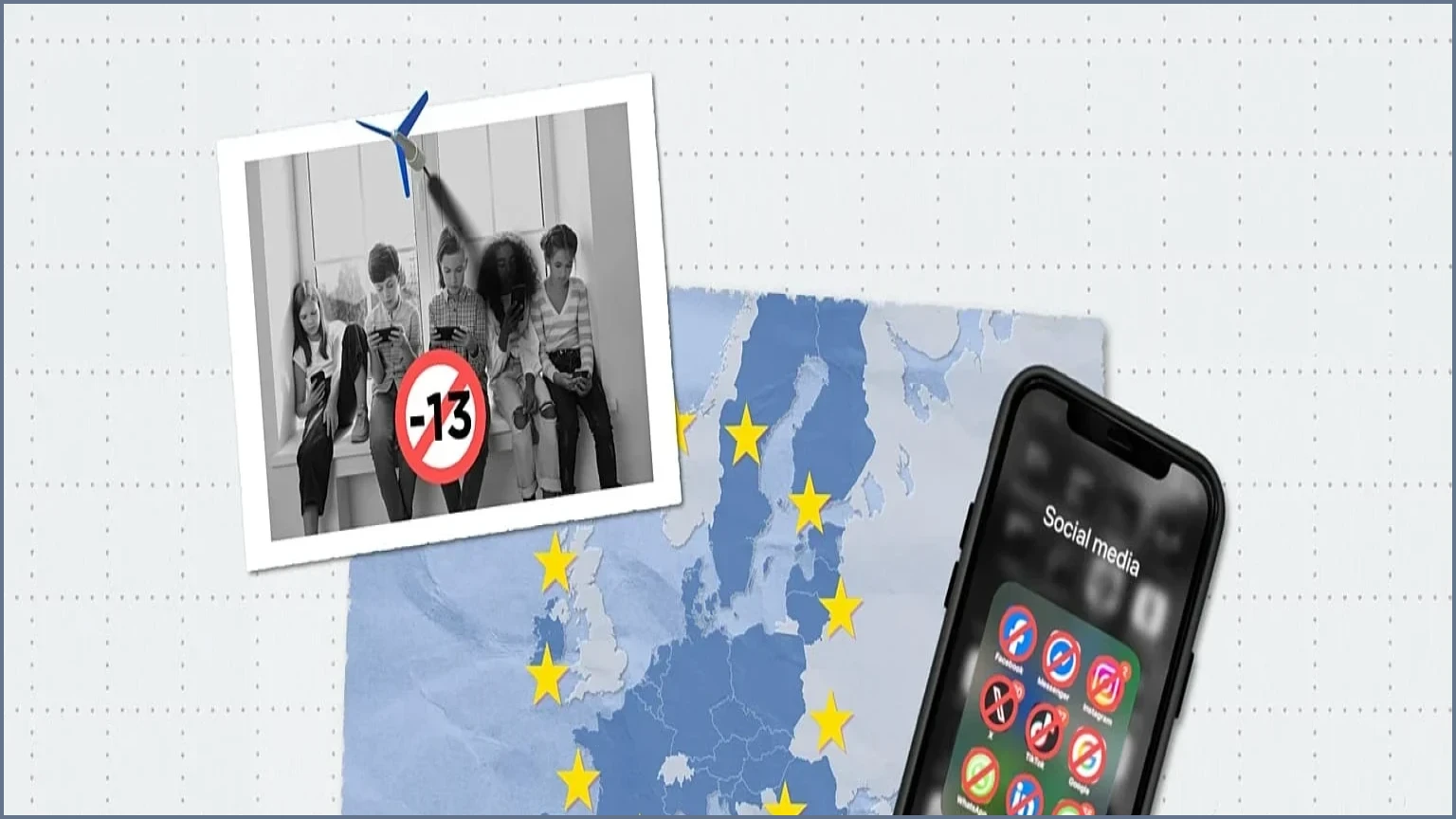
A new European Union proposal, the KIDS Act, is currently under consideration, aiming to ban children under 13 from using social media platforms while imposing feature limitations on users aged 13 to 15. The legislation is designed to combat phone addiction and doomscrolling, while also shielding children from harmful content, dangerous contacts, and various mental and physical health risks.
Public opinion across the EU shows a strong appetite for regulation. According to the Eurobarometer poll, "EU Challenges and Priorities," 91% of citizens agree that more measures are necessary to oversee how children interact with social media. When asked about specific actions, 36% of respondents supported a total ban for children under a certain age. This sentiment is strongest in Greece, where 49% of people back the measure, followed by Bulgaria, Romania, Portugal, Ireland, and Slovakia, all at 44%. Conversely, support is lowest in a cluster of central European nations, including Austria (27%), Germany (28%), and the Czech Republic (29%).
Despite the broad public concern—with 71% of respondents worried about cyberbullying, 70% about online grooming, and 69% about exposure to harmful content—the proposal has met with criticism from child rights organizations. While the goal of protecting children is widely supported, some advocates argue the current framework is insufficient. Jeanne-Marie Quashie, an EU advocacy officer at Terre des Hommes Netherlands, noted that while her organization supports 13 as a minimum age, this threshold is already standard practice for most platforms under Article 8 of the General Data Protection Regulation (GDPR). She argued that the new legislation needs significant improvement regarding how it regulates access for 13- and 14-year-olds.
Under the proposed rules, teenagers would be unable to create social media accounts independently. Instead, parents would be required to initiate and confirm the account, which would then be managed through a linked parent profile or an administrative dashboard. This system would allow parents to set specific restrictions, such as a maximum of one hour of screen time per day. Quashie expressed concern that this approach places a heavy burden on families rather than holding tech companies accountable. "The EU KIDS Act is moving in the right direction by targeting platform design over blanket bans," Quashie said. "But making access depend on a parent's sign-up shifts the burden from tech companies onto families. For 13- to 15-year-olds, safety must be built in, not switched on. Children's access to online spaces must be conditional on safety, not parental authorisation."
While the KIDS Act specifically targets addictive design, this issue polled lower than other concerns, with 60% of respondents expressing worry and only 28% stating they were very concerned. However, there are notable regional exceptions; in Cyprus, 89% of respondents are worried about addictive design, and in Luxembourg, the figure reaches 87%.