Hurricane Isaias has strengthened into a Category 3 storm as it moves toward the United States Gulf coast, leading to official declarations of emergency across Alabama, Florida, and Mississippi. This system marks the first hurricane of the 2026 Atlantic season, a period noted for its late start due to a strong El Niño effect that has historically disrupted storm development. The National Hurricane Center (NHC) reported that the storm was centered approximately 230 miles south of the mouth of the Mississippi River on Friday morning, moving north-north-east at 15mph with maximum sustained winds reaching 105mph.
Officials have warned of life-threatening storm surges, with projections suggesting rising seas up to 7ft and waves hitting heights of 30ft in some areas. The NHC specifically noted that Dauphin Island, a barrier island off the Alabama coast, could experience a 7ft surge, while Indian Pass in Florida could see a 6ft surge. Landfall is anticipated on Friday night, likely along the Alabama-Florida border. Beyond the surge, the storm is expected to deliver up to 15in of rainfall and potentially spawn tornadoes from Friday night into Saturday across a region stretching from Alabama to south-western Georgia.
In preparation, Alabama Governor Kay Ivey ordered immediate evacuations for non-residents in Gulf Shores, Orange Beach, and Dauphin Island, while encouraging voluntary departures for residents. Florida Governor Ron DeSantis has declared a state of emergency across 27 counties, with roughly 5,000 national guard troops expected to mobilize. Several counties and cities in southern Mississippi have also enacted emergency measures. Education has been impacted as well, with at least four Florida school districts canceling late-week classes.
The National Oceanic and Atmospheric Administration (Noaa) warned that damaging hurricane-force winds are expected to impact the Florida panhandle, southern Alabama, and southern Mississippi, advising residents to prepare for long-duration power outages. As of Thursday, the storm had already significantly affected the energy sector, with the Marine Minerals Administration reporting that 63% of the region's oil production had been halted and 121 of 371 crewed platforms evacuated.
This event serves as a significant test for the Federal Emergency Management Agency (FEMA) following recent restructuring and staff reductions. Reports from the US Government Accountability Office indicate that the agency lost approximately 17% of its workforce, or 4,300 employees, during fiscal year 2025. Experts have raised concerns regarding the agency's capacity to manage large-scale deployments given these changes.
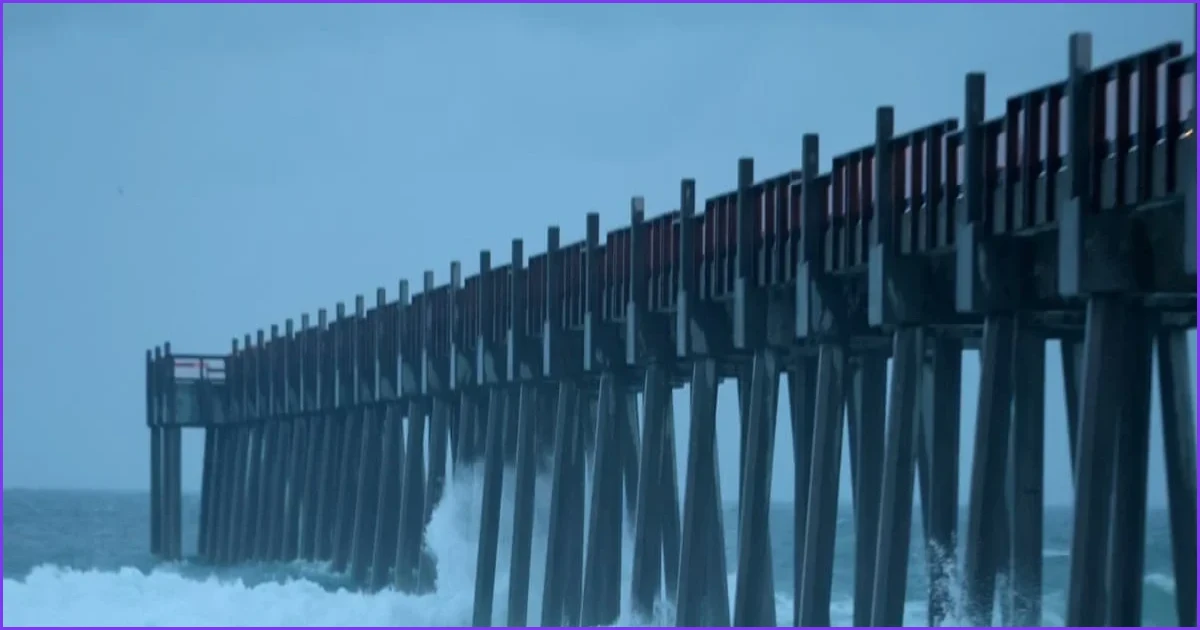
Heavy rain began falling along the coast on Friday morning and winds were picking up sharply, with tropical storm conditions expected by early afternoon.
The Atlantic hurricane season has been unusually quiet this year because of a strong El Niño, which disrupts storm formation over the Atlantic. The first hurricane of the season has not formed this late since 8 October 1905, which predates the satellite era (1960s) for tracking hurricanes.