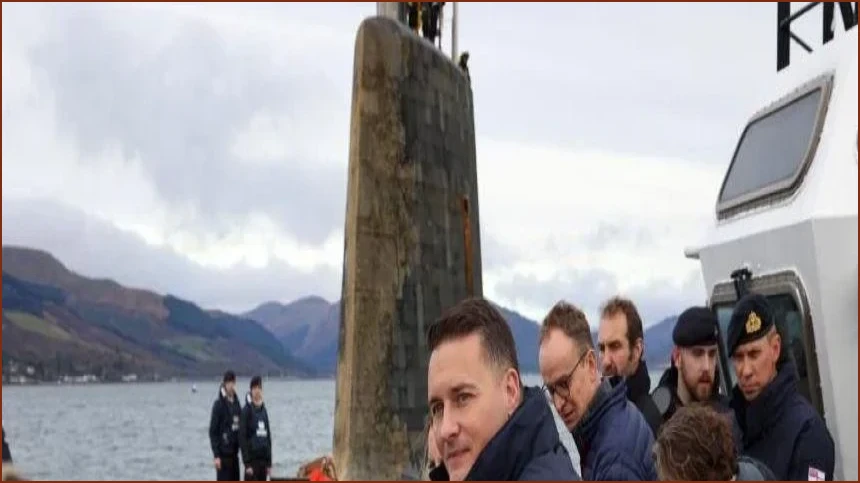
A Royal Navy ballistic missile submarine carrying Trident nuclear warheads has arrived back at its Scottish home port following an unprecedented 217 days spent continuously submerged beneath the surface. The 140-person crew aboard HMS Vengeance completed the longest undersea mission in British naval history, operating in near-total isolation since departing from Faslane, near Helensburgh in Argyll and Bute, on April 12.
As the vessel made its way up Gare Loch flanked by tugs and smaller naval support craft, crew members were visible standing atop the hull. The long period at sea left the submarine heavily encrusted with marine growth, while several of its sound-absorbing exterior tiles were missing. Defence Secretary Wes Streeting traveled to HM Naval Base Clyde to greet the returning personnel on Sunday.
The return of HMS Vengeance was originally anticipated last weekend but experienced a delay when the sister submarine designated to relieve it on patrol suffered a technical fault and had to turn back to port. Addressing the crew and their prolonged tour, Streeting acknowledged that extended operational lengths cause concern. He stated that it "doesn't sit lightly" with him when crews serve longer than planned, adding that he feels "even more indebted to the crew for the service they've given to the country, for the commitment they show, the dedication, the professionalism, the expertise." He remarked that the nation can take pride in both the submariners and the strategic nuclear deterrent.
Submarine mission durations for the UK's Vanguard-class fleet historically averaged around three months. However, operational stretches of six months or more have become routine in recent years due to a shortage of available, seaworthy boats. Speaking at a conference in Oslo last week, First Sea Lord Gen Sir Gwyn Jenkins commended the personnel for maintaining NATO security but stressed that the United Kingdom must improve its fleet maintenance record.
Maintenance setbacks have repeatedly constrained vessel availability. A major overhaul for HMS Vanguard at Devonport Dockyard in Plymouth took seven years before completion in 2022. Furthermore, HMS Victorious entered dry dock in 2023 for a £560 million deep maintenance program, leaving only HMS Vengeance, HMS Vigilant, and HMS Vanguard available for operational duties. The previous length record for a Royal Navy patrol was reportedly set by HMS Vanguard in April after spending 205 days at sea.
Commissioned during the 1990s with an initial design life of 25 years, the four Vanguard-class submarines are now expected to remain operational for up to 40 years until replacement Dreadnought-class vessels enter service in the early 2030s. Streeting confirmed that the replacement program remains on track and emphasized the urgency of bringing the new ships into service as quickly as possible. Precise patrol durations for equivalent Russian or Chinese vessels are not publicly disclosed, though most international navies operate on significantly shorter rotations.
Britain has maintained continuous sea-based nuclear deterrence since 1969, ensuring at least one armed submarine is on patrol at all times to preserve a retaliatory strike capability under the concept of mutually-assured destruction. Each 492-foot (150-meter) Vanguard-class vessel can carry up to 16 Trident missiles capable of launching multiple warheads, each vastly more powerful than the atomic bomb used at Hiroshima in 1945.
To maintain stealth, patrol vessels enforce complete radio silence submerged deep beneath the ocean, receiving incoming encrypted communications only via buoy or floating wire antenna when rising to shallower depths. Submariners endure rigorous daily schedules, typically working six-hour shifts alternated with six hours off while sharing confined quarters with up to nine bunks per cabin. Operational rules prohibit outward communications; crews receive only a single weekly 120-word incoming message known as a "Familygram," which is strictly vetted, with distressing news withheld if it might compromise crew effectiveness.
Living in filtered, recirculated air for over seven months creates unique physical side effects upon return to land. Submariners often find external environmental smells overwhelming and experience altered depth perception. Consequently, crew members are advised to refrain from driving vehicles for several days after coming ashore while their senses readjust.