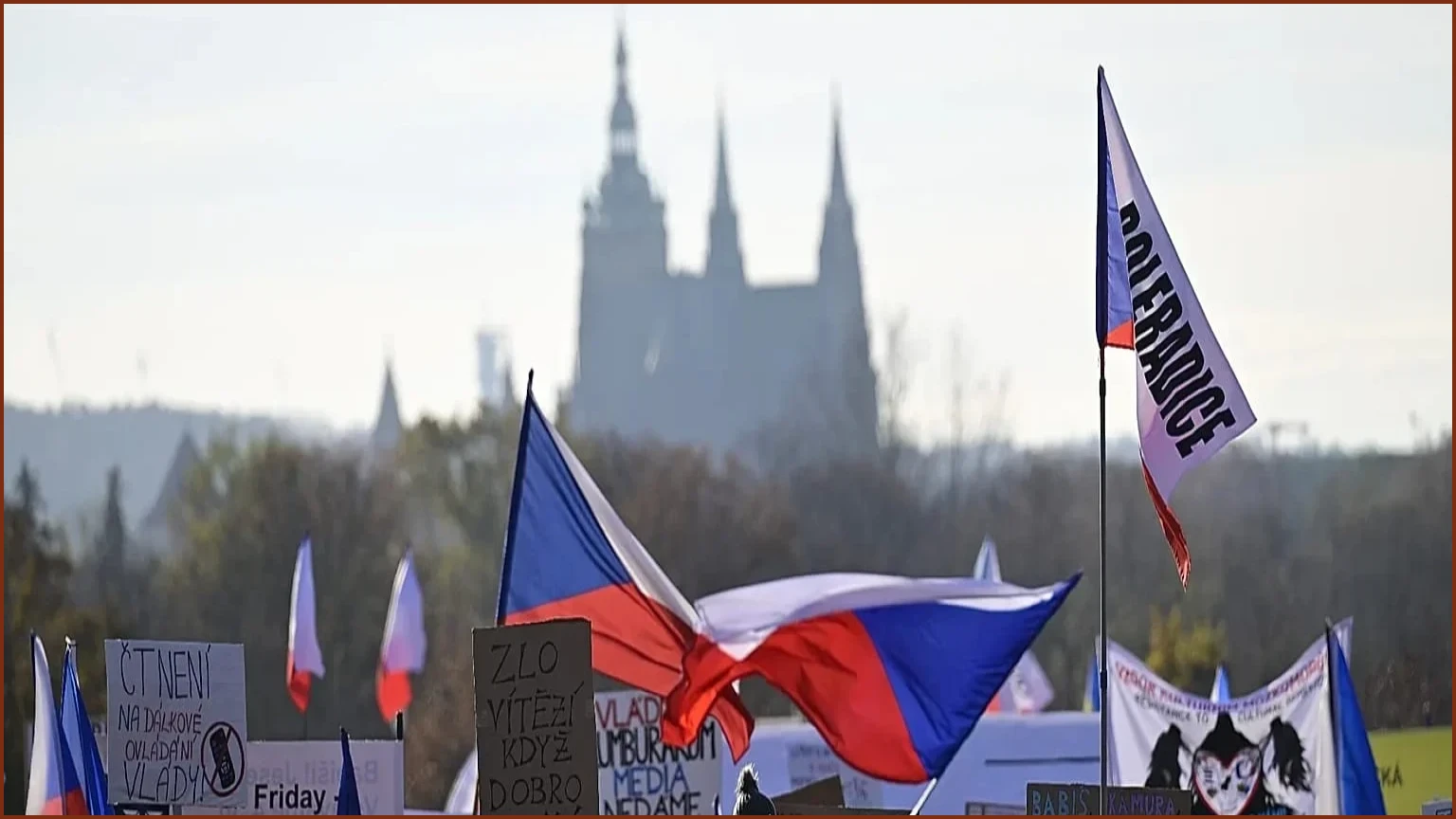
An estimated 350,000 to 400,000 people converged on Prague's Letná square on Sunday in a massive demonstration aimed at protecting the independence of public television and radio. The protest, organized by the civic group Million Moments for Democracy, was a direct response to government plans to overhaul the funding system for public broadcasters.
The rally's slogan, "Never again 4:36," alludes to a controversial October event in the Chamber of Deputies, where the government majority fast-tracked an amendment to the law during the early hours of a Saturday morning. By cutting short the plenary debate, the government prevented more than 60 opposition members of parliament from speaking on the issue. Protesters traveling from across the country used the event to voice sharp criticism of government policy, with some explicitly calling for the Freedom and Direct Democracy (SPD) party—led by Chamber of Deputies speaker Tomio Okamura—to exit the governing coalition.
Currently, Czech households contribute to public media through a monthly fee of 150 koruna for television and 55 koruna for radio. These fees provide significant revenue, with Czech Television receiving 6.73 billion koruna and Czech Radio receiving 2.47 billion koruna this year. The government, led by the Babiš administration, has proposed abolishing these household fees in favor of funding broadcasters directly through the state budget. Critics, including opposition parties, journalists, and members of the public, argue that this shift would undermine the freedom of public media by making them reliant on state funding.
The protest drew support from a wide cross-section of society, including student organizations, dozens of theatres, writers, prominent athletes, churches, and healthcare workers. International journalists' organizations also voiced their opposition to the plan. Speakers at the demonstration emphasized that public media should not be the property of the state, the government, or political figures, but rather a service belonging to all citizens that reflects diverse societal views.
While the event was broadcast live by public news channels and independent outlets, it faced backlash from government ranks. Radek Vondráček of the ANO party, the strongest party in the governing coalition, dismissed the organizers as an "association of professional agitators" during a television debate. Despite the scale of the gathering, police reported that the demonstration remained peaceful and concluded without incident by early evening.
In the Czech Republic, every household that owns a television or radio is required to pay a monthly fee of 150 koruna (2,400 forint) for television and 55 koruna (880 forint) for radio. This year, Czech Television's revenue from these fees amounts to 6.73 billion koruna (107.68 billion forint), while Czech Radio receives 2.47 billion koruna (39.52 billion forint).