Republican candidates facing increasingly difficult prospects in the upcoming midterm elections are starting to distance themselves from President Donald Trump, breaking with their party's standard-bearer as his low approval ratings and controversial policies threaten to drag down the GOP.
The growing anxiety within the Republican Party comes as public polling shows widespread voter disapproval of the president and his core agenda, which includes the ongoing war in Iran, sweeping import tariffs, and a hardline domestic immigration crackdown. The political fallout is particularly evident in key congressional and gubernatorial races across the country, where Republican nominees are falling behind their Democratic opponents in contests that will decide control of Congress.
In Florida, Byron Donalds, the Republican nominee for governor, recently overhauled his campaign website to remove prominent mentions of Trump's endorsement, relegating it to a standard endorsements section. Although Donalds later stated on social media that he was "proud" of the endorsement after the changes drew media attention, the shift reflects broader strategic concerns in the state. Aubrey Jewett, a political science professor at the University of Central Florida, noted that Florida Republican candidates are beginning to downplay their ties to Trump or criticize his policies because they realize they cannot take the state for granted, even as it has trended rightward.
Trump won Florida by 13 percentage points in 2024, largely due to support from Hispanic voters. However, his approval among Hispanics has plummeted following aggressive immigration enforcement. Representative Maria Elvira Salazar, a three-term congresswoman locked in a tight race in a heavily Hispanic Miami-area district, released an ad criticizing the administration's aggressive deportation push, stating it had gone "too far" and that Hispanic voters who helped Trump win "feel betrayed."
In Kansas, Senator Roger Marshall, running for reelection against Democrat Adam Hamilton, also raised concerns about federal immigration enforcement. In a social media post, Marshall stated that Immigration and Customs Enforcement (ICE) "needs to coordinate with our local law enforcement" amid increased ICE operations in the state. A recent poll showed Hamilton leading Marshall in Kansas, a state Trump won by 16 percentage points in 2024.
Meanwhile, in Iowa, Representative Ashley Hinson, who is trailing Democrat Josh Turek in Iowa's Senate race, has put significant distance between herself and the president. Despite Trump winning Iowa by double digits in 2024, Hinson called this week for an "immediate end" to the war in Iran. She also skipped the Republican midterm convention in Dallas, opting to attend a campaign fundraiser instead of appearing on stage during Trump's primetime speeches. Other Iowa Republicans locked in tight reelection contests, including Representatives Zach Nunn and Mariannette Miller-Meeks, recently backed a legislative measure aimed at halting military operations in Iran.
In Michigan, former Representative Mike Rogers, the Republican nominee for Senate, released a campaign ad declaring that "the war with Iran needs to end, and end quickly." Rogers is currently trailing Democratic nominee Abdul El-Sayed 47% to 40% in a recent poll. El-Sayed, a progressive aligned with Bernie Sanders who would become the first Muslim elected to the Senate, has been targeted by Trump and national Republicans as the face of the Democratic Party. However, the poll revealed that 48% of likely Michigan voters are casting ballots "to change the direction President Trump is leading the nation," while only 20% are voting to support the president.
In Ohio and Wisconsin, other prominent Republicans are echoing these concerns. Senator John Husted of Ohio has made similar calls to end the Iran conflict, as has Representative Tom Tiffany, the Republican candidate for governor in Wisconsin. Tiffany stated, "The president has final say in regards to this, but I just believe that we should be exiting Iran, that it's time to move on . . . time to come home, take care of business here in America." Notably, both Tiffany and Hinson previously voted multiple times in Congress against measures directing Trump to halt the war, while Rogers had also supported the president's military actions in Iran.
The conflict in Iran, which Trump initially predicted would last only a few weeks, is now entering its seventh month. The war has triggered a spike in fuel prices that has severely impacted Midwestern agricultural states. With diesel prices reaching record highs, Hinson, Rogers, Miller-Meeks, and Alaska Senator Dan Sullivan called this week for an export embargo on diesel fuel to ease the burden on domestic farmers. Sullivan, who is facing a difficult reelection bid, also chose to skip the Dallas convention.
Trump's approval rating has dropped significantly during the conflict, falling to 39% in the average of recent polls, down from 43% at the start of the war and 50% when he took office last year. A major poll this week showed his approval sinking to a historic low of 32%.
Republican pollster Brent Buchanan explained that candidates must show independence to win back voters who are souring on the president. Buchanan's polling shows that 12% of voters who supported Trump in 2024 are now wavering on whether to vote for a Republican congressional candidate. "They've got to show that independent streak in order to pull as many of those 12% of voters back to them," Buchanan said.
A poll conducted last week found that 56% of Republican voters now consider themselves primarily supporters of the Republican Party rather than supporters of Trump. This is a shift from January 2025, when Trump began his second term and 59% of Republican voters said they supported Trump over the party.
Nathan Gonzales, who runs a nonpartisan election handicapping firm, described the difficult position GOP candidates face: "If they try to distinguish themselves from President Trump in an effort to appeal to independent voters, they risk angering or alienating Republican voters who they also need to win."
In response to some Republicans breaking from Trump, White House spokesman Davis Ingle dismissed the idea that the party is fracturing, asserting that Trump remains the "unequivocal leader" and the most effective messenger for the GOP. "The choice has never been more clear: doubling down on President Trump’s winning, commonsense agenda or the Democrats’ extreme liberal policies and obstruction," Ingle said.
David Cohen, a political science professor at the University of Akron, argued that these distancing efforts may be "way too little, way too late." Cohen noted that Republicans were enthusiastic about making the midterms a referendum on Trump before his poll numbers collapsed. "These Republican candidates and elected officials are superglued to Trump, whether they want to be or not," Cohen said. He added that voters in swing states have "drawn a direct line" between high gas prices, economic anxiety, and Trump's decision to wage war in Iran, predicting a "blue tsunami" rather than just a wave.
The strategic dilemma was on display at the first-ever Republican midterm convention in Dallas earlier this month. The Republican National Committee chair dubbed the event "Trumpapalooza," aiming to project party unity and boost GOP voter enthusiasm. However, the event highlighted the party's internal struggles, with many empty seats in the arena and several high-profile battleground candidates choosing to stay away.
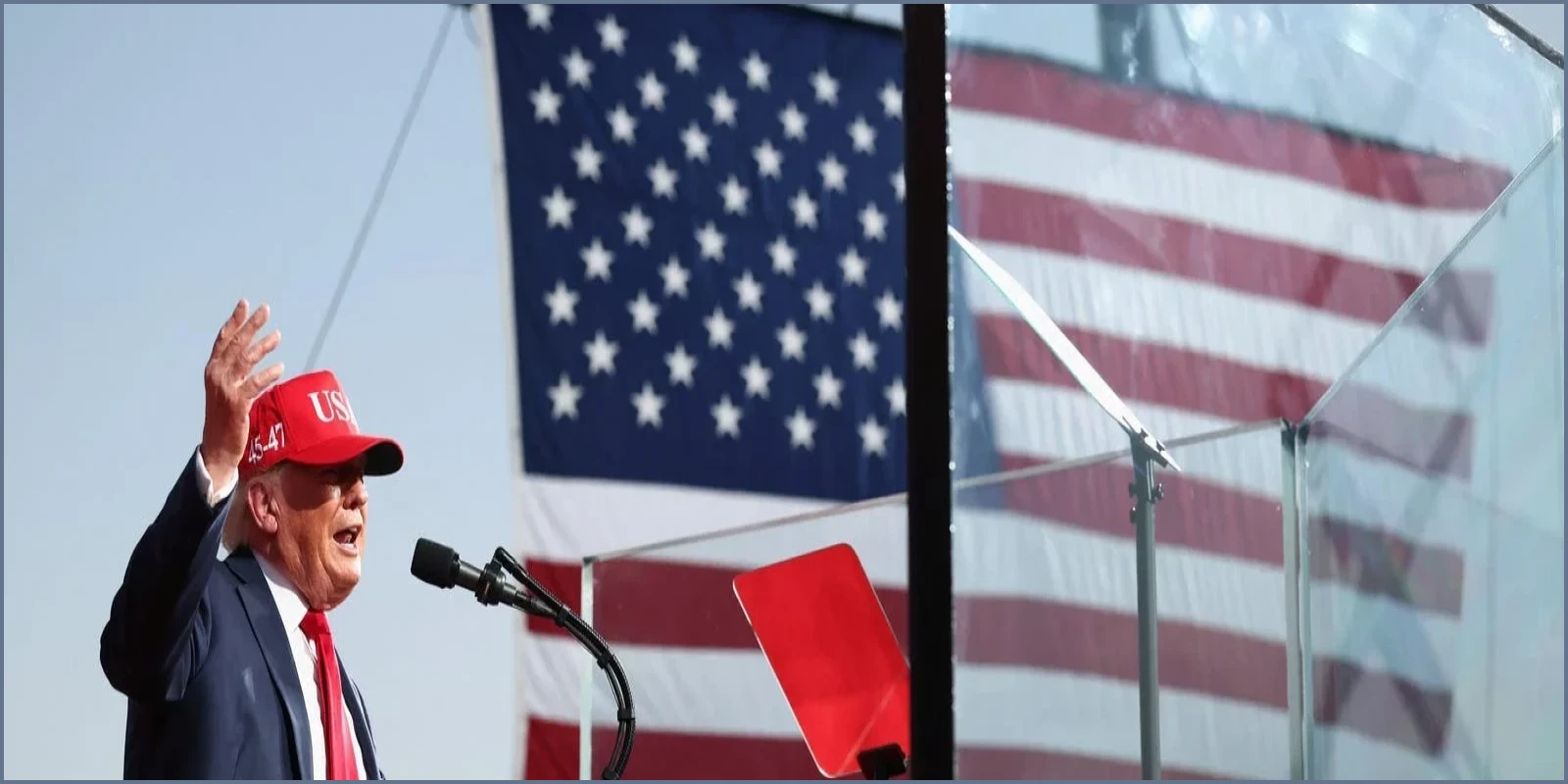
During his speeches, Trump urged voters to "pretend" he is on the ballot and pledged to be highly active on the campaign trail. "On Nov. 3, the great American majority is going to stand up and continue to make America great again," Trump told the crowd. Trump also promised that if Republicans retain control of Congress, voters would receive dividend checks of $5,000. The proposal drew immediate skepticism from core MAGA allies and was denounced as bribery by Democrats. He also had attendees raise their hands to pledge their allegiance to him and promise to vote.
Despite Trump's promise of a campaign blitz across 35 competitive House and Senate races, his recent travel has been limited. His only campaign stop since the Dallas convention was in North Carolina, where polling suggests Republican Senate nominee Michael Whatley is trailing Democratic former Governor Roy Cooper. On Saturday, September 26, Trump spent his time in Knoxville, Tennessee—a safely Republican area—attending a college football game between Tennessee and Texas. He has scheduled upcoming stops in Oklahoma and Alabama, which are also solidly Republican states far from the midterm battlegrounds.
Reports indicated that Trump plans to campaign in battleground states like Alaska, Iowa, Texas, and Florida, though these trips have not been officially announced. Trump has also complicated midterm campaigns by pushing controversial data centers that power artificial intelligence despite a nationwide backlash, and by working to expand foreign beef imports to lower grocery prices, which has angered ranchers in heavily Republican western states.
Democrats are heavily favored to win control of the House of Representatives and are increasingly confident about their chances to capture the Senate. To take control of the Senate, Democrats need a net gain of four seats to erase the current 53-47 Republican majority. While this goal once seemed unlikely, the backlash against Trump's policies has allowed Democrats to go on the offensive in traditionally red states. Battlegrounds now include Senate races in Alaska, Texas, Ohio, and Iowa—all states that Trump won by double digits in 2024. Currently, Republican candidates trail their Democratic opponents in all nine of the most closely contested Senate battleground races. With Democratic incumbent Senator Jon Ossoff leading in Georgia, Michigan remains a central battleground where the GOP hopes to flip a seat, though current polling shows Rogers trailing.
Just 39% of voters approve of the president's performance in the Real Clear Politics average of recent polls, down from 43% at the start of the war and 50% when he took office last year.
"I think we're looking at a blue tsunami," Cohen said. "I think 'wave' really doesn't capture the sentiment out there in the heartland. People are angry. And they understand that there's one person to blame."