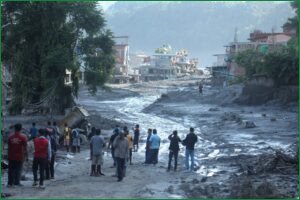
In the first week of July, a building collapse in Mumbai’s Mankhurd district buried five children beneath debris, marking a humanitarian tragedy during one of the city’s wettest July days in half a century. The deluge caused streets to disappear under floodwaters, halted transport networks, and left emergency services struggling to reach stranded residents. Thousands of kilometers away, London faced a different manifestation of the same crisis during a June 2026 heatwave where temperatures exceeded 36 degrees Celsius. As commuters fainted inside sweltering Underground trains, climate activists placed stickers on Tube stations reading, “Heatwave, sponsored by Shell,” to highlight the role of fossil fuels in global warming.
These events unfolded in vastly different economic and geographic settings, yet they reflected a common reality: climate change no longer distinguishes between developed and developing nations. Whether through floods, heatwaves, landslides, or dust storms, extreme weather is increasingly becoming the defining challenge of the 21st century. Scientific evidence supports this, as the World Meteorological Organization (WMO) reported in 2023 that the global mean near-surface temperature was 1.45 ± 0.12 degrees C above the pre-industrial average, nearing the 1.5 degrees C threshold set by the Paris Agreement. Simultaneously, atmospheric concentrations of carbon dioxide reached approximately 150 percent of pre-industrial levels, with methane at 264 percent and nitrous oxide at 124 percent, indicating an accelerating climate system storing more energy.
The summer of 2026 saw stark consequences in Europe, where more than 3,700 deaths were associated with the June heatwave across France, Belgium, and the Netherlands. Mortality within homes rose by an estimated 91 percent during the final week of June as prolonged high night-time temperatures prevented buildings from cooling. Impacts extended to public health and infrastructure, with Belgium experiencing unprecedented electricity price spikes due to air-conditioning demand. Outdoor events, such as the historic Battle of Waterloo reenactment, were canceled, and public transport systems in older European cities struggled to function safely. Meteorologists attributed these conditions to an Omega blocking pattern, or heat dome, where a persistent high-pressure ridge becomes trapped between two low-pressure systems. While Omega blocks are natural, climate change increases the baseline temperatures, making heatwaves hotter and longer, with Europe warming at roughly twice the global average.
India faces a more complex picture, confronting multiple climate extremes simultaneously. In Kerala’s Wayanad district, heavy rainfall near Meenakshi Bridge triggered landslides that destroyed homes and claimed lives, with rainfall over twenty-four hours reaching nearly ten times the expected daily average for July. In Maharashtra, landslides in Ratnagiri destroyed homes and disrupted traffic on the Mumbai-Pune Expressway near Khandala, contributing to at least 13 fatalities over three days. Waterlogging paralyzed Western Railway services and forced flight diversions in Mumbai. These disasters occurred despite an overall 38 percent deficit in monsoon rainfall, as some districts received between 600 and 1,700 percent of normal rainfall through intense cloudbursts. More than 94,000 people across hundreds of villages were affected by these floods and landslides.
This growing contrast illustrates that climate change increases variability as much as it changes averages. Prolonged dry spells are now interrupted by brief, intense rainfall that overwhelms drainage and destabilizes slopes. On May 30, western Rajasthan experienced a sequence where extreme heat dried soils and increased dust availability, followed by a powerful dust storm in Bikaner with winds of 70-80 kilometers per hour, which reduced visibility to zero before heavy rain followed. These are not isolated incidents but interconnected components of cascading climate events. Furthermore, the influence of El Niño, a natural warming of the equatorial Pacific Ocean, complicates India’s climate by weakening the southwest monsoon and increasing drought risks, while simultaneously enhancing atmospheric instability that produces localized cloudbursts. Scientists warn that strong El Niño episodes may rival severe historical events, increasing agricultural, water, and food security risks. Although El Niño is a natural oscillation, its interaction with human-induced climate change creates unpredictable outcomes, effectively raising the baseline upon which natural variability operates.
The principle of “wet gets wetter, dry gets drier” is becoming evident as the hydrological cycle accelerates. India embodies this paradox, where agricultural drought coexists with urban inundation. Beyond meteorology, climate disasters disproportionately affect poor households, farmers, the elderly, and outdoor workers. The economic costs, including damage to transport, agriculture, and energy systems, strain government budgets and discourage investment. While scientific advances have improved forecasting and early-warning systems, prediction cannot eliminate vulnerability. Governments must prioritize climate-resilient infrastructure, modernize building standards, protect natural resources, and improve emergency response. At the international level, cooperation on emissions reductions, climate finance, and technology transfer is essential. The scientific debate over the existence of climate change is settled; the current challenge is whether societies can respond with the urgency required by an increasingly volatile planet.
This apparent contradiction reflects a broader climate principle frequently summarized as “wet gets wetter, dry gets drier.” As global temperatures rise, evaporation increases, allowing the atmosphere to retain substantially more water vapor. Regions already prone to heavy rainfall often receive even more intense precipitation, while dry regions experience greater evaporation and prolonged drought. The hydrological cycle becomes faster, stronger, and more erratic.
Originally published under Creative Commons by 360info ™.