European law enforcement authorities suspect German boat dealer Marvin Reuter of serving as a key supplier of nautical equipment to migrant smuggling rings operating across the English Channel. French prosecutors are currently seeking the 35-year-old's extradition to face charges including human smuggling, criminal conspiracy, and involuntary manslaughter.
Reuter, the managing director of MaReBoote—a small marine supply firm based in Werne near Dortmund in the state of North Rhine-Westphalia—is actively contesting his extradition. A European Arrest Warrant was issued by French authorities in May, covering alleged offences dating back to December 2024. Under law, Reuter cannot be formally charged until he is extradited to France, and he remains presumed innocent unless proven guilty in court.
Case files obtained from police, court, and tax records show that UK authorities informed German police that 29 percent of detected small-boat Channel crossings in the first four months of this year, up to the end of April, involved vessels or engines tied to MaReBoote. French investigators report that at least 82 boats supplied by Reuter's firm reached the English coastline during a two-year period ending in May.
Investigators also suspect equipment from MaReBoote was involved in two separate fatal incidents in which four men died. Among those who lost their lives was 20-year-old Syrian national Suliman al Husein, who died from cardiac arrest after being crushed on an overcrowded dinghy during a failed launch west of Calais in January 2025. He was the first recorded migrant death in the Channel that year, and his body was found on the floor of a boat bearing the MaReBoote logo.
A critical lead in the international investigation came during an early morning traffic stop in May near the northern French port of Boulogne-sur-Mer. French police intercepted a German-registered BMW towing a trailer after observing the vehicle overtaking at high speed. Inside, officers discovered jerry cans of fuel, a boat engine, inflation pumps, and a rolled-up inflatable dinghy. Both the car and the boat bore MaReBoote branding.
The two German nationals inside the vehicle were subsequently arrested and convicted of human smuggling offences. Interrogation records reveal that one courier admitted under questioning, "Of course I knew that it wasn't legal. The money made me turn a blind eye." The men stated they were paid up to €1,000 (£830) per drop to deliver equipment to foreign nationals on the French coastline, and both identified Reuter as the employer who hired and paid them for the transport.
Following Reuter's arrest in Germany in May, where he was temporarily released pending extradition proceedings, police conducted raids that netted more than 30 dinghies and 9,000 life jackets linked to his business. The seized inventory was moved to a high-security police warehouse at an undisclosed location in western Germany.
French authorities gathered further evidence through covert wiretaps inside a French detention facility, where a suspected smuggling chief was recorded discussing purchasing marine supplies from a German firm run by a man named Marvin. Furthermore, officers retrieved the business address of MaReBoote directly from the suspect's mobile device. Five other individuals—comprising an Iranian, three Iraqis, and a Syrian—have already been charged in France in connection with the broader smuggling investigation.
The police operation against Reuter marks the first application of new German legislation enacted late last year, which explicitly criminalized aiding illegal migration to the United Kingdom. Prior to the legal change, certain anti-smuggling statutes in Germany no longer applied to UK-bound crossings following Brexit, allowing the country to emerge as a major storage and transit hub for international smuggling networks.
Dan Cannatella-Barcroft, deputy director for organized immigration crime at the UK National Crime Agency (NCA), commended Germany's law enforcement efforts while emphasizing that the country remains a critical nexus for migrant trafficking. He noted that the vast majority of small-boat equipment intercepted in recent years passed through Germany after being manufactured in China and shipped via Turkey. Germany's transport infrastructure, proximity to northern France, and the presence of established Kurdish-led networks make it a prime operational corridor.
When questioned at his business in Werne, Reuter declined to answer questions, instructed reporters to leave, and drove away before returning to state he was reporting the interaction to the police. In subsequent written communications, he did not address the specific factual allegations but accused reporting media of harassment. His defense team is fighting the extradition request, citing overcrowded conditions in French prisons as a primary argument while maintaining that any legal proceedings should take place within Germany.
Addressing the broader enforcement strategy, French prosecutor Samuel Finielz confirmed that while selling nautical equipment is entirely legal, it becomes a criminal act when a vendor is fully aware that the supplies will be utilized by organized illegal immigration or human trafficking syndicates. Although small-boat Channel crossings decreased significantly in 2026 amid intensified enforcement and broader drops in European irregular migration, investigations into supply chains remain active.
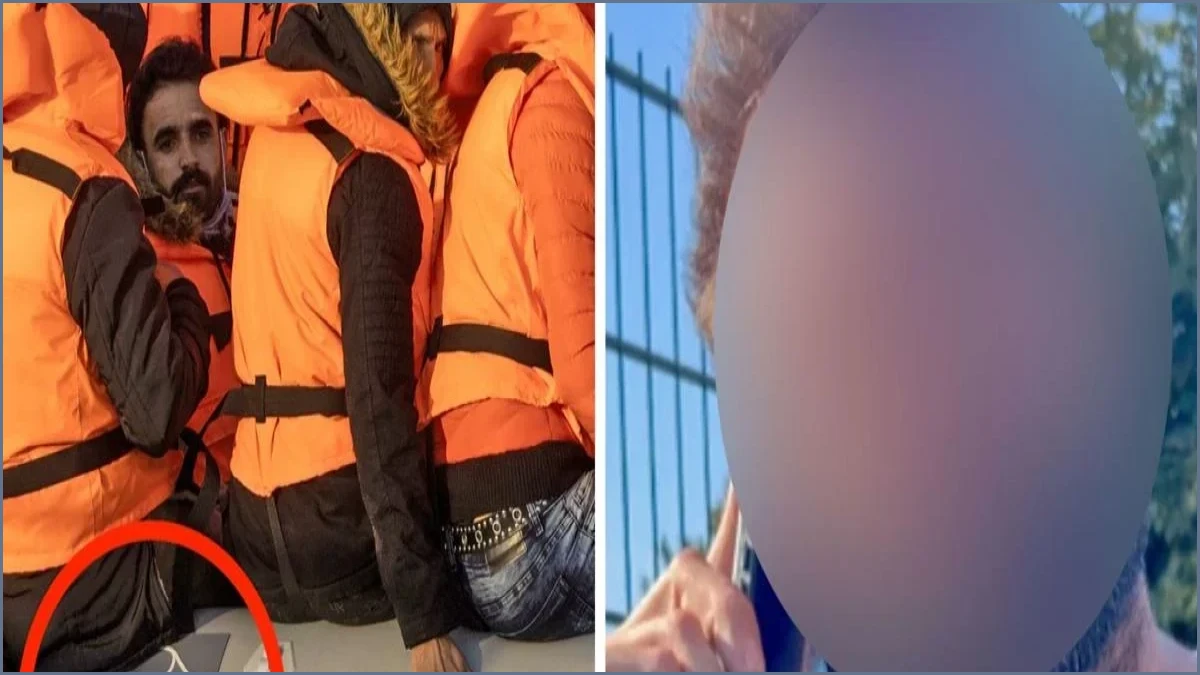
A press photo from 2021 – migrants in a boat from Marvin Reuter's firm (logo circled)
In 2021, Reuter told the Sun and Guardian he felt "frustrated" and "anxious" that his vessels had ended up in the hands of smugglers.