One year after a ceasefire took effect in Gaza on Oct. 10, 2025, the territory remains without the promised international peacekeeping force or any substantial reconstruction efforts. Instead of a complete withdrawal, Israel's military has expanded its footprint to control roughly 70% of Gaza, pushing more than 2 million Palestinian residents into condensed areas near the sea.
Although overall bombing slowed down compared to the full-scale war, Israeli operations targeting Hamas persisted throughout the twelve-month period. According to figures from Gaza's Health Ministry, those continued attacks killed more than 1,400 Palestinians over the past year, nearly 500 of whom were women and children.
Despite the ongoing strikes, the reduction in large-scale bombardment permitted an increase in food shipments, helping reverse severe starvation after U.N.-backed experts declared a famine in northern Gaza last year.
The initial phase of the agreement brought immediate movement across the territory. On Oct. 10, 2025, the first day of the ceasefire, Palestinians returned to the ruins of Gaza City following the withdrawal of Israeli forces and the conclusion of their ground operation. Days later, on Oct. 13, families gathered in Khan Younis to welcome Palestinian prisoners released in exchange for Israeli hostages.
Dangers from unexploded ordnance and continued troop actions surfaced early in the truce. At Al-Shifa Hospital on Oct. 23, 2025, 12-year-old Joud Al-Angar and his younger cousin were treated for dime-sized scabs across their bodies after picking up shrapnel from an Israeli munition in the rubble, having mistaken it for coal to help cook dinner for their family.
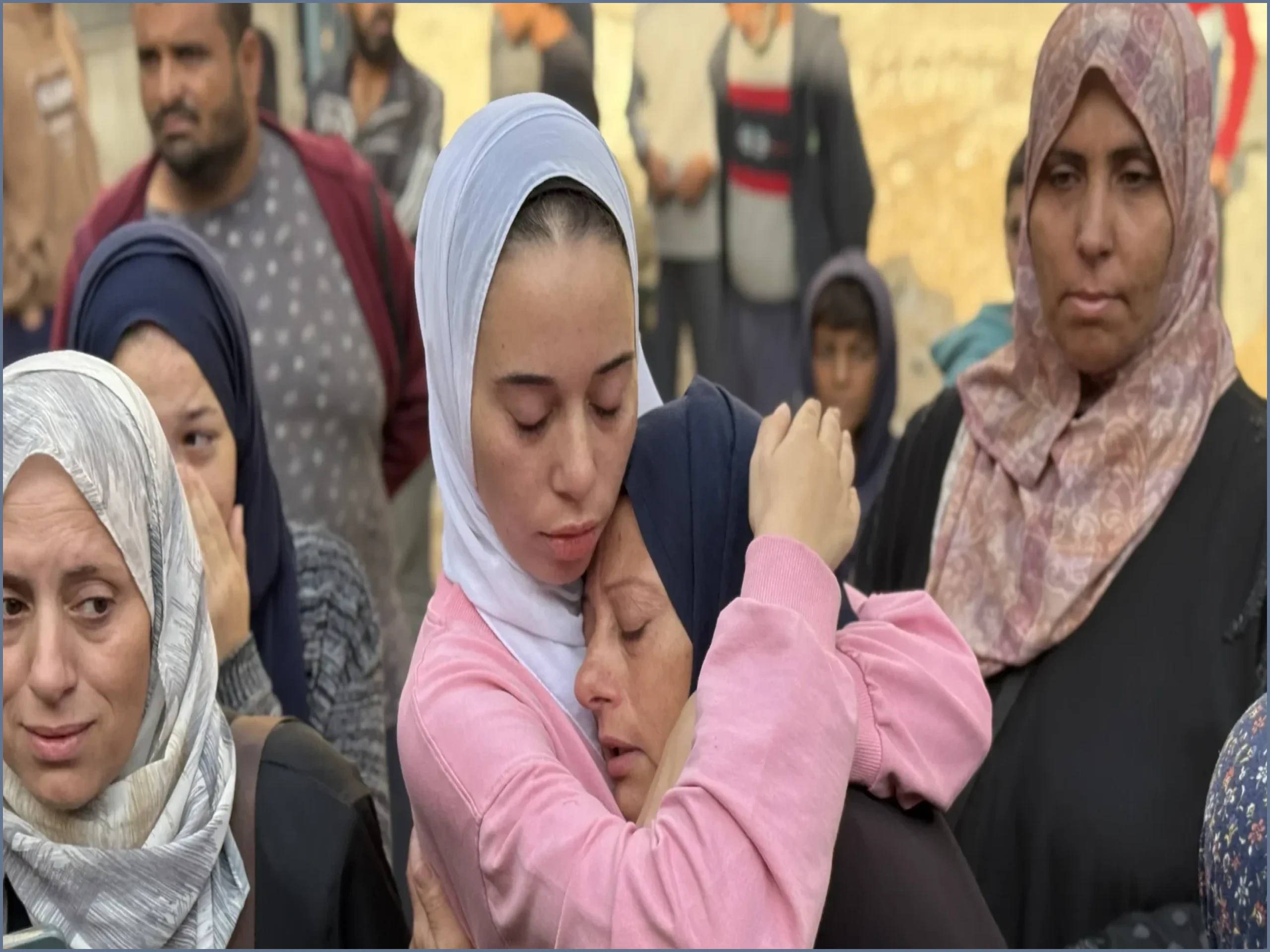
By late autumn, residential areas were again hit by direct strikes. On Nov. 20, 2025, six weeks into the ceasefire, Israeli airstrikes destroyed homes and tents in Gaza City, leaving a Palestinian mother mourning her son at Al-Shifa Hospital while the shrouded bodies of several victims, including children, filled the facility's morgue. Days later, on Nov. 25, severe weather compounded local hardship as a father and his son waded through flooded Gaza City streets while transporting humanitarian aid.
Winter brought severe exposure and further violence to displaced families. On Dec. 10, 2025, Saqer Al-Ankah held his dying 10-year-old granddaughter, Bayan, at Baptist Hospital in Gaza City after she was shot in her tent by Israeli troops occupying northeast Gaza. That same day in Al-Zuweida, children wore virtual reality headsets as part of a TechMed Gaza initiative offering psychosocial support for trauma.
On Dec. 11, Raed el-Ghazawi and his family of five reported that their tent in Gaza City was freezing cold and damp from heavy winter rainstorms. Less than a week later, on Dec. 17, Palestinian Christian children decorated a Christmas tree inside Gaza City's Holy Family Church for the first time since the war began.
The turn of the year saw changes in aid delivery and international access. On Dec. 23, 2025, fresh produce reappeared on Gaza City streets following the official famine declaration. However, on Dec. 31, patients gathered at a Doctors Without Borders clinic in Gaza City just one day before Israel banned more than 40 international non-governmental organizations from bringing staff or humanitarian supplies into the enclave.
Efforts to cope with psychological trauma and recover past victims continued into early 2026. On Feb. 12, Palestinian female artists met on a Gaza City beach to paint as therapy for the first time since the war started. In Beit Lahia, rescue workers began retrieving bodies from crushed structures on Feb.
16. Among those recovered was the skeleton of 60-year-old Shawqi Abu Naser, extracted more than a year after an Israeli airstrike killed 132 members of his family, leading his mother to sit beside her son's body the following day.
Community life and religious traditions resumed amid restrictions in the spring. On March 20, 2026, Palestinians assembled in open spaces across Gaza City for early morning prayers celebrating Eid al-Fitr at the end of Ramadan, with children watching street performers and interacting with Hamas militants. On April 18, residents in Jabalia gathered near U.N. food aid boxes in an area requiring explicit Israeli entry authorization.
Military markers further defined territorial expansion by May 2026. On May 7, Israeli forces placed yellow blocks in Bureij to delineate restricted zones barred to Palestinians. Even so, public life persisted: young chess players held their first post-war tournament at a Gaza City coffee shop on May 12, and on May 14, a child carrying water jugs in the Al-Shati refugee camp passed a wall mural of Spanish football star Lamine Yamal painted on building rubble.
On May 16, an Israeli airstrike in Gaza City set a building ablaze and killed Izz al-Din al-Haddad, the leader of Hamas's military wing, alongside his wife, daughter, and a neighbor. On May 31, children played on a trampoline during Eid holidays in Beit Lahia, an area designated by the military as an orange zone where aid groups face restrictions.
Targeted attacks and community gatherings extended into the summer months. On June 22, 2026, a child examined a burned vehicle targeted on a busy Gaza City street in an airstrike that killed a teenage girl on her way to find internet access for her final exams. On July 7, thousands of displaced residents assembled under Egyptian flags among Gaza City rubble for a public screening of Egypt's World Cup match against Argentina.
On July 12, nine months into the ceasefire, a plume of smoke rose over Gaza City after another home was targeted by an airstrike.
The long-term toll of the conflict was highlighted again in late summer. On Aug. 4, 2026, 100 corpses wrapped in Palestinian flags were laid out in Gaza City after being exhumed from a building bombed in October 2023. On Aug. 19, a child wept at Al-Shifa Hospital's morgue entrance following his brother's death in an airstrike. On Aug.
25, youth in Khan Younis formed a human chain for the global Swim With Gaza initiative to fund swimming lessons. By Sept. 1, 2026, blood-stained toys remained in a Gaza City home following an Israeli raid to capture a Hamas security officer, an operation during which his family members were killed in accompanying airstrikes.